多资产

Search documents
券商资管迈向真资管时代!破局三重困局,重塑核心壁垒!
券商中国· 2026-03-18 03:17
Core Viewpoint - The brokerage asset management industry is undergoing profound changes, transitioning from traditional growth models reliant on channel business and non-standard asset expansion to a "true asset management" era due to multiple pressures such as public fund license constraints, low interest rate environments, and insufficient active management capabilities [1] Group 1: Industry Challenges - The industry faces three core challenges: the solidification of public fund license structures, the impact of low interest rates on traditional profit models, and the long-term development of active management capabilities [3][4] - Currently, only 14 brokerage firms or their asset management subsidiaries possess public fund qualifications, limiting the growth potential for those without licenses to focus solely on private equity [3] - The low interest rate environment has fundamentally disrupted previous fixed income strategies, necessitating a shift away from reliance on traditional models [4] Group 2: Strategic Transformation - Brokerages are restructuring their asset management strategies through product strategy reconstruction, business chain collaboration, and rethinking liability logic to create competitive advantages [2] - The focus is shifting towards "multi-asset" management, with firms like Guojin Asset Management emphasizing their capabilities in multi-asset allocation and product customization [8] - There is a growing emphasis on "customer-centric" solutions, with firms adapting to the complex and customized needs of high-net-worth and institutional clients [10][12] Group 3: Competitive Advantages - The brokerage asset management sector is leveraging its full business chain collaboration as a key competitive advantage, differentiating itself from other asset management institutions [11] - Firms are increasingly focusing on customized services and flexible account systems to meet the diverse needs of clients, moving from merely selling products to providing comprehensive account management [12] - The industry is also exploring new growth avenues such as public REITs, which are expected to become significant drivers for expanding public non-cash scale [9]


理财净值化驶入深水区 “稳稳的幸福”悄然退场
Zhong Guo Zheng Quan Bao· 2026-02-23 20:31
Core Insights - The article discusses the recent volatility in the net value of wealth management products in China, highlighting the challenges faced by investors who expected stable returns [1][3] - It emphasizes the transition to net value-based products and the impact of market fluctuations on investor expectations and product performance [4][6] Group 1: Product Performance and Investor Reactions - Wealth management products have experienced significant net value fluctuations, leading to unexpected losses for investors like Xiao Wei, who faced a decline in net value shortly after purchasing [1][2] - Many investors holding R2 risk-rated products were unprepared for the volatility, leading to a mismatch between their expectations of stable growth and the actual performance of these products [3][4] - The historical volatility of wealth management indices has increased, particularly for higher-risk products, indicating a trend of rising fluctuations in net values [4][5] Group 2: Market Conditions and Strategic Adjustments - The low interest rate environment has pressured wealth management products to adopt a "multi-asset, multi-strategy" approach to enhance returns, resulting in increased exposure to high-volatility assets [5][6] - Regulatory changes have mandated a shift towards transparent valuation of underlying assets, which has exposed the true risks and volatility of wealth management products [6][7] - Companies are encouraged to manage investor expectations effectively to prevent irrational redemptions during periods of net value fluctuations, emphasizing the importance of long-term investment strategies [7][8] Group 3: Recommendations for Investors - Investors are advised to remain patient and avoid panic selling during short-term net value declines, as these fluctuations are considered normal in the market [8] - It is suggested that investors focus on the underlying asset allocation and investment strategies of wealth management products rather than solely on risk ratings [7][8] - Regular investment strategies, such as dollar-cost averaging, can help mitigate the impact of market volatility on overall returns [8]
理财净值化驶入深水区“稳稳的幸福”悄然退场
Zhong Guo Zheng Quan Bao· 2026-02-23 20:18
Core Viewpoint - The transition to net value-based wealth management products is deepening, leading to increased volatility in product values, which is challenging for investors accustomed to stable returns [1][4]. Group 1: Market Trends - Recent fluctuations in wealth management product values have drawn investor attention, with many experiencing unexpected losses due to market volatility [1][2]. - The net value of a fixed income-enhanced product held by an investor increased from 1.1124 to 1.1223 between January 15 and January 29, but subsequently fell to 1.1138, causing concern among investors [2][3]. - Historical volatility of wealth management indices has increased, indicating greater fluctuations in asset prices, particularly for higher-risk products [3][4]. Group 2: Product Characteristics - Many wealth management products are now employing a "multi-asset, multi-strategy" approach to enhance returns, particularly in a low-interest-rate environment [4][6]. - As of the end of 2025, fixed income assets accounted for 51.93% of total investment assets in wealth management products, with a notable increase in allocations to high-volatility assets [4][5]. - The transition to net value-based products requires accurate reflection of underlying asset price fluctuations, which may lead to lower returns if stability is prioritized [5][6]. Group 3: Investor Behavior - Investors holding R2 risk-rated products are experiencing a mismatch between their expectations of stable growth and the actual volatility of product values [3][7]. - It is advised that investors manage their expectations and avoid panic selling during short-term fluctuations, as this could lead to realized losses [7]. - Long-term investment strategies, such as regular contributions, can help mitigate the impact of short-term volatility on returns [7].
西南财经大学信托与理财研究所所长翟立宏:多资产、多策略是增厚投资收益的重要抓手
Mei Ri Jing Ji Xin Wen· 2025-12-25 14:57
Core Viewpoint - The banking wealth management market is undergoing a critical transformation in its revenue sources and product structure due to the intertwined macroeconomic backdrop of low interest rates and "asset scarcity" [1] Group 1: Restructuring of Wealth Management Product Revenue Sources - The low interest rate environment and "asset scarcity" are reshaping the revenue sources of wealth management products, presenting both challenges and opportunities for the banking wealth management industry [2] - Traditional fixed-income products are facing significant yield constraints, while the exploration of equity assets is seen as a primary direction for enhancing product yield flexibility [2] - The product structure is expected to shift towards "fixed income plus" products and multi-strategy offerings, with a focus on themes like retirement, ESG, and technology innovation [2] Group 2: Role of Banking Wealth Management in Retirement Planning - Banking wealth management is a core component in building the third pillar of retirement, leveraging its extensive distribution network and customer trust to promote personal pension schemes [3] - New regulations encourage the issuance of long-term products, which can channel significant "long money" into essential sectors like infrastructure and healthcare, supporting long-term economic development [3] - By lowering investment thresholds and optimizing management fees, banking wealth management enhances accessibility to professional retirement investment services [3] Group 3: Advantages and Challenges of Retirement Wealth Management - Compared to funds and insurance products, retirement wealth management offers a better fit for the long-term, stable, and risk-controlled needs of retirement funds [4][5] - Retirement wealth management products have an average annualized return of approximately 3.91% with a volatility of only 0.17%, highlighting their risk control advantages [4] - The development of retirement wealth management faces challenges from demand, supply, and investment sides, including a lack of long-term investment awareness among residents and product homogeneity [6] Group 4: Future Development of Banking Wealth Management - Small and medium-sized banks without wealth management subsidiaries are transitioning to a distribution model, focusing on localized services and customer trust [7] - By 2026, the banking wealth management market is expected to enter a phase of high-quality development centered on professional active management capabilities [8] - The industry is likely to see increased concentration, with a shift towards licensed wealth management companies and a significant optimization of product structures [8] Group 5: Investment Strategies for Investors - Investors are advised to set reasonable investment goals and expectations, focusing on long-term sustainable returns within their risk tolerance [9] - A scientific asset allocation strategy is recommended, utilizing cash management and fixed-income products for defensive purposes while capturing market opportunities with "fixed income plus" and mixed products [9] - Maintaining a long-term holding strategy is essential to smooth out short-term volatility and avoid emotional trading based on market fluctuations [9]
走出“舒适区”:2025年银行理财在规模新高下的收益突围战|2025中国经济年报
Hua Xia Shi Bao· 2025-12-24 07:40
Core Insights - The banking wealth management industry has reached a historical peak of 34 trillion yuan by the end of November, increasing by 4 trillion yuan from the previous year, indicating a significant recovery from the "redemption wave" of 2022 [2] - Despite the growth in scale, the average annualized yield of wealth management products has significantly decreased, with a downward trend observed throughout the year [3][4] - The industry is transitioning from a traditional bond-centric model to a more diversified investment strategy due to low interest rates and high market volatility [4][5] Wealth Management Performance - The average annualized yield for wealth management products in the first half of 2025 is 2.12%, down from 2.65% in 2024, with yields continuing to decline in the third quarter [3] - The total yield generated for investors has decreased from 206 billion yuan in the first quarter to 179.2 billion yuan in the third quarter, reflecting a quarter-on-quarter decline of 3.81% [3] - The core reason for declining yields is the compression of underlying asset returns, with LPR cuts and falling bank deposit rates contributing to the trend [3] Strategic Shifts in Wealth Management - Wealth management companies recognize the need to diversify their asset strategies, moving towards multi-asset and multi-strategy approaches to enhance yield generation [4][5] - The introduction of policies allowing wealth management funds to participate in new stock subscriptions has opened new avenues for investment, with some products achieving annualized returns as high as 23.55% [5] - The growth of index-based wealth management products has surged, with 97 products identified by mid-December 2025, indicating a shift towards equity market exposure [5][6] Asset Allocation Trends - Wealth management firms are increasingly focusing on constructing diversified asset portfolios to mitigate risks and enhance returns, moving away from reliance on traditional bonds [8][9] - The allocation to cash and bank deposits has increased from 23.9% to 24.8%, highlighting a strategy to stabilize net asset values [8] - The investment in public funds, particularly ETFs, has risen significantly, with secondary bond funds and equity ETFs seeing substantial increases in holdings [9] Alternative and Cross-Border Investments - Wealth management companies are actively exploring alternative and cross-border asset allocations, with gold-related products gaining attention due to rising prices [10] - The QDII investment scale has surpassed 123 billion yuan, indicating a growing interest in global asset diversification [10] Overall Market Strategy - The overarching strategy in the banking wealth management market remains focused on stability, aiming to meet client expectations for steady returns while controlling risks [11] - Despite the expansion in wealth management scale, equity investments still represent a low proportion of total assets, with only 2.1% of the market share in equity assets as of the third quarter of 2025 [11][12] - The participation of wealth management products in IPOs has increased, but the overall activity in the new stock market remains limited, indicating room for growth in this area [12][13]

这类产品,快速崛起
Zhong Guo Ji Jin Bao· 2025-12-14 13:40
Group 1 - The core viewpoint of the article highlights the rapid growth of non-FOF products in the "fixed income plus" market, with a call for relaxing the investment ratio limits to better meet investor needs and further promote market development [1][5][8] - As of the end of Q3 this year, the market value of non-FOF products investing in public funds exceeded 3.418 billion, representing a year-on-year growth of 381.81% [2][8] - The number of non-FOF products investing in public funds reached 48, with a 29.73% increase compared to the same period last year [2][8] Group 2 - Industry experts believe that these innovative products significantly promote the development of the "fixed income plus" market by introducing diverse strategies and professional research capabilities [3][4] - The investment in public funds helps to stabilize net value curves and enhances the attractiveness and stability of products, especially during periods of high individual stock uncertainty [3][4] - There is a growing consensus in the industry to raise the investment limit for non-FOF products from 10% to between 15% and 20% to better accommodate diverse investor needs [5][6][7] Group 3 - The flexibility of asset allocation is limited by the current 10% investment cap, and increasing this limit could enhance the yield elasticity of "fixed income plus" products while keeping risks manageable [6][7] - The growth of secondary bond funds has been significant, with a 84% increase in scale this year, indicating a shift towards fund-based participation in the equity market [8][9] - Suggestions for future development include expanding the investment scope to include Hong Kong stock ETFs and convertible bond ETFs, as well as optimizing fee structures to lower investor costs [8][9]
低利率时代的收益突围:永赢基金详解固收增强解决方案
中国基金报· 2025-12-05 07:35
Core Viewpoint - In a continuously declining interest rate environment, traditional fixed-income assets are providing diminishing coupon yields, making it increasingly difficult for investors to achieve returns. The core proposition of wealth management has shifted towards achieving stable asset appreciation, which is addressed by Yongying Fund through systematic multi-asset and multi-strategy layouts, particularly in the "fixed income enhancement" direction [1]. Group 1: Response to Low Interest Rate Environment - Yongying Fund's absolute return investment department general manager Liu Xingyu emphasizes that when interest rates remain low for an extended period, relying solely on bond assets to meet return targets is inadequate. Expanding into multi-asset and multi-strategy approaches is a necessary choice [3]. - Liu proposes a "multi-asset, multi-strategy" core solution, which involves diversifying asset classes (such as bonds, stocks, convertible bonds, gold, and overseas equities) to effectively broaden the investment portfolio's efficient frontier and optimize the risk-return ratio [3]. - Liu outlines seven specific paths to pursue absolute returns, highlighting the importance of identifying and enhancing long-term high Sharpe ratio assets, actively managing to achieve returns that exceed benchmarks [3]. Group 2: Deep Collaboration Between Stocks and Bonds - Yongying Fund's fixed income investment department general manager Wu Wei notes that the scale of fixed income enhancement products has returned to historical highs, with low to medium volatility being the core variety. Data shows that low to medium volatility strategies often better reflect the "synergistic effect of stocks and bonds" [5]. - The innovative "deep collaboration between stocks and bonds" operational model allows fixed income to play three core roles: liquidity management, providing basic coupon income, and assisting equity in enhancing returns and controlling drawdowns [5]. - Wu believes that under this model, fixed income managers will elevate their perspective from a single bond market to the overall product, focusing on comprehensive evaluations of the relationship between stocks and bonds to manage overall drawdown [5]. Group 3: Product Matrix and Performance - Yongying Fund has established a clear product matrix for fixed income enhancement, with a full range of low, medium, and high volatility layouts. For instance, the Yongying Xinxin A product achieved a return of 21.61% over the past two years, significantly outperforming the peer average of 11.93% [6]. - The Yongying Multi-Asset and Multi-Strategy product has a maximum drawdown of only -0.71%, better than the peer average of -1.39% [6]. Group 4: Systematic Research and Support - Effective execution of strategies relies on a robust systematic research and investment platform. Yongying Fund has developed five systems that span front, middle, and back offices, aiming to scientifically identify market cycle positions and capture various asset return opportunities [10]. - The Qianxing fixed income research system utilizes big data and AI technologies to construct intelligent rating, risk warning, and bond strategy modules, enhancing bond investment capabilities [10]. Group 5: Market Outlook - Looking ahead, Liu anticipates that global liquidity easing and fiscal expansion will likely continue, with U.S. tech stocks, U.S. Treasuries, and gold being noteworthy assets. The A-share market is expected to shift from valuation-driven to profit-driven, with improving corporate earnings as a key support [12]. - Wu provides a practical perspective on the bond market, suggesting that the monetary policy is likely to remain accommodative, with interest rate bonds expected to oscillate within a "low interest rate + high volatility" range, presenting trading opportunities [12].

工银理财党委书记吴茜:多资产、多策略成资管行业趋势
2 1 Shi Ji Jing Ji Bao Dao· 2025-10-23 03:51
Core Insights - The era of "beta-driven" investment is over, and the asset management industry is shifting towards multi-asset and multi-strategy approaches as a new paradigm for asset allocation [4][5] Industry Trends - The asset management industry is entering a phase of comprehensive competition and cooperation, with bank wealth management, public funds, and insurance asset management all exceeding 30 trillion yuan in assets under management (AUM), with wealth management reaching over 32 trillion yuan by the end of September [4] - The traditional asset allocation logic that supported growth is failing, leading to three main challenges: 1. In a "low interest rate, high volatility, and asset scarcity" environment, the consensus is shifting towards multi-asset and multi-strategy approaches [4] 2. The reallocation of household wealth presents growth opportunities, but wealth management is lagging behind insurance and public funds in terms of growth rates [4][5] 3. The "Net Value 3.0" era demands higher performance stability and consistency, requiring a shift from asset-driven models to strategy-driven models [5][6] Future Directions - The industry must develop a factory-like, industrialized management system that aligns with client risk-return needs, emphasizing professional division of labor, process control, and standardized output [5][6] - Key issues to address include: 1. Transforming "vague investment art" into "precise engineering blueprints" to enhance investment team capabilities and decision-making processes [6] 2. Upgrading from "workshop-style operations" to "standardized assembly line production" for precise process management [6][7] 3. Building a human-centered multi-strategy system to promote strategy upgrades and iterations, focusing on investment manager profiles and performance attribution analysis [7]
私募“双十基金”达32只,梁宏旗下产品在列!
Sou Hu Cai Jing· 2025-08-26 08:16
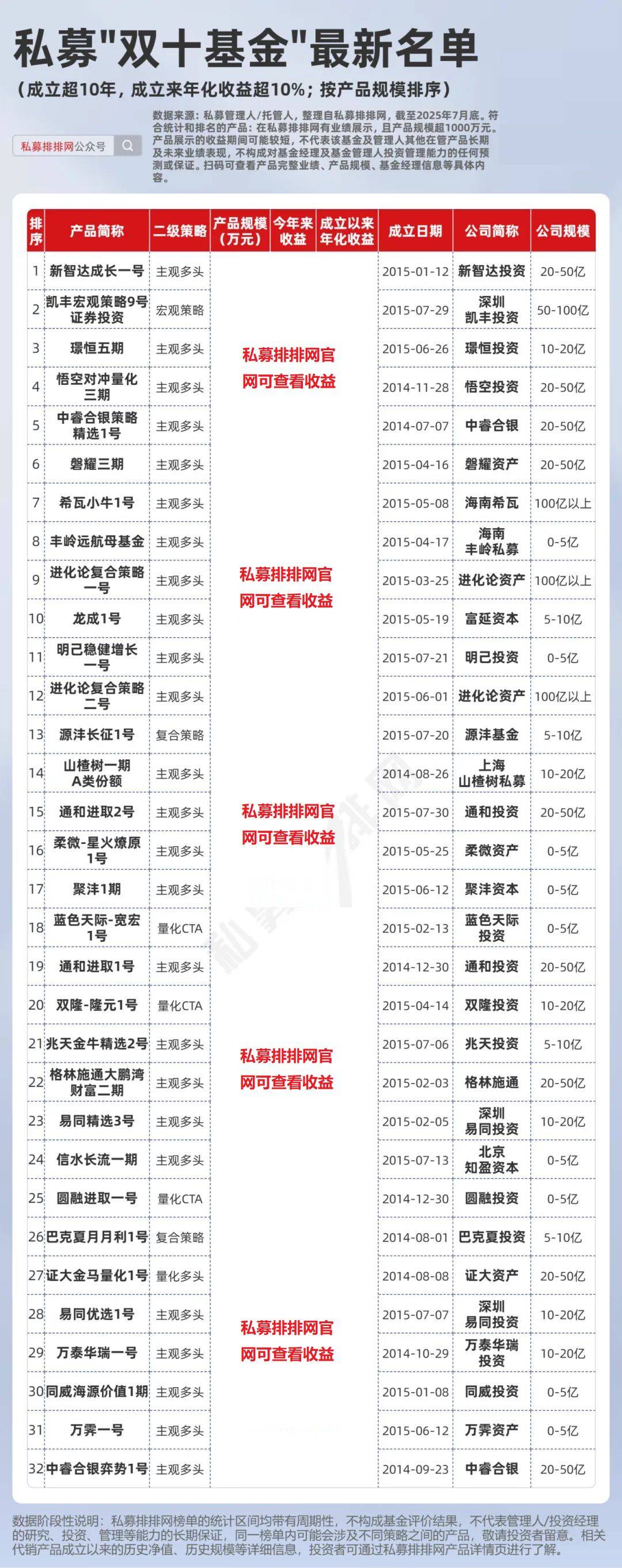
Group 1 - The article emphasizes the importance of long-term performance in the capital market, highlighting that strategies need to be continuously learned and iterated to achieve sustained profits [1] - It categorizes private equity products into "long-distance running" types, focusing on those with outstanding performance over the past five years and those established for over ten years, referred to as "double ten funds" [1] - As of July 2025, there are 61 private equity products that have been established for ten years, with 32 of them achieving an annualized return of over 10%, accounting for approximately 52% [2] Group 2 - Among the "double ten funds," 14 products reached historical highs in July 2025, with 25 of them being subjective long/short products [2] - Notable private equity firms such as Evolutionary Assets, Shenzhen Yitong Investment, Tonghe Investment, and Zhongrui Huyin each have two products listed among the top performers [3] - The article provides a detailed table of various private equity products, including their strategies, sizes, and performance metrics, showcasing the diversity in the market [4][5] Group 3 - The subjective long/short product "Xi Wa Xiao Niu No. 1," managed by Liang Hong, was established near the peak of the last bull market and has shown significant returns [5][6] - Liang Hong expresses a preference for core companies that can be compared with international leaders, rather than supply chain stocks [6][7] - The article also discusses the performance of quantitative long/short products, noting that the average annualized return for these products over the past five years is 13.27% [12] Group 4 - The multi-asset strategy products have an average annualized return of 10.84% over the past five years, with several products reaching historical highs in July 2025 [16] - The article highlights the performance of bond strategy products, which have an average annualized return of 11.87% over the past five years, with many products achieving historical highs recently [24] - It concludes with a focus on the performance of futures and derivatives strategy products, which also show strong returns and historical highs [20]
南方浩达稳健优选一年持有混合(FOF)A,南方浩达稳健优选一年持有混合(FOF)C: 南方浩达稳健优选一年持有期混合型基金中基金(FOF)2025年第2季度报告
Zheng Quan Zhi Xing· 2025-07-21 02:26
Core Viewpoint - The report provides an overview of the performance and management strategies of the Southern Haoda Steady Preferred One-Year Holding Mixed Fund of Funds (FOF) for the second quarter of 2025, highlighting its investment objectives, financial indicators, and market conditions affecting its performance [1][2][3]. Fund Overview - The fund is a mixed fund of funds (FOF) aiming for long-term stable appreciation of assets through diversified asset allocation across various funds with different risk-return characteristics [1][2]. - The fund's performance benchmark is set at 15% of the CSI 300 Index return and 85% of the Shanghai Government Bond Index return [1]. Financial Indicators and Fund Performance - As of the end of the reporting period, the A share net value was 1.0460 RMB, with a net value growth rate of 1.38%, while the C share net value was 1.0372 RMB, with a growth rate of 1.28% [5]. - The fund's performance over the past three months showed a net value growth rate of 1.27% for both A and C shares, with a standard deviation of 0.11% and 0.14% respectively [2][5]. Management Report - The fund manager has adhered to relevant laws and regulations, ensuring compliance and risk control while managing the fund's assets [4][6]. - The macroeconomic environment in the second quarter was stable, with improvements in PMI and a low inflation rate, while the U.S. economy showed signs of slowing down [4][3]. Investment Strategy - The fund adopted a multi-asset and multi-strategy diversification approach, focusing on domestic assets while also allocating to overseas assets and commodities [3][4]. - In equity investments, the fund increased exposure to large-cap value stocks and reduced holdings in high-growth technology stocks during market fluctuations [3]. Future Outlook - The fund maintains a cautious short-term outlook while remaining optimistic in the medium to long term, anticipating potential government stimulus measures and a stable economic recovery [4][3].