
汇添富标普港股通低波红利指数

Search documents
下半年募资能力较强的红利基金,看看哪只让你意外了?
Sou Hu Cai Jing· 2025-12-14 08:42
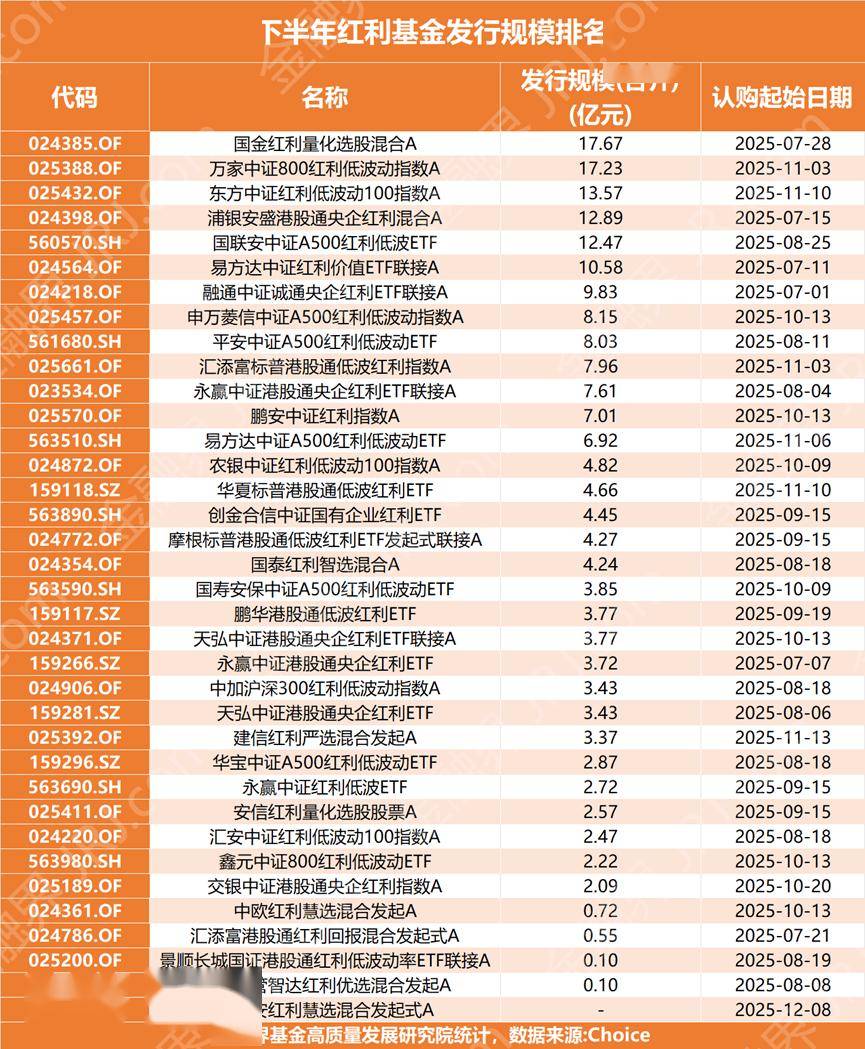
Group 1 - The core viewpoint of the articles highlights a significant acceleration in the issuance and fundraising of dividend-themed public funds in the second half of the year, with a notable increase in both the number and scale of new products [1][3] - In the first half of the year, 26 dividend-themed funds were established, raising approximately 9.3 billion yuan, with a median size of around 300 million yuan. In contrast, by December 12, 36 new dividend-themed funds were launched in the second half, raising a total of 20.4 billion yuan, representing a doubling in scale compared to the first half [1][3] - The average fundraising capability of single funds has significantly improved, with the largest fund raising 1.767 billion yuan and the median size increasing to 400 million yuan [1][3] Group 2 - Among the 36 new funds, 27 are index funds and 9 are actively managed equity funds, indicating that tool-based products dominate the dividend strategy [1] - The top fundraising fund in the second half is the Guojin Dividend Quantitative Stock Mixed A, which raised 1.767 billion yuan, followed closely by the Wanji Zhongzheng 800 Dividend Low Volatility Index A at 1.723 billion yuan [3] - The issuance activity is led by Yongying Fund, which launched 3 dividend-themed funds, while several other companies, including Yifangda, Tianhong, and Penghua, each issued 2 products [3] Group 3 - A structural change is evident in the current issuance trend, with Hong Kong dividend funds becoming a significant source of new products, as 12 related products were established in the second half, surpassing the number from the first half [3] - The leading fund in the Hong Kong dividend category is the浦银安盛港股通央企红利混合A, which raised 1.289 billion yuan, with other funds like the 汇添富标普港股通低波红利指数 and 永赢中证港股通央企红利ETF联接 also showing substantial fundraising [3] - The "dividend low volatility" strategy has seen rapid expansion, with 18 related products launched in the second half, tracking various indices such as 中证800红利低波 and 中证A500红利低波, providing investors with more diverse options [3]

177亿!公募下半年“押注”红利资产
Guo Ji Jin Rong Bao· 2025-11-28 05:39
Core Viewpoint - The recent volatility in the growth sector has led to increased interest in "low volatility + high dividend" assets, resulting in a significant rebound in the fundraising of dividend funds and a surge in new product launches by public funds in the second half of the year [1][2]. Group 1: Fundraising and New Products - As of November 27, 49 dividend funds have been reported in the second half of the year, a substantial increase from 37 in the first half [2][4]. - In November alone, seven new dividend-themed funds were established, with two exceeding 1 billion yuan and five surpassing 500 million yuan in size [2][3]. - The total size of the 35 new dividend funds established in the second half reached 17.685 billion yuan, compared to only 5.565 billion yuan for the 26 funds launched in the first half [2][4]. Group 2: Market Trends and Investor Behavior - The surge in fundraising for dividend funds is attributed to the low volatility characteristics that meet the defensive needs of certain investors, especially in the context of a potential value reassessment of dividend assets [2][5]. - The fourth quarter is traditionally seen as a favorable time for investing in dividend themes, with expectations for high-dividend companies increasing as the annual report disclosure period approaches [5][6]. - The low interest rate environment and weak economic recovery in China are favorable for dividend strategies, particularly in the Hong Kong stock market, which offers attractive dividend yields [5][6]. Group 3: Long-term Investment Outlook - The valuation of dividend assets remains low, indicating significant long-term upside potential [6]. - The new "National Nine Articles" policy encourages listed companies to distribute dividends, reinforcing mainstream capital's preference for dividend strategies [6]. - Despite uncertainties in U.S. tariff policies, the net dividend yield of Hong Kong dividend stocks remains higher than that of A-shares after accounting for dividend taxes [6].