江淮运河

Search documents
城数Lab. | 水运第一省,原来在内陆
Mei Ri Jing Ji Xin Wen· 2025-12-07 07:04
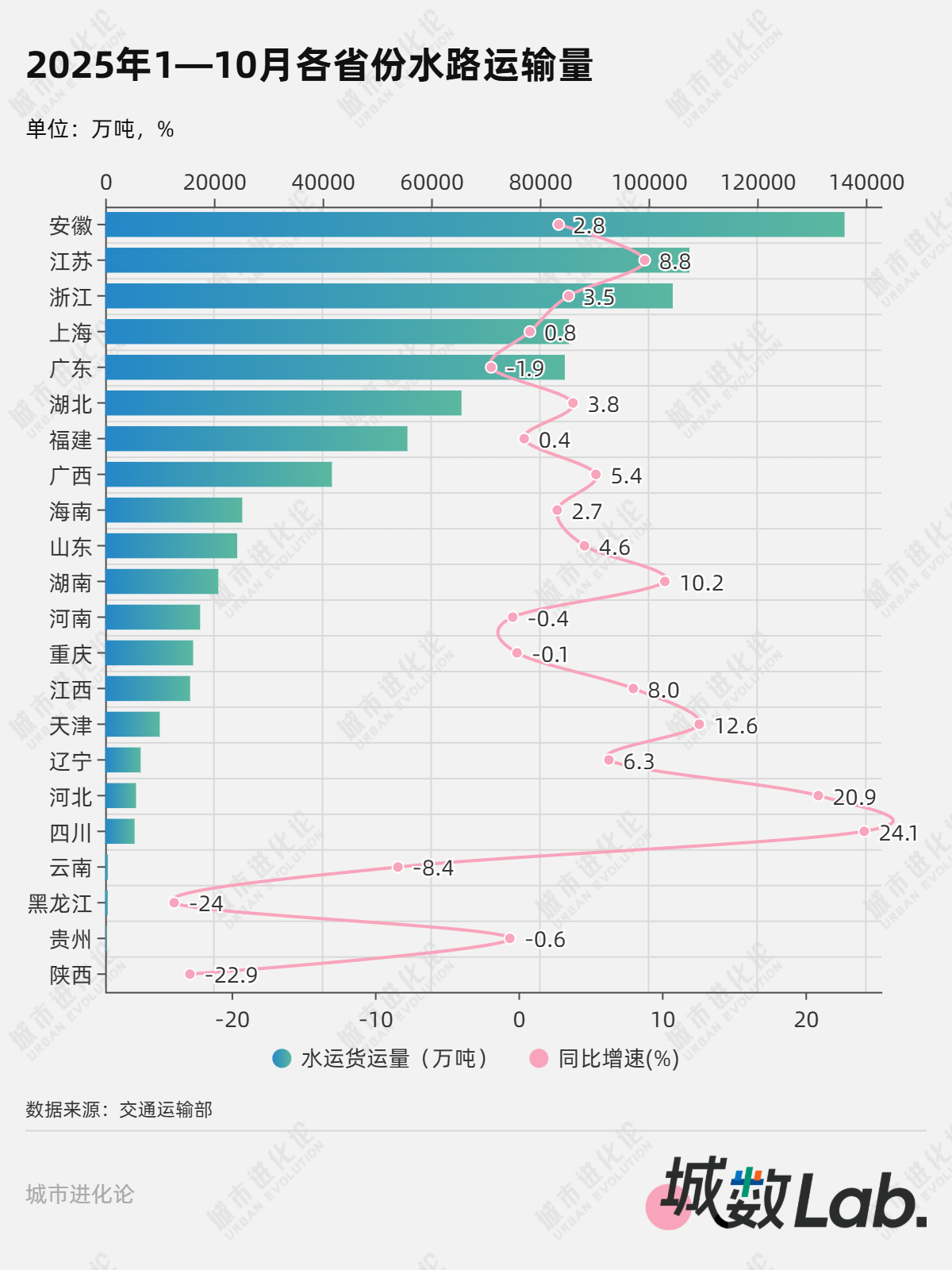
每经记者|程晓玲 每经编辑|刘艳美 放眼全国,一场水运竞速暗流涌动。广西、湖南、湖北等地相继发力运河规划与建设,江苏、浙江、四川、河南等经济大省也密集出台政策加码内河航运。 各地争相入局,意味着现有格局或将打破重塑。当前全国各地水路货运量实力如何? 交通运输部最新数据显示,今年1—10月,全国水路货运量82.9亿吨,同比增长3.5%。其中,共3个省份水路货运量超10亿吨,安徽以13.6亿吨高居第一;江 苏10.75亿吨、浙江10.45亿吨,分列二、三位。 安徽的强势领先并非偶然。在全国水路货运量排行榜上,这个"近海却不沿海"的内陆省份,已连续12年位列第一。数据显示,2013年,安徽水运货运量一跃 反超浙江、江苏、广东、上海,排名从上年全国第五升至第一,此后一直稳坐"头把交椅"。 为什么是安徽? 从内河水运条件看,安徽自北向南分布有淮河、长江、新安江三大水系,全国内河高等级航道中有"一纵两横一网"覆盖安徽。2023年江淮运河全线贯通,彻 底改写安徽水运格局的同时,也进一步巩固其水运大省地位。 公开资料显示,江淮运河北接沙颍河航道、南连芜申运河,形成平行于京杭大运河的我国第二条南北水运大动脉,通航后形成"工"字 ...

\四纵\开启内河水运大发展时代:重大工程系列报告之五
Hua Yuan Zheng Quan· 2025-09-19 09:12
Investment Rating - The report maintains a "Positive" investment rating for the inland waterway transportation industry [4] Core Viewpoints - The inland waterway transportation sector has long been underdeveloped, but a significant development era is about to begin. Compared to road and rail, water transport has clear advantages, with unit turnover rates and costs favoring water transport [4][7] - The "Four Vertical" channel project is expected to reshape the inland economic landscape, enhancing regional connectivity and promoting industrial transfer and upgrading [19][20] - The construction of the "Four Vertical" channels is still in its early stages, with expected acceleration in future efforts [4][19] Summary by Sections Investment Rating - The report maintains a "Positive" investment rating for the inland waterway transportation industry, indicating confidence in its growth potential [4] Industry Overview - The inland waterway transportation sector has been underdeveloped for years, with water transport's share increasing from 9.26% in 2000 to an expected 17.25% in 2024. However, the share of inland waterway cargo turnover remains low at 8.58% compared to 28% in Germany and 15% in the USA in 2020 [7][9] "Four Vertical" Channel Project - The "Four Vertical" project includes major waterways such as the Beijing-Hangzhou Grand Canal and the Jianghuai Line, aiming to create a modern inland waterway network that enhances transportation efficiency and reduces logistics costs [4][19] - The total investment for the Zhejiang-Guangdong Canal is estimated at approximately 320 billion yuan, with significant portions of the project already underway [21][23] Economic Impact - The construction of the "Four Vertical" channels is projected to significantly boost demand for construction materials and services, including explosives, cement, and aggregates [45][49] - The Jianghuai Line is expected to enhance the economic connectivity between the Yangtze River Delta and the Central Plains, with projected cargo turnover reaching 1.5 billion tons by 2027 [40][43] Future Prospects - The report highlights that the inland waterway transportation sector is set for rapid growth, with fixed asset investments in waterway and pipeline transportation showing significant year-on-year increases [20][21] - The ongoing construction of the "Four Vertical" channels is anticipated to further stimulate economic activity and improve logistics efficiency across regions [4][19]
又一世纪运河来了?中国拼命“挖运河”,背后是一场真正的国运之战
3 6 Ke· 2025-05-27 07:48
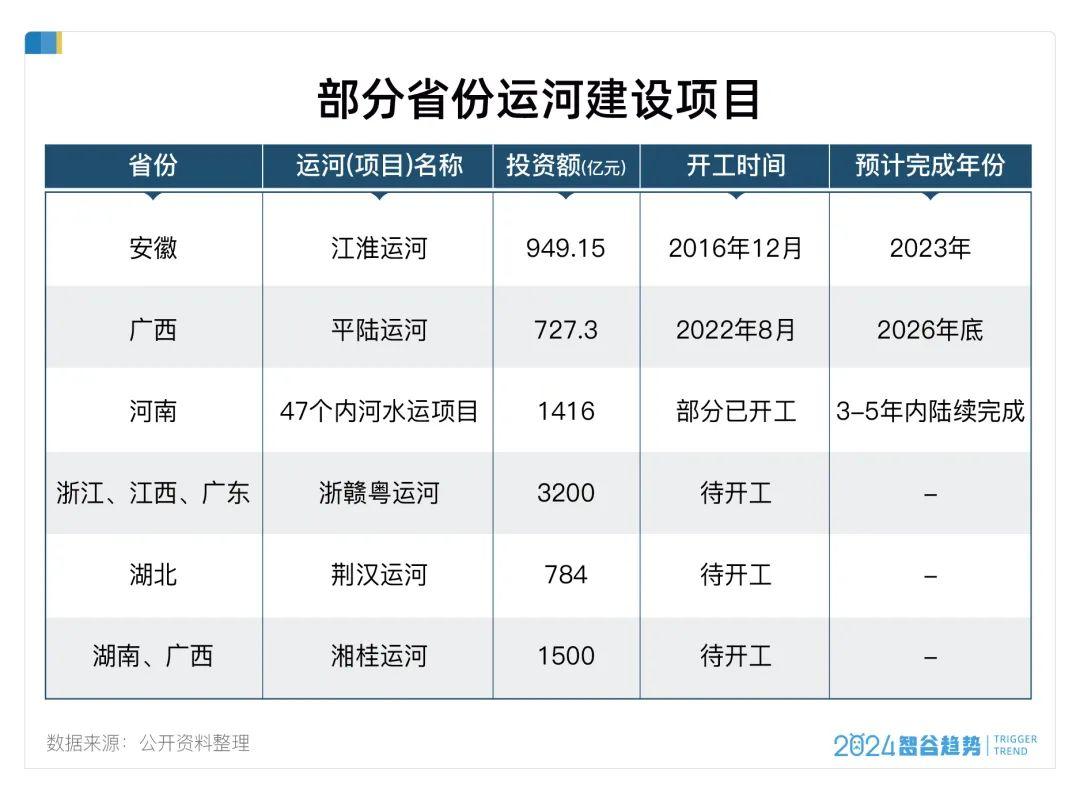
Core Viewpoint - The recent implementation of the "Implementation Opinions on High-Level Construction of 'Shipping Zhejiang'" highlights the strategic push for the construction of the Zhejiang-Jiangxi Canal, which is part of a broader initiative to enhance inland waterway transportation across China, marking the onset of a "new canal era" in the country [2][18][22]. Investment and Economic Impact - A total of over 850 billion yuan is being invested across at least eight provinces to revive inland waterway transport, with the Zhejiang-Jiangxi-Guangdong Canal alone projected to cost 320 billion yuan, surpassing the Grand Canal to become the world's longest canal [2][18]. - The construction of these canals is expected to significantly reduce transportation costs, with water transport costing only half of rail transport, one-fifth of road transport, and one-twentieth of air transport [7][21]. Project Details - The Zhejiang-Jiangxi Canal will span approximately 760 kilometers, connecting key cities in Zhejiang and Jiangxi provinces, and is seen as a monumental water transport project [1][5]. - Other notable projects include the Xianggui Canal with an investment of 150 billion yuan, the Jianghuai Canal at 95 billion yuan, and the Jinghan Canal at 74.8 billion yuan, all aimed at enhancing connectivity and economic integration [2][10]. Historical Context and Future Prospects - Historical examples, such as the Suez Canal and the Grand Canal, illustrate the transformative power of major waterway projects in reshaping trade and economic dynamics [3][4]. - The successful completion of these canal projects is anticipated to create a comprehensive water transport network across China, facilitating economic growth and regional development [22][23]. Strategic Importance - The push for canal construction is part of a broader strategy to strengthen domestic circulation and address bottlenecks in the logistics and transportation system, which currently sees a logistics cost-to-GDP ratio of 14.1% [19][20]. - The development of these canals is viewed as a critical step in establishing a robust inland waterway system that can support China's economic ambitions and enhance regional connectivity [21][22].