
油气相关ETF

Search documents
海外创新产品周报:景顺发行纳指等权ETF-20260323
Shenwan Hongyuan Securities· 2026-03-23 15:28
沈思逸 A0230521070001 shensy@swsresearch.com 益 量 化 研 究 证 券 研 究 报 告 请务必仔细阅读正文之后的各项信息披露与声明 本研究报告仅通过邮件提供给 博时基金 博时基金管理有限公司(researchreport@bosera.com) 使用。1 2026 年 03 月 23 日 景顺发行纳指等权 ETF ——海外创新产品周报 20260323 相关研究 证券分析师 沈思逸 A0230521070001 shensy@swsresearch.com 邓虎 A0230520070003 denghu@swsresearch.com 联系人 权 ETP 研 究 - ⚫ 美国 ETF 创新产品:景顺发行纳指等权 ETF。上周美国共 12 只新发产品,景顺上周发行 2 只新产品,1 只为纳斯达克 100 的等权 ETF,通过每季度等权的方式降低集中度,"降 低集中度"也是近两年美国机构投资者比较关心的投资话题;另 1 只为主动红利 ETF,除 了关心股息率、股息增长水平,产品选股时同时关注公司质量、动量指标。 ⚫ 美国 ETF 资金流向:国内股票产品流入明显。过去一周中 ...


ETF龙虎榜 | 这些方向 资金大幅流入
Zhong Guo Zheng Quan Bao· 2026-02-01 23:20
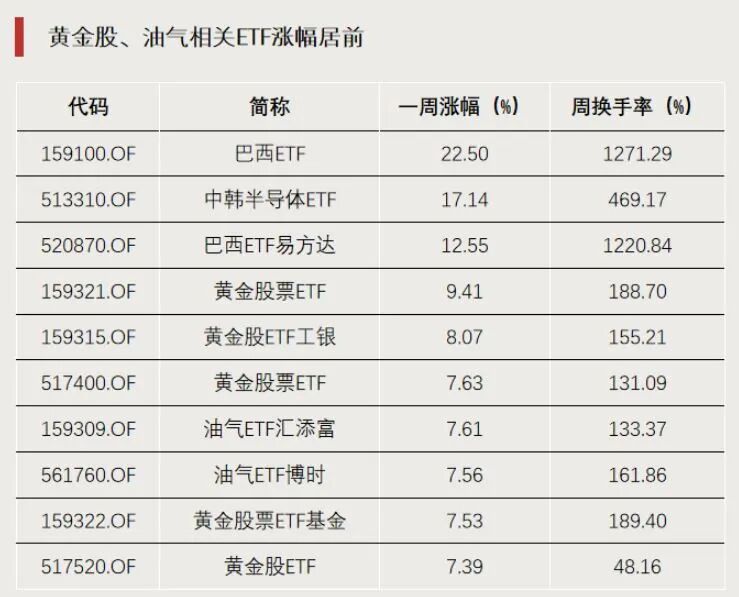
Core Viewpoint - The recent performance of ETFs indicates a strong interest in gold and energy-related sectors, with significant inflows into these areas despite an overall market outflow in ETF funds [1][9]. Fund Flows - Overall, the ETF market experienced a net outflow of 2984.22 billion yuan from January 26 to January 30 [1][8]. - Gold and non-ferrous related ETFs were the main beneficiaries, with gold ETFs linked to Shanghai Gold Exchange Au99.99 contracts receiving over 200 billion yuan in net inflows [9]. - ETFs tracking the SSH gold stock index saw a total net inflow of 75.25 billion yuan, while those tracking various non-ferrous metal indices had a combined net inflow of 170.49 billion yuan [9][10]. ETF Performance - A total of 541 ETFs recorded positive returns, accounting for over 35% of the market [3]. - Gold and energy-related ETFs led the gains, with several gold stock ETFs increasing by over 7% [3][6]. - The Brazilian ETF (159100) had the highest weekly gain at 22.5%, while the A500 ETF (159361) saw a trading volume exceeding 2200 billion yuan [2][4]. Trading Activity - The trading activity for ETFs tracking major indices such as the CSI 300 and SGE Gold 9999 remained robust, with significant weekly trading volumes [11][12]. - The CSI 300 ETF saw the largest net outflow, with over 700 billion yuan withdrawn from the Huatai-PineBridge CSI 300 ETF [13]. Sector Insights - The commercial aerospace sector faced adjustments, with satellite and general aviation-related ETFs experiencing declines of over 10% [3]. - The semiconductor sector also saw notable performance, with the Korea-China Semiconductor ETF (513310) showing a year-to-date decline of 45.09% [8][7]. Market Outlook - Analysts suggest focusing on cyclical resources supported by global demand and the AI industry, while also being cautious of potential short-term cooling risks in the market [14].

黄金股主题ETF领涨 有色相关ETF成“吸金”主力
Zhong Guo Zheng Quan Bao· 2026-02-01 21:25
Group 1 - The A-share market experienced high volatility from January 26 to January 30, with gold and oil-related ETFs showing significant gains, exceeding 7% [1][2] - A total of 541 ETFs achieved positive returns during the same period, with over 35% of the ETFs in the A-share market reporting positive performance [2] - The Brazilian ETF (159100) led the market with a weekly increase of 22.5%, while several other ETFs, including those tracking the semiconductor sector, also saw gains exceeding 10% [2][3] Group 2 - Overall, the ETF market faced a net outflow of approximately 2984.22 billion yuan during the week, indicating a general trend of capital withdrawal [4] - Gold and non-ferrous metal ETFs emerged as the main beneficiaries of capital inflow, with the gold ETF (518880) attracting the highest net inflow of 8.503 billion yuan [4] - The ETFs tracking the CSI 300 and other major indices saw significant trading volumes, with the CSI 300 ETF surpassing 3000 billion yuan in weekly trading volume [4][5] Group 3 - The broad-based ETFs continued to experience substantial net outflows, particularly the CSI 300 ETFs, which saw net outflows exceeding 700 billion yuan for some funds [5] - The market sentiment is cautious, with analysts suggesting a need to balance aggressive and defensive investment strategies, focusing on high-growth sectors while also considering undervalued dividend assets [6][7] - The geopolitical landscape is influencing investment strategies, particularly in rare metals, which are gaining importance for national strategic security amid rising regional conflicts [7]
黄金股主题ETF领涨有色相关ETF成“吸金”主力
Zhong Guo Zheng Quan Bao· 2026-02-01 20:53
Core Viewpoint - The A-share market experienced fluctuations at high levels, with gold and oil-related ETFs showing significant gains, while overall ETF funds saw a net outflow of nearly 300 billion yuan during the week of January 26 to January 30 [1][2]. ETF Performance - During the week, 541 ETFs achieved positive returns, with over 35% of the total ETFs showing gains. Gold and oil-related ETFs led the performance, with several gold stock ETFs and oil ETFs rising over 7% [1][2]. - The Brazilian ETF (159100) had the highest weekly gain at 22.5%, while the South Korean semiconductor ETF and other Brazilian ETFs also saw gains exceeding 10% [1]. Fund Flows - The overall ETF market experienced a net outflow of approximately 298.42 billion yuan from January 26 to January 30. However, gold and non-ferrous metal ETFs emerged as the main beneficiaries of fund inflows, with the gold ETF (518880) attracting the highest net inflow of 8.503 billion yuan [2][3]. - Other notable inflows included over 5 billion yuan for both the non-ferrous metal ETFs (516650 and 512400) and over 4 billion yuan for the Guotai gold ETF [2]. Trading Volume - ETFs tracking major indices such as the CSI 300 and CSI 500 saw significant trading volumes, with the CSI 300 ETF exceeding 300 billion yuan and the CSI A500 ETF surpassing 220 billion yuan in weekly trading volume [3]. Market Sentiment and Strategy - Analysts suggest that the current market requires caution due to potential short-term cooling risks, emphasizing the need for a balance between growth and defensive strategies. High-technology manufacturing and information technology sectors are highlighted for their solid growth logic despite high valuations [3][4]. - Investment strategies should focus on sectors benefiting from global demand and the AI industry, while also considering the defensive value of dividend assets in response to potential market volatility [4].