外需顺周期

Search documents
中泰证券:2月聚焦“外需顺周期+AI产业链” 关注反内卷带来的边际变化
Zhi Tong Cai Jing· 2026-02-01 23:41
Group 1 - The core viewpoint of the reports indicates that after two years of valuation recovery in the A-share market, the third year is often difficult to sustain high valuations, with market performance increasingly reliant on profit realization [1] - The report suggests a focus on sectors with visible performance and improved supply-demand structures, particularly in cyclical industries benefiting from global manufacturing recovery and China's competitive manufacturing advantages [1] - The AI industry remains a clear investment theme, but the focus should shift from thematic expansion to performance-driven investments, particularly in areas with supply shortages such as computing power and storage [1] Group 2 - In January, the A-share market exhibited typical spring volatility characteristics, with major indices recording positive returns, particularly the Sci-Tech 50 index which rose by 15.67% [2] - The market's upward momentum was driven by a rapid influx of incremental capital, with average daily trading volume reaching 3.04 trillion yuan, a significant increase from the previous month [3] - Regulatory interventions and global disturbances have led to fluctuations in market risk appetite, causing a slowdown in the pace of index increases [3] Group 3 - In the technology sector, thematic investments initially outperformed, but as margin requirements increased, there was a shift towards sectors with more predictable earnings, such as semiconductors and power equipment [4] - Cyclical assets, particularly in non-ferrous metals and petrochemicals, have shown strong performance due to three driving factors: spillover from technology sector growth, supply-side constraints, and external geopolitical factors [4] - The market is expected to exhibit a structural characteristic moving forward, with indices likely to remain volatile and focused on resource, technology, and overseas expansion themes [5][6]

ETF龙虎榜 | 这些方向 资金大幅流入
Zhong Guo Zheng Quan Bao· 2026-02-01 23:20
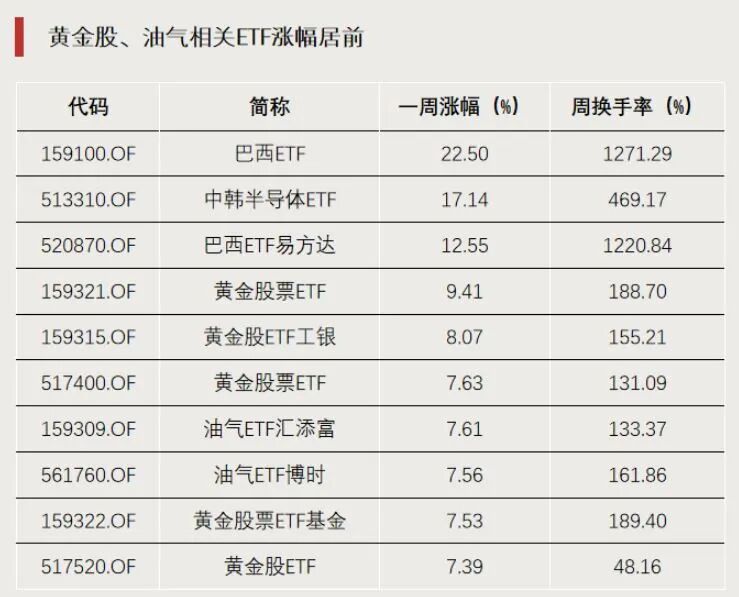
Core Viewpoint - The recent performance of ETFs indicates a strong interest in gold and energy-related sectors, with significant inflows into these areas despite an overall market outflow in ETF funds [1][9]. Fund Flows - Overall, the ETF market experienced a net outflow of 2984.22 billion yuan from January 26 to January 30 [1][8]. - Gold and non-ferrous related ETFs were the main beneficiaries, with gold ETFs linked to Shanghai Gold Exchange Au99.99 contracts receiving over 200 billion yuan in net inflows [9]. - ETFs tracking the SSH gold stock index saw a total net inflow of 75.25 billion yuan, while those tracking various non-ferrous metal indices had a combined net inflow of 170.49 billion yuan [9][10]. ETF Performance - A total of 541 ETFs recorded positive returns, accounting for over 35% of the market [3]. - Gold and energy-related ETFs led the gains, with several gold stock ETFs increasing by over 7% [3][6]. - The Brazilian ETF (159100) had the highest weekly gain at 22.5%, while the A500 ETF (159361) saw a trading volume exceeding 2200 billion yuan [2][4]. Trading Activity - The trading activity for ETFs tracking major indices such as the CSI 300 and SGE Gold 9999 remained robust, with significant weekly trading volumes [11][12]. - The CSI 300 ETF saw the largest net outflow, with over 700 billion yuan withdrawn from the Huatai-PineBridge CSI 300 ETF [13]. Sector Insights - The commercial aerospace sector faced adjustments, with satellite and general aviation-related ETFs experiencing declines of over 10% [3]. - The semiconductor sector also saw notable performance, with the Korea-China Semiconductor ETF (513310) showing a year-to-date decline of 45.09% [8][7]. Market Outlook - Analysts suggest focusing on cyclical resources supported by global demand and the AI industry, while also being cautious of potential short-term cooling risks in the market [14].

这些方向,资金大幅流入
Zhong Guo Zheng Quan Bao· 2026-02-01 23:17
Group 1 - The core viewpoint of the article highlights the significant fluctuations in the ETF market, particularly the strong performance of gold and oil-related ETFs, followed by a sharp decline in gold stock ETFs on January 30 [1][3][6] - During the week of January 26 to January 30, the overall ETF market experienced a net outflow of 298.22 billion yuan, with gold and non-ferrous metal ETFs being the main beneficiaries of capital inflow [1][9] - Gold ETFs, particularly those linked to the Shanghai Gold Exchange Au99.99 spot contracts, saw a net inflow exceeding 20 billion yuan, while ETFs tracking the SSH gold stock index had a net inflow of 7.525 billion yuan [1][9] Group 2 - The trading volume for ETFs tracking major indices such as the CSI 300 and CSI 500 remained active, with the A500 ETF from E Fund exceeding a trading volume of 220 billion yuan [2][11] - A total of 541 ETFs recorded positive returns, with gold and oil-related ETFs leading the gains, some exceeding 7% [3][6] - The Brazilian ETF (159100) had the highest weekly gain at 22.5%, while several gold stock ETFs also showed significant increases [3][4] Group 3 - Year-to-date, gold stock ETFs have shown remarkable performance, with the gold stock ETF (159321) increasing over 40%, and others like the gold stock ETF from ICBC and (517520) rising over 30% [6][7] - The semiconductor-related ETFs and Brazilian ETFs also ranked among the top performers year-to-date [7][8] - The net inflow for the gold stock ETF (517520) was notably high at 3.228 billion yuan, indicating strong investor interest [8] Group 4 - The article notes that the overall market sentiment is shifting towards focusing on economic trends rather than speculative trading, with an emphasis on cyclical resources and AI-related sectors [14] - Analysts suggest a balanced investment strategy that includes high-growth sectors like technology while also considering undervalued dividend assets to mitigate potential market volatility [14]
黄金股主题ETF领涨 有色相关ETF成“吸金”主力
Zhong Guo Zheng Quan Bao· 2026-02-01 21:25
Group 1 - The A-share market experienced high volatility from January 26 to January 30, with gold and oil-related ETFs showing significant gains, exceeding 7% [1][2] - A total of 541 ETFs achieved positive returns during the same period, with over 35% of the ETFs in the A-share market reporting positive performance [2] - The Brazilian ETF (159100) led the market with a weekly increase of 22.5%, while several other ETFs, including those tracking the semiconductor sector, also saw gains exceeding 10% [2][3] Group 2 - Overall, the ETF market faced a net outflow of approximately 2984.22 billion yuan during the week, indicating a general trend of capital withdrawal [4] - Gold and non-ferrous metal ETFs emerged as the main beneficiaries of capital inflow, with the gold ETF (518880) attracting the highest net inflow of 8.503 billion yuan [4] - The ETFs tracking the CSI 300 and other major indices saw significant trading volumes, with the CSI 300 ETF surpassing 3000 billion yuan in weekly trading volume [4][5] Group 3 - The broad-based ETFs continued to experience substantial net outflows, particularly the CSI 300 ETFs, which saw net outflows exceeding 700 billion yuan for some funds [5] - The market sentiment is cautious, with analysts suggesting a need to balance aggressive and defensive investment strategies, focusing on high-growth sectors while also considering undervalued dividend assets [6][7] - The geopolitical landscape is influencing investment strategies, particularly in rare metals, which are gaining importance for national strategic security amid rising regional conflicts [7]
黄金股主题ETF领涨有色相关ETF成“吸金”主力
Zhong Guo Zheng Quan Bao· 2026-02-01 20:53
Core Viewpoint - The A-share market experienced fluctuations at high levels, with gold and oil-related ETFs showing significant gains, while overall ETF funds saw a net outflow of nearly 300 billion yuan during the week of January 26 to January 30 [1][2]. ETF Performance - During the week, 541 ETFs achieved positive returns, with over 35% of the total ETFs showing gains. Gold and oil-related ETFs led the performance, with several gold stock ETFs and oil ETFs rising over 7% [1][2]. - The Brazilian ETF (159100) had the highest weekly gain at 22.5%, while the South Korean semiconductor ETF and other Brazilian ETFs also saw gains exceeding 10% [1]. Fund Flows - The overall ETF market experienced a net outflow of approximately 298.42 billion yuan from January 26 to January 30. However, gold and non-ferrous metal ETFs emerged as the main beneficiaries of fund inflows, with the gold ETF (518880) attracting the highest net inflow of 8.503 billion yuan [2][3]. - Other notable inflows included over 5 billion yuan for both the non-ferrous metal ETFs (516650 and 512400) and over 4 billion yuan for the Guotai gold ETF [2]. Trading Volume - ETFs tracking major indices such as the CSI 300 and CSI 500 saw significant trading volumes, with the CSI 300 ETF exceeding 300 billion yuan and the CSI A500 ETF surpassing 220 billion yuan in weekly trading volume [3]. Market Sentiment and Strategy - Analysts suggest that the current market requires caution due to potential short-term cooling risks, emphasizing the need for a balance between growth and defensive strategies. High-technology manufacturing and information technology sectors are highlighted for their solid growth logic despite high valuations [3][4]. - Investment strategies should focus on sectors benefiting from global demand and the AI industry, while also considering the defensive value of dividend assets in response to potential market volatility [4].
3只ETF,罕见涨停
Zhong Guo Zheng Quan Bao· 2026-01-28 13:03
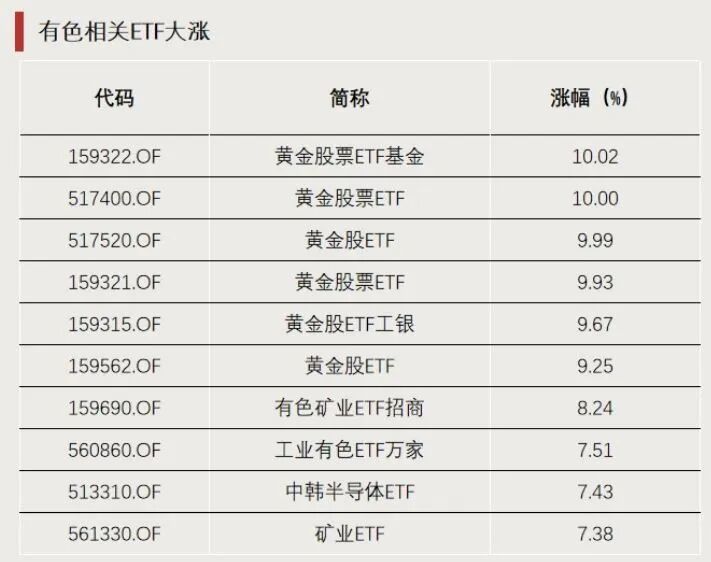
Group 1 - Resource stocks experienced a surge, leading to a significant increase in related ETFs, with 9 out of the top 10 performing ETFs being gold and resource-related [1][3] - Among the top-performing ETFs, 6 were gold-related, with 3 reaching the daily limit up [3][4] - The rise in gold prices is attributed to its safe-haven appeal and a renewed trend of "selling U.S. assets," driven by waning confidence in U.S. assets, a potential interest rate cut cycle, and geopolitical tensions [3] Group 2 - Multiple Hu-Shen 300 ETFs saw substantial trading volumes, with total ETF trading reaching 538.918 billion yuan, an increase of 22.3914 billion yuan from the previous day [7] - Major Hu-Shen 300 ETFs, such as Huatai-PineBridge and E Fund, recorded trading volumes exceeding 400 billion yuan and 320 billion yuan respectively [7][8] - Despite high trading volumes, these ETFs faced significant net outflows recently, with major funds experiencing over 100 billion yuan in outflows [8][10] Group 3 - The strong performance of resource-related ETFs has attracted significant capital inflows, with 5 gold and resource-related ETFs appearing in the top ten for net inflows on both January 26 and January 27 [5] - On January 27, the top net inflow ETFs included the Nonferrous Metals ETF and several gold ETFs, with inflows ranging from 7.06 billion yuan to 16.57 billion yuan [6] Group 4 - The recent performance of the nonferrous metals sector is driven by a "tight supply-demand balance" and enhanced financial attributes, with new demand engines emerging from AI data centers and renewable energy [11] - Global mining capital expenditure has been insufficient, leading to ongoing supply constraints, while the long-term expansion of U.S. dollar credit and the trend of "de-dollarization" are reshaping the pricing logic of precious metals [11] - Investment focus is recommended on cyclical resource products supported by global demand, particularly in the context of AI-related shortages, suggesting that resource products may outperform AI sectors [11]