
泰康兴泰回报沪港深A

Search documents
泰康基金桂跃强业绩透视:股债业绩显著分化 权益产品近三年亏超16%跑输业绩比较基准
Xin Lang Ji Jin· 2026-01-20 11:42
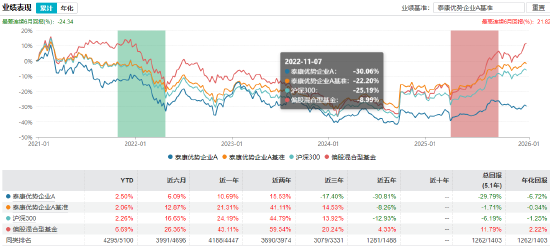
Core Viewpoint - The performance of fund manager Gui Yueqiang from Taikang Fund shows significant divergence across different product types, with equity products underperforming the market while fixed-income products have not met benchmarks either [1][27]. Group 1: Performance Overview - Gui Yueqiang's equity products have a three-year return of 3.89%, underperforming the CSI 300 index [1]. - His fixed-income products have a three-year return of 6.47%, also failing to beat the China Bond Composite Index [1]. - The two actively managed equity funds have seen losses exceeding 16% over three years, significantly trailing their performance benchmarks [2]. Group 2: Fund Composition and Holdings - Major holdings in the equity funds include Tencent Holdings (9.78%), Fuyao Glass (A+H combined 7.64%), and Nongfu Spring (3.03%) [3]. - The fixed-income investments constitute only 3.94% of the portfolio, indicating a core strategy driven by equity investments [3]. - The asset allocation in the third quarter report shows a concentration in manufacturing (40.74%), telecommunications (13.33%), and public utilities (2.36%), with no holdings in traditional blue-chip sectors like finance and real estate [8]. Group 3: Fund Performance Metrics - The Taikang Advantage Enterprise A fund has an asset size of 764 million yuan, with a return of -29.79% since its management began on December 22, 2020 [2]. - The Taikang Blue Chip Advantage fund has an asset size of 248 million yuan, with a total return of 1.56% since August 14, 2020, and a three-year return of -16.49% [5]. - The Taikang Hongtai Return A fund has an asset size of 450 million yuan, with a total return of 69.81% since June 8, 2016, but a three-year return of 6.25%, which does not beat its benchmark [15]. Group 4: Risk and Strategy - The fixed-income products generally maintain a solid foundation with over 75% in fixed income, focusing on high-quality bonds and minimizing credit risk [9][27]. - The equity products have shown a concentrated style, which has not yielded excess returns during recent market fluctuations [27].

绝对收益产品及策略周报:上周159只固收+产品业绩创历史新高-20250319
Haitong Securities· 2025-02-19 06:12
Quantitative Models and Construction Methods 1. Model Name: Macro Timing Model - **Model Construction Idea**: The model predicts future macroeconomic environments using proxy variables and selects optimal assets for absolute return portfolios based on these predictions[25] - **Model Construction Process**: - The model uses proxy variables to forecast macroeconomic conditions such as inflation, economic growth, interest rates, exchange rates, and risk sentiment[25] - Based on these forecasts, the model selects assets that are expected to perform best in the predicted environment[25] - Example formula: $ \text{Expected Return} = \alpha + \beta \times \text{Macro Variable} $ where $\alpha$ is the intercept and $\beta$ is the coefficient representing the sensitivity to the macro variable[25] - **Model Evaluation**: The model is effective in predicting macroeconomic conditions and selecting optimal assets for different environments[25] - **Model Test Results**: - Q1 2025 predictions: Inflation environment - Asset returns: CSI 300: 0.10%, CSI 2000: 6.05%, Nanhua Commodity Index: 3.26%, China Bond Total Wealth Index: 0.51%[25] 2. Model Name: Macro Momentum Model - **Model Construction Idea**: The model uses multiple dimensions such as economic growth, inflation, interest rates, exchange rates, and risk sentiment to time major asset classes like stocks and bonds[25] - **Model Construction Process**: - The model constructs macro momentum indicators based on economic growth, inflation, interest rates, exchange rates, and risk sentiment[25] - These indicators are used to time investments in major asset classes[25] - Example formula: $ \text{Momentum Score} = \sum_{i=1}^{n} w_i \times \text{Indicator}_i $ where $w_i$ is the weight of the $i$-th indicator and $\text{Indicator}_i$ is the value of the $i$-th indicator[25] - **Model Evaluation**: The model is effective in timing investments based on macroeconomic conditions[25] - **Model Test Results**: - February 2025 returns: CSI 300: 3.19%, China Bond Total Wealth Index: 0.08%, Shanghai Gold Exchange AU9999 contract: 6.43%[25] Model Backtest Results 1. Macro Timing Model - **Weekly Return**: -0.12%[32] - **Monthly Return**: 0.36%[32] - **Year-to-Date Return**: -0.31%[32] - **Annualized Volatility**: 2.71%[32] - **Maximum Drawdown**: 0.51%[32] - **Sharpe Ratio**: -0.95[32] 2. Macro Momentum Model - **Weekly Return**: -0.20%[32] - **Monthly Return**: 0.18%[32] - **Year-to-Date Return**: 0.15%[32] - **Annualized Volatility**: 1.50%[32] - **Maximum Drawdown**: 0.47%[32] - **Sharpe Ratio**: 0.87[32] Quantitative Factors and Construction Methods 1. Factor Name: PB Profitability - **Factor Construction Idea**: The factor selects stocks based on their price-to-book (PB) ratio and profitability metrics[38] - **Factor Construction Process**: - Stocks are ranked based on their PB ratio and profitability metrics[38] - The top-ranked stocks are selected for the portfolio[38] - Example formula: $ \text{PB Profitability Score} = \frac{\text{Net Income}}{\text{Book Value}} $ where $\text{Net Income}$ is the company's net income and $\text{Book Value}$ is the company's book value[38] - **Factor Evaluation**: The factor is effective in selecting stocks with high profitability relative to their book value[38] 2. Factor Name: High Dividend Yield - **Factor Construction Idea**: The factor selects stocks based on their dividend yield[38] - **Factor Construction Process**: - Stocks are ranked based on their dividend yield[38] - The top-ranked stocks are selected for the portfolio[38] - Example formula: $ \text{Dividend Yield} = \frac{\text{Annual Dividends}}{\text{Stock Price}} $ where $\text{Annual Dividends}$ is the total dividends paid annually and $\text{Stock Price}$ is the current stock price[38] - **Factor Evaluation**: The factor is effective in selecting stocks with high dividend yields[38] Factor Backtest Results 1. PB Profitability Factor - **Weekly Return**: 0.09%[39] - **Monthly Return**: 0.36%[39] - **Year-to-Date Return**: 0.38%[39] - **Annualized Volatility**: 2.63%[39] - **Maximum Drawdown**: 1.82%[39] - **Sharpe Ratio**: -0.44[39] 2. High Dividend Yield Factor - **Weekly Return**: 0.03%[39] - **Monthly Return**: 0.15%[39] - **Year-to-Date Return**: 0.01%[39] - **Annualized Volatility**: 2.34%[39] - **Maximum Drawdown**: 1.39%[39] - **Sharpe Ratio**: -0.64[39]