浴室台盆柜

Search documents
@家居企业,美国推迟加征关税至2027年
Sou Hu Cai Jing· 2026-01-06 03:05
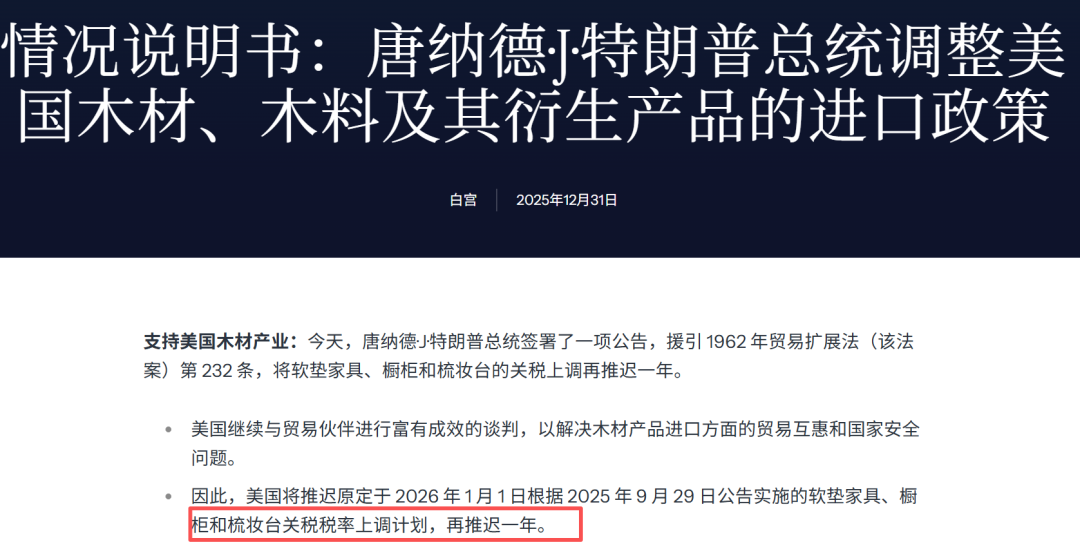
Group 1 - The Trump administration has officially announced the postponement of the planned tariff increase on soft furniture, kitchen cabinets, and bathroom vanity cabinets from January 1, 2026, to 2027, maintaining the current tariff rate of 25% during this period [2] - The initial tariff increase was set to raise kitchen cabinet tariffs to 50% and soft furniture tariffs to 30% in 2026, following a previous executive order signed in September 2025 [2] - The announcement was made on December 31, raising questions about the timing and implications for the industry [2] Group 2 - The postponement of the tariff increase is primarily aimed at alleviating inflation in the U.S. and appealing to voters, as rising prices of household products directly impact living costs [3] - The American Furniture Alliance and other industry organizations have protested against high tariffs, and the delay has led to a surge in stock prices for U.S. furniture retailers [3] Group 3 - The announcement also indicates constructive progress in trade relations with certain partners regarding mutual trade and national security issues related to wood products, creating a more favorable atmosphere for future negotiations [4] - The U.S. accounts for approximately 26% of China's furniture exports, making the postponement beneficial for related enterprises to adjust their market and production strategies [4] Group 4 - Despite the delay, the tariff increase is only postponed, not canceled, and there remains a possibility of an increase in 2027, highlighting the long-term uncertainty in U.S. trade policies, especially concerning wood products and furniture [4] - The U.S. Department of Commerce is conducting additional investigations into various sectors, which may lead to further tariff pressures on related products in the future [6] Group 5 - For Chinese furniture export companies, building core competitiveness is essential for long-term stability in the face of trade fluctuations, emphasizing the need for market diversification and global supply chain strategies [6]


关税突发!刚刚,特朗普,改口!
Zhong Guo Ji Jin Bao· 2026-01-01 10:15
Group 1 - The core point of the article is that Trump has postponed the tariff increase on furniture and cabinets until 2027, responding to voter dissatisfaction with rising prices [3][4]. - The new tariffs on soft furniture, kitchen cabinets, and bathroom vanity cabinets were originally set to take effect this week but have been delayed, maintaining the current tariff rate of 25% [3][4]. - The planned increase included raising kitchen cabinet tariffs to 50% and soft furniture tariffs to 30% by 2026, which has now been halted [3][4]. Group 2 - The White House stated that the U.S. is engaged in productive negotiations with trade partners regarding the import of wood products, addressing trade equity and national security concerns [4]. - Trump's administration has faced criticism for failing to stabilize prices, partly due to the tariffs imposed on various goods since he took office in early 2025 [4][5]. - The tariffs were justified by Trump on national security grounds, claiming they aim to protect the domestic lumber industry, particularly in response to Canadian lumber exports [5].
关税突发!刚刚,特朗普,改口!
中国基金报· 2026-01-01 10:09
Core Viewpoint - Trump has postponed the tariff increase on furniture and cabinets for one year, now set to take effect in 2027 [2][4]. Group 1: Tariff Details - The new tariffs on soft furniture, kitchen cabinets, and bathroom vanities were originally scheduled to take effect this week but have been delayed [6][9]. - The tariffs were set at 25% and were planned to increase to 50% for kitchen cabinets and 30% for soft furniture by 2026 [6][7]. Group 2: Economic Context - The delay in tariff increases comes amid rising dissatisfaction among voters regarding price levels, indicating a strategic move to alleviate economic pressure [5]. - Despite the planned tariffs, furniture prices had already risen significantly due to existing tariffs on most goods from China and Vietnam, the two main sources of U.S. furniture imports [8]. Group 3: Government Position - The White House stated that the U.S. is engaged in productive negotiations with trade partners to address trade equity and national security concerns related to wood product imports [8]. - Trump has defended the tariffs as necessary for protecting the domestic lumber industry, citing national security concerns regarding wood imports from Canada [11].