淘宝到家

Search documents
阿里拟减持三江购物不超1643万股
Zheng Quan Shi Bao· 2025-11-05 18:36
Core Viewpoint - Alibaba's subsidiary, Hangzhou Alibaba Zeta Information Technology Co., Ltd. (referred to as "Ali Zeta"), plans to reduce its stake in Sanjiang Shopping (601116) by up to 16.43 million shares, representing no more than 3% of the company's total share capital [1] Group 1: Shareholding and Reduction Plans - As of now, Ali Zeta holds 164 million unrestricted circulating shares of Sanjiang Shopping, accounting for 30% of the company's total share capital [1] - Ali Zeta has been a shareholder of Sanjiang Shopping for 9 years, having acquired a 9.33% stake from the controlling shareholder, Shanghai He'an Investment Management Co., Ltd., in November 2016 [2] - In 2018, Ali Zeta's shareholding increased to 32% after participating in a non-public stock issuance by Sanjiang Shopping [3] Group 2: Previous Reduction Activities - Prior to the current reduction plan, Ali Zeta had announced a plan in April 2023 to reduce its stake by up to 3% [4] - From August 6 to August 11, 2023, Ali Zeta reduced its holdings by a total of 1.095 million shares, which accounted for 2% of Sanjiang Shopping's total share capital [4] Group 3: Business Cooperation with Alibaba - Sanjiang Shopping has entered into multiple cooperation agreements with Alibaba, including a framework agreement to leverage each other's supply chain advantages and integrate e-commerce resources [2] - The cooperation agreement with Hema (a subsidiary of Alibaba) is set to expire on March 31, 2026, with no plans for renewal after that date [4] - The full subsidiary of Sanjiang Shopping, Zhejiang Zhehai Huadi Network Technology Co., Ltd., is projected to generate revenues of 429 million yuan, 447 million yuan, and 550 million yuan from 2022 to 2024, with net profits of 7.2 million yuan, 11.26 million yuan, and 18.33 million yuan respectively [5]


阿里再度出手!拟减持!
Zheng Quan Shi Bao· 2025-11-05 12:34
Core Viewpoint - Alibaba's subsidiary, Hangzhou Alibaba Zetai Information Technology Co., Ltd., plans to reduce its stake in Sanjiang Shopping by up to 16.43 million shares, representing no more than 3% of the company's total share capital [1][2]. Group 1: Shareholding and Reduction Plan - As of now, Alibaba Zetai holds 164 million shares of Sanjiang Shopping, accounting for 30% of the company's total share capital [3]. - Alibaba Zetai has been a shareholder of Sanjiang Shopping for 9 years, having acquired shares through a transfer agreement in 2016 [4]. - In 2018, Alibaba Zetai's stake increased to 32% following participation in a non-public stock issuance [6]. Group 2: Previous Reduction Activities - Prior to the current reduction plan, Alibaba Zetai had announced a similar plan in April 2023, intending to reduce its stake by up to 3% [6]. - From August 6 to August 11, 2023, Alibaba Zetai reduced its holdings by a total of 1.1 million shares, which accounted for 2% of Sanjiang Shopping's total share capital [6]. Group 3: Business Cooperation with Hema - Sanjiang Shopping has a business cooperation agreement with Hema, a subsidiary of Alibaba, which is set to expire on March 31, 2026, and will not be renewed [7]. - The revenue projections for Sanjiang Shopping's subsidiary managing Hema stores are 429 million yuan, 447 million yuan, and 550 million yuan for the years 2022, 2023, and 2024, respectively, with net profits of 7.2 million yuan, 11.26 million yuan, and 18.33 million yuan [7].
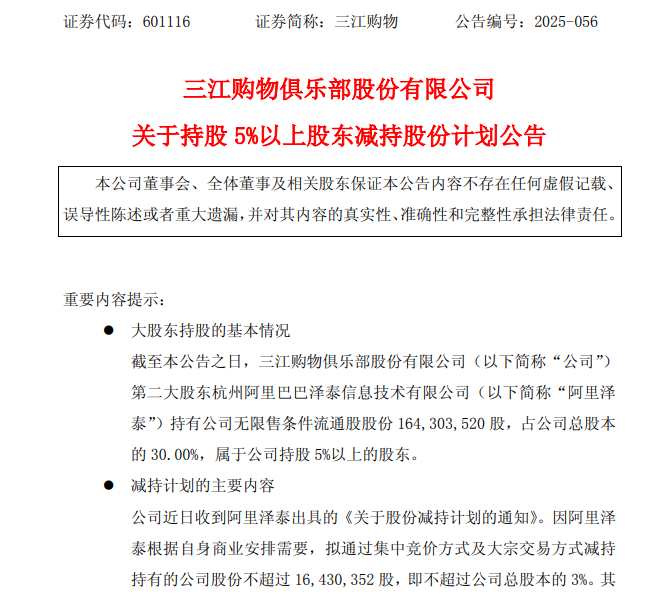
阿里再度出手!拟减持!
证券时报· 2025-11-05 12:27
Core Viewpoint - Alibaba's subsidiary, Hangzhou Alibaba Zetai Information Technology Co., plans to reduce its stake in Sanjiang Shopping by up to 16.43 million shares, representing no more than 3% of the company's total share capital [1][4]. Group 1: Shareholding and Reduction Plans - As of now, Alibaba Zetai holds 164 million shares of Sanjiang Shopping, accounting for 30% of the company's total share capital [4]. - Alibaba Zetai has been a shareholder of Sanjiang Shopping for 9 years, having acquired a 9.33% stake in 2016 [5]. - In April 2023, Alibaba Zetai announced a plan to reduce its stake by up to 3%, which was followed by a reduction of 5.47 million shares through both centralized bidding and block trading in August [6]. Group 2: Business Cooperation and Future Prospects - Sanjiang Shopping and Alibaba have signed multiple cooperation agreements, including a framework agreement in 2016 to leverage each other's supply chain advantages and e-commerce resources [5]. - The cooperation with Hema (a subsidiary of Alibaba) is set to expire on March 31, 2026, and will not be renewed according to a notice received from Hema [7]. - The revenue projections for Sanjiang Shopping's subsidiary managing Hema stores are 429 million yuan, 447 million yuan, and 550 million yuan for 2022, 2023, and 2024 respectively, with net profits increasing from 7.2 million yuan in 2022 to 18.33 million yuan in 2024 [8].

第17届双十一,5大电商平台论剑,规则、流量、战场已彻底改变
Sou Hu Cai Jing· 2025-11-02 04:14
Core Insights - The article discusses the evolution of China's e-commerce industry, particularly focusing on the "Double Eleven" shopping festival, which has transformed from a niche event into the world's largest shopping extravaganza since its inception in 2009 [1][3]. Group 1: Historical Evolution of Double Eleven Strategies - The Double Eleven event can be divided into three main phases from 2015 to 2024, each characterized by distinct features and competitive dynamics [4]. - The first phase (2015-2017) was dominated by Alibaba's Taobao/Tmall and JD.com, with a focus on price competition and traffic acquisition. Sales figures grew from 91.2 billion yuan in 2015 to 168.2 billion yuan in 2017 [7]. - The second phase (2018-2020) saw the entry of content platforms like Douyin and Kuaishou, leading to a more intense competition landscape. Pinduoduo emerged as a significant player with its social group-buying model [8][9]. - The third phase (2021-2024) marked a shift towards refined operations, with platforms focusing on user experience and sustainable growth. Sales peaked at 540.3 billion yuan in 2021, but platforms began emphasizing quality metrics over gross merchandise volume (GMV) [10]. Group 2: Tactical Evolution of Major Platforms - Taobao/Tmall's pricing strategy evolved from "site-wide 50% off" to complex promotional rules, and finally to simplified rules like "official discounts" starting in 2023 [12][44]. - JD.com maintained a straightforward pricing strategy, introducing "official discounts" and "instant sales" while enhancing its logistics capabilities, achieving an average fulfillment time of 18 minutes by 2025 [18][76]. - Pinduoduo's strategy shifted from "lowest price" to "same price for the same item," reflecting a focus on merchant interests and product quality [24][77]. - Douyin e-commerce emphasized content-driven sales, integrating short videos and live streaming to create a seamless shopping experience, with significant sales growth during the Double Eleven period [31][79]. - Kuaishou e-commerce leveraged its "old iron economy" to build strong relationships with users, achieving high repurchase rates through trust-based interactions [37][40]. Group 3: Key Tactical Dimensions - Pricing strategies across platforms transitioned from complex calculations to straightforward discounts, with a notable emphasis on user-friendly promotions [44][46]. - Traffic acquisition methods evolved from traditional advertising to content marketing, with platforms increasingly relying on live streaming and social media to attract users [48][51]. - User operations shifted towards precision marketing, with platforms utilizing data analytics to enhance user engagement and loyalty [55][58]. - Supply chain management became a focal point, with platforms investing in logistics efficiency and real-time delivery capabilities to improve customer experience [62][65].