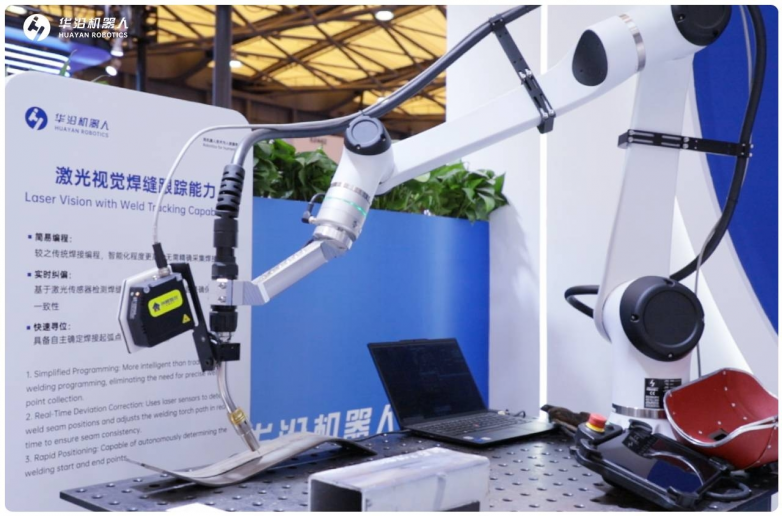
激光焊接机器人

Search documents
成都造机器人亮相中东展会
Xin Lang Cai Jing· 2026-01-27 18:56
Core Insights - Chengdu Kanop Robot Technology Co., Ltd. showcased its advanced products and localized service strategies at the Steel Fab 2026 exhibition in Sharjah, UAE, attracting significant attention and establishing preliminary cooperation intentions with over 12 partners, highlighting the strength of "Chengdu Intelligent Manufacturing" in global industrial upgrades [1][2] Group 1 - The exhibition featured the latest generation of laser welding robots demonstrating precision cutting, which attracted clients focused on heavy equipment and energy infrastructure due to its enhanced heat resistance and stability design [1] - A user-friendly collaborative welding robot was presented, offering high performance and ease of use, providing solutions for factories facing skilled labor shortages [1] - The overseas market manager emphasized that the Middle East is not only a key export market but also a strategic frontier for localizing technology adaptation and industrial collaboration [1] Group 2 - Kanop reached preliminary cooperation intentions with over 12 partners, covering aspects such as direct procurement and overall production line upgrades [2] - The overseas sales manager noted that direct communication with end customers and international peers allowed the team to identify new trends in the Middle East market, particularly in energy conservation, environmental protection, and digital integration [2]

2025年中国激光焊接机器人行业概述、市场销量、进出口贸易及未来趋势研判:销量波动幅度大,出口分布广泛,产业竞争力将进一步提升[图]
Chan Ye Xin Xi Wang· 2026-01-14 01:13
Core Insights - The article discusses the increasing adoption and significance of laser welding robots in various industries, including automotive, aerospace, electronics, and medical devices, highlighting their efficiency and quality improvements in production processes [1][10]. Group 1: Overview of Laser Welding Robots - Laser welding robots are advanced automated welding devices that combine modern laser technology with industrial robotics, enabling precise, efficient, and high-quality welding operations [1][2]. - The market for laser welding robots in China is projected to exceed 2,300 units in both 2023 and 2024, indicating a growing trend in their adoption [1][11]. Group 2: Sales and Market Structure - The market is dominated by arc and spot welding robots, which account for approximately 90% of the market share, while laser welding robots are expected to represent about 4.6% of the market by 2024 [8]. - In 2022 and 2023, China exported 8,259 and 6,973 laser welding robots, respectively, but exports are expected to decline to 1,003 units in 2024 due to global economic pressures and ongoing trade frictions [11]. Group 3: Import and Export Dynamics - In the first 11 months of 2025, China imported 10 laser welding robots with an import value of $1.844 million, indicating a decline in imports as domestic production capabilities improve [11]. - The average import price of laser welding robots in 2025 was $184,400 per unit, significantly higher than the export average of $14,700 per unit, suggesting that imports are primarily high-end products while exports consist of lower-value robots [11][12]. Group 4: Export Markets and Trends - In 2025, China successfully exported laser welding robots to 43 countries, with Kazakhstan receiving 452 units (37.6% of total exports) and Poland receiving 320 units (26.3% of total exports) [12][13]. - The top three export markets by value were Brazil ($4.072 million), Vietnam ($2.693 million), and the United States ($2.046 million) [13]. Group 5: Industry Development Trends - The laser welding robot industry is evolving towards greater intelligence, performance enhancement, and industry chain integration, with a focus on AI and IoT technologies [11]. - As domestic companies increase R&D investments, the competitiveness of Chinese laser welding robots is expected to improve, along with a rise in the industry’s localization rate [11].


赋能焊接新生态,华沿协作机器人成功亮相2025埃森焊接展
Cai Fu Zai Xian· 2025-06-23 07:04
Core Viewpoint - The 28th Beijing Essen Welding and Cutting Exhibition showcased advancements in collaborative welding robots, emphasizing the theme "Intelligent Leadership for a Collaborative Future" and highlighting the potential of Huayan Robotics in the automation and intelligent welding sector [1][18]. Group 1: Product Features and Innovations - Huayan Robotics, a top three manufacturer of collaborative welding robots in China, focused on enhancing precision, adaptability, and collaboration capabilities of their robots at the Essen Exhibition [2]. - The E10L-Pro demonstrated integrated end-effector force control, requiring less than 3N of drag force for operation, significantly improving programming efficiency and simplifying welding processes [2]. - The Elfin-Pro, equipped with advanced laser sensors, can accurately identify weld seam positions and adjust the welding path in real-time, enhancing automation and reducing the need for precise manual input from welders [2]. Group 2: Expanded Capabilities - The E03-Pro, in conjunction with a seventh axis, expands the operational range to cover several meters while ensuring safety in human-robot collaboration, catering to large workpieces like ships and engineering machinery [4]. - A collaborative large-arm welding robot, designed for heavy structures, features an 1.8-meter reach, allowing it to access distant welding points without repositioning, thus improving efficiency for large-scale projects [6]. - The portable E05-Pro welding workstation is designed for mobile welding applications, allowing for easy transport and setup in confined spaces, with a high protection rating of IP66 for operation in challenging environments [8]. Group 3: Advanced Technologies - The introduction of a 3D vision system in collaborative robots enables them to autonomously identify weld seams and adjust for any positional deviations, simplifying the welding process for operators [10]. - Laser welding robots, which offer significant advantages in thin plate welding, can achieve speeds of 6-12m/min, improving efficiency by 2-3 times compared to traditional methods, while also ensuring safety through non-contact processing [12]. - The "Robot+" strategy aims to explore new application scenarios for collaborative robots, including an electric-driven mobile workstation that can autonomously navigate and adjust its height for welding tasks [14]. Group 4: Future Directions - At the 2025 Essen Welding Exhibition, Huayan Robotics plans to showcase new functionalities, products, and applications, reinforcing its commitment to innovation in collaborative robot technology and building a collaborative industrial ecosystem with global partners [18].