灵衢架构

Search documents
在白山黑水之间,书写振兴东北的数智新篇
Huan Qiu Wang Zi Xun· 2025-12-18 07:55
Core Viewpoint - Heilongjiang is leveraging its unique resources and strategic partnerships, particularly with Huawei, to drive digital transformation and innovation in artificial intelligence and computing power integration, positioning itself as a key player in China's digital economy [1][3]. Group 1: Digital Transformation as a Core Economic Engine - Heilongjiang has established AI innovation and computing power integration as the core engine for economic development during the 14th Five-Year Plan, driven by its inherent "seeking change" ethos [1]. - The province's confidence is rooted in its rich resource endowment, including a concentration of computing power demand and abundant electricity resources, making it an ideal hub for a new type of intelligent computing center [1]. - Heilongjiang boasts a strong educational foundation with institutions like Harbin Institute of Technology and Harbin Engineering University, providing a continuous supply of talent for AI and computing industries [1]. Group 2: Challenges and Shortcomings - Compared to coastal eastern regions, Heilongjiang's digital economy is relatively underdeveloped, with a weak industrial digitalization foundation and an existing "digital divide" [2]. - Traditional enterprises, especially SMEs, face significant challenges in transformation due to high technical barriers, substantial capital investment, and a lack of talent [2]. - There is a pressing need for continuous improvement in digital infrastructure, including computing power scheduling efficiency and data element circulation [2]. Group 3: Partnership with Huawei - Huawei has committed to deeply engage with Heilongjiang, integrating its technological expertise in computing, communication, energy, cloud, and AI to support the province's digital economy and high-quality urban development [3]. - The collaboration aims to provide a comprehensive suite of innovative technologies and extensive industrial ecosystem resources, tailored to Heilongjiang's unique advantages and strategic needs [3]. - Huawei's proposed solutions include stable green electricity for computing power through collaborative technologies and the establishment of resource pools for various industry applications [3]. Group 4: Industry Ecosystem Development - Huawei is facilitating Heilongjiang's digital transformation by establishing collaborative platforms, such as joint innovation labs with China Railway Harbin Bureau Group, focusing on standardizing solutions for the railway sector [4]. - The establishment of the "AI Empowering Digital Development Industry Alliance" signifies a new cooperative paradigm aimed at bridging the gap between technology research and industrial application [5]. - Huawei's initiatives are permeating various sectors, enhancing infrastructure intelligence and building a sustainable talent pipeline for long-term development [5]. Group 5: Practical Applications of Digital Transformation - The "Longzheng Zhishu" government model exemplifies successful digital governance, integrating over 400 billion pieces of data and significantly improving efficiency in local government operations [6]. - The logistics company Dada Zhiyun has transformed its operations into a comprehensive supply chain service provider by leveraging Huawei's technology to create an integrated logistics platform [6]. - The establishment of a modern industrial college in collaboration with Huawei is revolutionizing IT talent training, providing practical experience and skills aligned with industry needs [7]. Group 6: Conclusion - The partnership between Huawei and Heilongjiang represents a deep integration of technological empowerment and regional advantages, driving the revitalization of the Northeast and contributing to high-quality development in the digital economy [7].
华为全联接大会:昇腾芯片路线图公布,灵衢2.0技术规范开放
Huan Qiu Wang· 2025-09-18 06:42
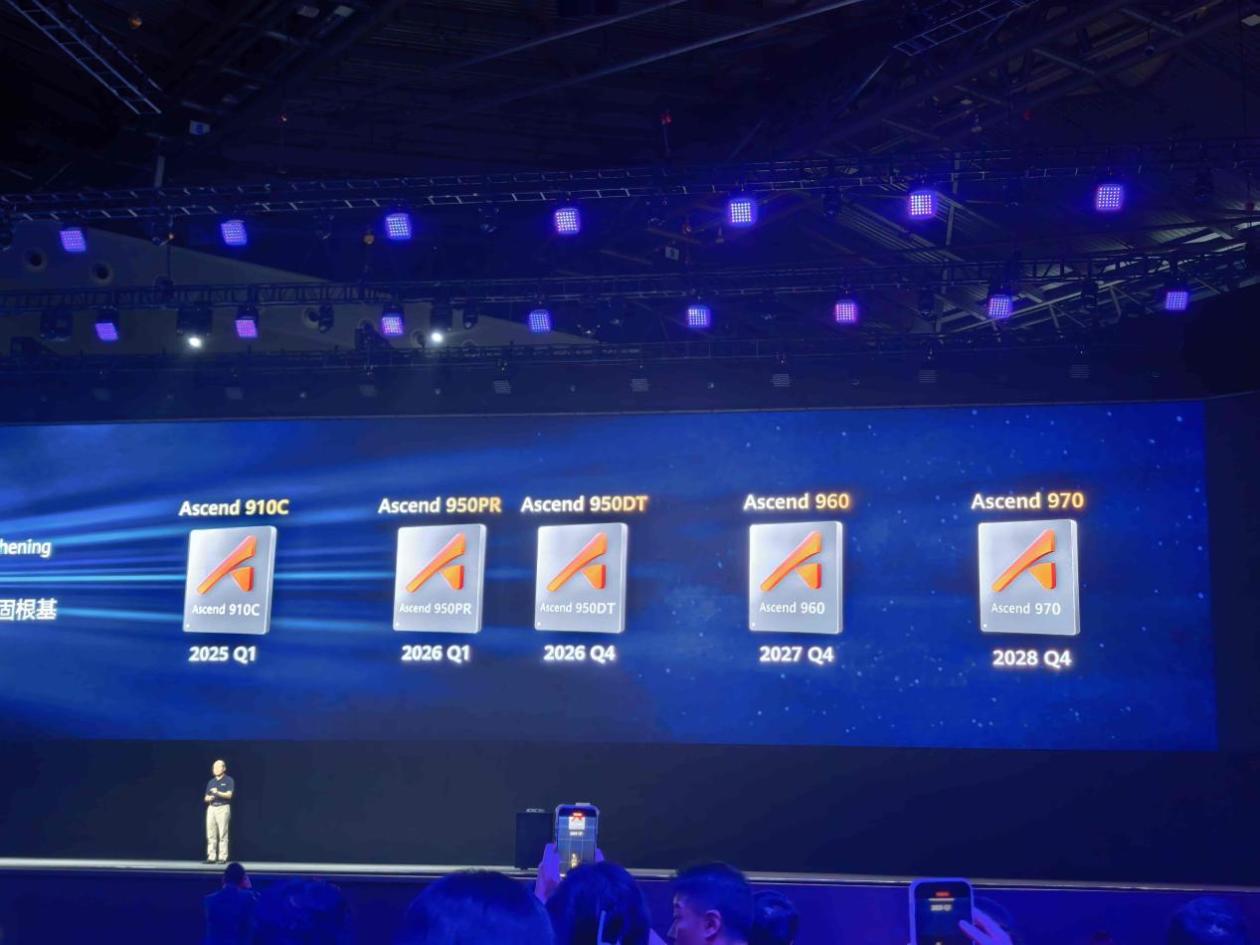
Core Insights - Huawei's rotating chairman Xu Zhijun delivered a keynote speech at the All-Connect Conference, unveiling the evolution roadmap of the Ascend chip and the Lingqu 2.0 technology specifications for ultra-node interconnection [1][3] Group 1: Ascend Chip Development - Over the next three years, Huawei plans to develop three series of Ascend chips: Ascend 950 series, including Ascend 950PR and Ascend 950DT, with launches scheduled for Q1 2026 and Q4 2026 respectively, followed by Ascend 960 in Q4 2027 and Ascend 970 in Q4 2028 [3] - The Ascend chips will enable Huawei to create computing solutions that meet customer demands, with ultra-nodes becoming the dominant product form in AI infrastructure [3] Group 2: Ultra-node Deployment - Since the launch of the Atlas 900 ultra-node in March, Huawei has deployed over 300 units, serving more than 20 clients across various industries, making it the largest ultra-node in the world [3] - The planned ultra-nodes based on future Ascend chips, Atlas 950 and 960, will support 8192 and 15488 computing cards respectively, achieving computing power of 8 EFLOPS and 30 EFLOPS, significantly surpassing NVIDIA's planned products [5] Group 3: Interconnection Technology - To address the technical challenges of large-scale ultra-nodes, Huawei has introduced high-reliability mechanisms at every layer of the interconnection protocol, enhancing optical interconnection reliability by 100 times [5] - The company has developed the ultra-node interconnection protocol architecture, Lingqu, to meet the requirements of large-scale ultra-nodes [5][7] Group 4: Lingqu 2.0 Specifications - Xu Zhijun announced the opening of the Lingqu 2.0 technology specifications, which include UnifiedBus 2.0 protocol and various firmware and OS reference designs [8][9][10]