
炭化小豆

Search documents
九千年前的炭化小豆(考古中国)
Ren Min Ri Bao· 2025-10-25 22:12
Core Viewpoint - The discovery of carbonized small beans at the Xiaogao site in Shandong, dating back approximately 9,000 years, provides significant evidence of early agricultural practices in East Asia, particularly the integration of legumes into the crop system alongside grains, which predates previous findings in China by 4,000 years [2][3][5]. Group 1: Archaeological Findings - An international team, including researchers from Shandong University and Washington University in St. Louis, published findings in the Proceedings of the National Academy of Sciences, highlighting the importance of the Xiaogao site in understanding the origins of agriculture in northern China [2][3]. - The excavation at Xiaogao involved systematic sampling of 891 flotation samples, leading to the identification of 45 carbonized small beans among 32,000 carbonized plant remains, confirming the presence of a diverse agricultural system [3][4]. - Radiocarbon dating of two small beans revealed ages of 8,985–8,645 cal.BP and 8,032–7,939 cal.BP, marking a significant advancement in the timeline of legume domestication in the region [3][4]. Group 2: Agricultural Practices and Implications - The findings indicate that 9,000 years ago, the lower Yellow River region had already developed an early "grain + legume" agricultural system, showcasing the nutritional and ecological benefits of combining these crops [3][4]. - The presence of small beans alongside other crops like millet and soybeans suggests an early understanding of sustainable agricultural practices, which improved soil fertility and provided essential protein [3][4]. - The research emphasizes the need to reassess the role of food diversity in human civilization and the importance of legumes in sustainable agricultural development [4][6]. Group 3: Collaborative Research Efforts - The success of this research is attributed to international collaboration among scholars from China, the U.S., Japan, and South Korea, who shared archaeological data from over 40 sites and utilized multidisciplinary techniques [6]. - The study of small bean domestication reflects a broader global issue, highlighting the necessity of cross-regional and interdisciplinary cooperation to understand the dynamics of agricultural evolution [6].

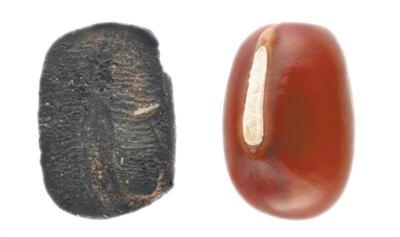
山东淄博发现9000年前炭化小豆 比秦始皇早近7000年
Mei Ri Jing Ji Xin Wen· 2025-10-11 22:38
Core Insights - The archaeological discovery at the Xiaogao site in Shandong, China, revealed charred small beans (adzuki beans) dating back 9,000 years, which is 4,000 years earlier than previous similar findings in China [1][3] - This finding indicates that a dry farming system based on "grains + legumes" was established in the lower Yellow River region 9,000 years ago, providing groundbreaking evidence for the study of agricultural origins in East Asia [1][3] Group 1 - The Xiaogao site, a typical post-Li culture site, has revealed rich remains including house sites, ash pits, pottery, and stone grinding plates, dating from 9,000 to 7,500 years ago [3] - A systematic analysis of 891 flotation samples identified 30,000 charred plant grains, including millet, foxtail millet, rice, soybeans, and small beans, with 45 charred small beans being particularly significant as the earliest evidence of small beans in the Yellow River basin [3] - The discovery highlights that 9,000 years ago, the lower Yellow River had already developed a complex agricultural system combining grains and legumes, showcasing the ecological wisdom of early farmers in crop combination [3] Group 2 - Professor Lang Jianfeng from Shandong University noted that the domestication of small beans in East Asia is a long-term, multi-centered complex process [5] - The research team compared small bean remains from over 140 sites in East Asia and found distinct evolutionary trajectories in the Yellow River basin, Japan, and the Korean Peninsula [5] - The small beans from the Xiaogao site measured only 5.8 cubic millimeters, significantly smaller than modern wild varieties, indicating an early "primitive form" of domestication, with significant size increase in Chinese small beans occurring 4,000 years later [5]
