
牛肉零食

Search documents
牛肉涨价,第一批“倒下”的会是谁?
Tai Mei Ti A P P· 2026-01-08 03:06
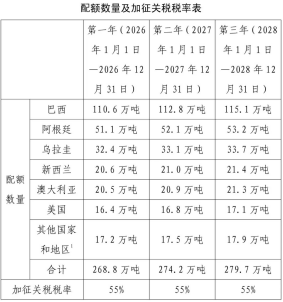
Core Viewpoint - The Chinese Ministry of Commerce has announced a safeguard measure for imported beef, implementing country-specific quotas and an additional 55% tariff on imports exceeding these quotas starting January 1, 2026, for a duration of three years [1][2]. Group 1: Import Quotas and Tariffs - The new regulation signifies the end of unlimited supply for imported beef, which currently accounts for 30% of China's beef consumption, leading to a more complex and stratified beef market [2]. - The quota distribution for 2026 includes Brazil at 1.106 million tons, Argentina at 511,000 tons, Uruguay at 324,000 tons, and Australia and New Zealand at approximately 200,000 tons each, totaling about 2.688 million tons [3][4]. Group 2: Market Reactions and Price Changes - Following the announcement, traders have begun stockpiling beef, resulting in price increases of 2-3 yuan per pound for imported beef in Shanghai [3]. - The quota for imported beef is expected to be exhausted by mid-2026, as the import volume has already exceeded the total quota for that year [5]. Group 3: Impact on the Restaurant Industry - The increase in beef prices will challenge restaurants that rely heavily on beef as a core ingredient, forcing them to reconsider their cost structures and sourcing strategies [6]. - The shift in supply dynamics may lead to a market segmentation where price-sensitive restaurants may opt for alternative proteins, while premium brands focus on high-quality beef supply chains [8]. Group 4: Long-term Industry Adjustments - The safeguard measures are seen as an opportunity for domestic beef producers to enhance their capabilities and innovate, as reliance on imports becomes less viable [9]. - Companies are expected to adapt by improving supply chain resilience and focusing on product innovation to meet changing consumer demands for quality and sustainability [10]. Group 5: Future Market Dynamics - The next three years will likely see a more layered and complex beef consumption landscape, influenced by consumer acceptance, corporate adaptability, and industry upgrades [11].

2025年牛肉零食品牌推荐:秘制卤香,嚼出草原风味
Tou Bao Yan Jiu Yuan· 2025-08-11 14:58
Investment Rating - The report does not explicitly state an investment rating for the beef snack industry Core Insights - The beef snack industry is experiencing significant growth driven by increasing consumer health awareness and dietary structure optimization, with the market expected to reach CNY 26.67 billion by 2024 and CNY 30.7 billion by 2029, reflecting a compound annual growth rate of 2.86% [8][9] - The industry has evolved through four stages: industrialization, standardization, rapid development, and maturity, with current trends focusing on health, gifting, and scenario-based consumption [7][26] - The market is characterized by high competition, with leading brands leveraging quality beef sourcing and innovative production techniques to capture market share [14][15] Market Background - The beef snack industry primarily uses beef as the main ingredient, processed through various methods to create protein-rich, convenient snacks that cater to diverse consumer preferences [5][6] - The industry has seen a shift towards healthier, low-sugar, and low-sodium products, with over 40% of offerings meeting these criteria [7] Market Status Market Size - The market size for beef snacks in China is projected to reach CNY 26.67 billion in 2024, driven by a growing demand for high-protein, low-fat products [8] - Per capita beef consumption in China reached 7.04 kg in 2022, a 53.7% increase from 2012, indicating a shift in meat consumption patterns [8] Market Supply and Demand - Producers are increasingly focusing on cultural elements in branding and packaging to differentiate their products in a competitive market [9] - The number of retail snack stores in China has surged from 13,000 in 2022 to 22,000 in 2023, with projections of reaching 45,000 by 2025, indicating robust market growth [11] Market Competition Market Assessment Dimensions - Key competitive factors include raw material selection, processing technology, brand recognition, and channel penetration [12][13] - Leading brands are utilizing advanced production techniques and maintaining stable supply chains to enhance profitability [13] Market Competition Landscape - The beef snack market is highly concentrated, with top companies like 科尔沁 leveraging superior beef sourcing to maintain a competitive edge [14] - Future growth for leading brands will be driven by effective channel management and market positioning [15] Top Brand Recommendations - Notable brands include 张飞牛肉, 科尔沁, and 蒙都, each with unique technological innovations and market strategies that cater to consumer preferences [16][17][18] Development Trends - The beef snack industry is expected to evolve towards diversification and premiumization, with products increasingly tailored for specific consumption scenarios [26] - Online sales channels are projected to contribute over 55% of market growth, while offline experiences are also expanding [26]