特斯拉自动驾驶系统

Search documents
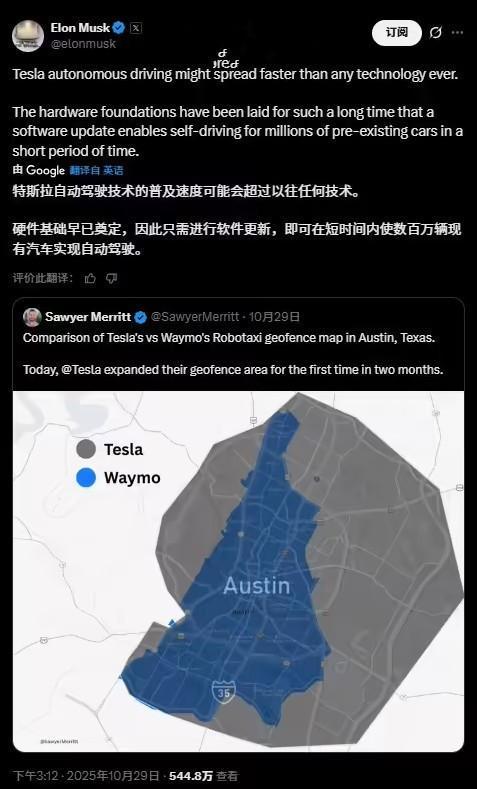
马斯克称:特斯拉自动驾驶系统有望成史上普及最快技术
Huan Qiu Wang Zi Xun· 2025-10-30 07:03
Core Insights - Tesla's CEO Elon Musk expressed optimism about the rapid adoption of its autonomous driving technology, predicting it could become the fastest adopted technology in human history [1] - Musk's comments were in response to a comparison made by industry observer Sawyer Merritt, highlighting Tesla's Robotaxi network's geographical coverage compared to Waymo's autonomous driving service [1] - Tesla's existing hardware allows for software updates to unlock autonomous driving capabilities for millions of vehicles without significant hardware modifications, facilitating rapid deployment [1] Summary by Sections - **Robotaxi Deployment**: Tesla is transitioning its Robotaxi plans into reality, having deployed an "Unsupervised FSD" system in Austin and the San Francisco Bay Area, although safety drivers are still required for monitoring [2] - **Service Area Expansion**: Tesla expanded its Robotaxi service area in Austin to 243 square miles (approximately 629.4 square kilometers), nearly tripling the coverage from two months ago, while Waymo's service area remains at about 90 square miles [4] - **Competitive Landscape**: The competition in the autonomous driving sector is shifting from achieving technological breakthroughs to scaling deployment quickly, with Tesla demonstrating a clear intent to dominate the market [4]


谷歌:Waymo 有望在 2040 年实现巨大发展,耐心终将回报
美股研究社· 2025-07-02 11:39
Core Viewpoint - Google's Waymo has significant long-term growth potential, with estimates suggesting a valuation of $500 billion by 2040, despite current losses and market uncertainties [1][6]. Group 1: Waymo's Current Status and Future Projections - Waymo is currently providing approximately 250,000 rides per week, but is not expected to break even until around 2030 [3]. - In a bullish scenario for 2030, Waymo's valuation could reach $200 billion, representing about 5% of Google's projected market cap of nearly $4 trillion [1][5]. - By 2040, Waymo could contribute around 10% or more to Google's total valuation, which may reach $5 trillion [1][8]. Group 2: Competitive Landscape - Waymo's technology combines lidar, radar, cameras, and high-definition maps, but its cost per vehicle is significantly higher than Tesla's, which could impact its competitive edge [2]. - Tesla's autonomous driving system is currently more cost-effective and has a larger dataset for training, which may give it a profitability advantage once scaled [2][7]. - Other competitors like Amazon's Zoox and Baidu's Apollo are also in the race, with Apollo likely to dominate the domestic market in China [2]. Group 3: Financial Outlook and Market Dynamics - Waymo's revenue is projected to reach $5 billion by 2030, with a potential for $50 billion by 2040, driven by ride-hailing and autonomous freight services [5][6]. - The operational profit margin for Waymo could reach around 40%, aligning with other software-driven businesses [3]. - The growth of autonomous vehicles is expected to be supported by government policies aimed at boosting GDP, which may facilitate Waymo's expansion [6]. Group 4: Investment Considerations - Investing in Google should consider Waymo as a high-growth potential asset, despite the competitive challenges it faces [8]. - Google's stock may not currently offer high returns, but its resilience makes it a valuable addition to certain investment portfolios [8]. - The autonomous vehicle market is anticipated to grow exponentially over the next few decades, positioning Waymo as a promising venture within Google's broader business strategy [8].