特斯拉FSD(完全自动驾驶)

Search documents
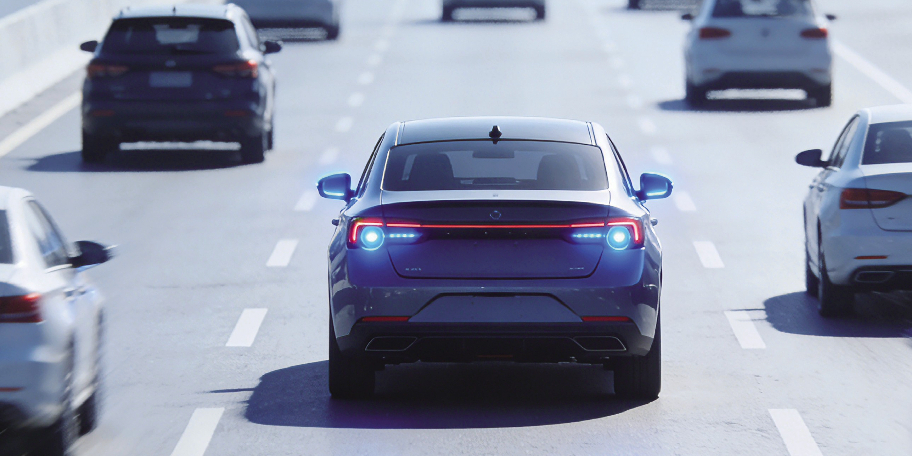
智驾“小蓝灯”的高速奇遇:被别车、被调戏、被当“瘟神”
Jing Ji Guan Cha Wang· 2026-02-28 03:37
Core Insights - The increase in vehicles with "blue lights" indicates a growing adoption of intelligent driving features, particularly the city NOA (Navigation Assisted Driving) function, which is projected to reach approximately 2.67 million units sold in 2025, representing a market penetration rate of 11.6% [3] - The rise in usage of intelligent driving systems has led to mixed feelings among drivers, with some appreciating the technology while others express concerns about safety and reliability [4][6] Group 1: Market Trends - The sales of vehicles equipped with city NOA are expected to reach around 2.67 million units in 2025, with a total projected sales of 3.3 million units when including Tesla's FSD and other models [3] - Huawei reported that its intelligent driving system accumulated over 470 million kilometers during the Spring Festival, with an average of 382 kilometers per user and a 180% increase in active users compared to the previous year [3] Group 2: User Experiences - Drivers have varied perceptions of "blue light" vehicles, categorized into three groups: the "suspicious" who avoid them, the "rule-followers" who appreciate their adherence to traffic rules, and the "provocateurs" who test the systems [6][7] - Some drivers have reported negative experiences with their intelligent driving systems, including erratic behavior and safety concerns, leading to a lack of trust in the technology [10][11] Group 3: Industry Challenges - The current state of intelligent driving technology is still in its early development phase, with significant differences in driving styles and capabilities among various manufacturers [12] - Regulatory bodies are beginning to implement standards to address the inconsistencies in intelligent driving systems, with new regulations expected to take effect by 2027 [13] Group 4: Future Outlook - As the industry progresses towards higher levels of automation, there is optimism that intelligent driving systems will become more reliable and user-friendly, reducing the negative experiences associated with current technologies [14]

智驾价格“打下去”:车企密集“亮剑”,下探到6万元车型
Bei Ke Cai Jing· 2025-03-25 09:31
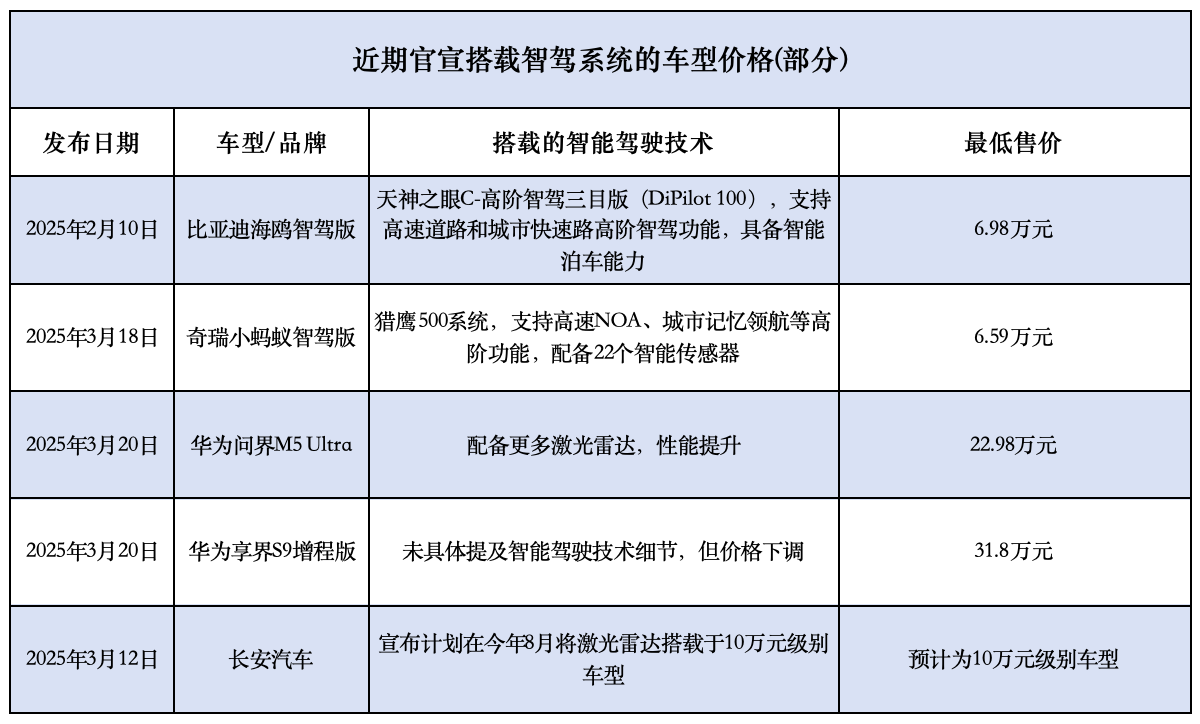
Core Viewpoint - The automotive industry is experiencing a fierce competition in the smart driving sector, with companies like BYD and Chery introducing advanced driving technologies at increasingly lower price points, marking a significant shift in market dynamics [1][4][6]. Group 1: Price and Technology Competition - BYD has introduced its high-end smart driving system in models priced at 69,800 yuan, while Chery has followed suit by offering smart driving features in models starting at 65,900 yuan [3][4]. - Multiple companies, including Huawei, Chery, and GAC, have recently held smart driving technology launch events, emphasizing a strategy of "no lowest, only lower" pricing [2][6]. - The introduction of smart driving technology in lower-priced models is seen as a "dimensionality reduction strike," significantly lowering the entry barrier for consumers [6]. Group 2: Features and Specifications - Chery's new model, the small ant smart version, is equipped with 22 intelligent sensors and supports 23 smart driving functions, including automatic parking and high-speed navigation [5][6]. - The BYD Seagull model features the "Tian Shen Eye" high-end smart driving system, which is the first of its kind in a vehicle priced under 70,000 yuan [7]. Group 3: Market Trends and Predictions - The competition is expected to intensify as more automakers, like Changan, plan to introduce smart driving features in models priced at 100,000 yuan and below [8]. - Analysts suggest that the increasing maturity of sensor technologies, such as millimeter-wave and ultrasonic radars, is driving down the costs of smart driving systems, making them more accessible [9][10]. - The penetration rate of L2 and above smart driving new cars is projected to exceed 60% by 2025, with L3 level vehicles accounting for 8.5% of the market [22].