
特高压输电网络

Search documents
中国人均电力超欧洲30%的数据,马斯克转发,只甩了句“人们不理解”,这话里的意味可太足了!那个被马斯克随手转发的图表,不仅仅是一条显示中国人均用电量超过欧洲30%的简单曲线,更像是一道划破旧认知的闪电。马斯克对此只有短短四个字的评语:“人们不理解”。这句简短的感叹其实非常有嚼头...
Sou Hu Cai Jing· 2025-12-23 01:48
Core Insights - The article highlights that China's per capita electricity consumption exceeds that of Europe by 30%, challenging Western perceptions of energy consumption and industrial capabilities [1][2]. Group 1: China's Energy Landscape - China's per capita electricity consumption has doubled, showcasing a significant advancement in its industrial capacity and energy consumption compared to Europe [2][5]. - The increase in electricity consumption is attributed to the growth of various sectors, including data centers, urban transportation networks, and the electric vehicle industry, which are major consumers of electricity [2][5]. Group 2: European Energy Challenges - Europe, particularly Germany, faces high and unpredictable industrial electricity prices, with rates reaching €0.22 per kWh, nearly three times that of China [3][4]. - The volatility in energy prices in Europe has led to significant industrial withdrawals, with companies like BASF and Trinity relocating operations to countries like India due to lower energy costs [3][4]. Group 3: Infrastructure and Technological Advancements - China's robust energy infrastructure, including a high-capacity transmission network, allows for efficient energy distribution from renewable sources across vast distances, contrasting with Europe's fragmented energy grid [4][5]. - International companies, including Total and Siemens, are investing in China to leverage its advanced energy technology and stable energy supply for their operations [5]. Group 4: Perceptions and Future Implications - Elon Musk's comment "people do not understand" reflects a critique of Western arrogance and a recognition of China's emerging status as a leader in energy technology [2][5]. - The article suggests that the narrative of China's industrial inferiority is outdated, as evidenced by its advancements in renewable energy and electric vehicles, which are becoming global benchmarks [5].


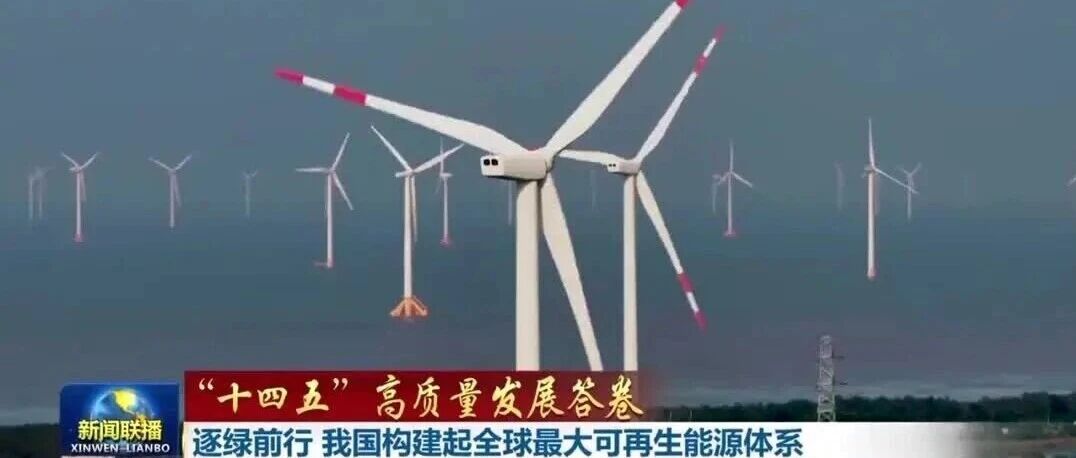
新闻联播︱“十四五”高质量发展答卷 逐绿前行 我国构建起全球最大可再生能源体系
国家能源局· 2025-10-20 23:08
Core Viewpoint - China is undergoing a significant transformation in its energy production and consumption patterns, focusing on green energy development and achieving substantial progress in renewable energy generation since the "14th Five-Year Plan" [2][5]. Group 1: Renewable Energy Development - The transformation of barren deserts and wastelands into vast power generation fields illustrates China's commitment to green energy [2]. - The annual electricity generation from solar power in a specific area is equivalent to replacing 560,000 tons of coal [3]. - China generates over 10 trillion kilowatt-hours of electricity annually, accounting for one-third of global electricity production, with one-third of this coming from renewable sources [4]. Group 2: Infrastructure and Capacity Expansion - The construction of six large hydropower stations along the Yangtze River forms the world's largest clean energy corridor [5]. - The "14th Five-Year Plan" includes nine major clean energy bases, with seven located in western regions, highlighting the geographical focus of renewable energy development [5]. - The total area of newly added solar panels over five years could cover 530,000 football fields, and the length of newly added wind turbine blades could stretch from the easternmost to the westernmost points of China and back [5]. Group 3: Energy Transmission and Storage - The establishment of 19 ultra-high voltage transmission lines over five years has created a super network for electricity delivery, increasing the cross-regional transmission of clean energy by 70% [5]. - Renewable energy from the west now supports one-fifth of the electricity demand in the eastern and central regions [5]. - New energy storage technologies, such as gravity storage and compressed air, have been introduced in the "Five-Year Plan," playing a crucial role in managing peak electricity demand [5]. Group 4: Achievements and Goals - China has built the world's largest and most complete renewable energy industry chain, achieving the target of 20% non-fossil energy consumption as set in the "14th Five-Year Plan" [5].
打通能源动脉 点亮万家灯火 央企谱写能源转型“中国方案”
Zhong Guo Zheng Quan Bao· 2025-10-15 22:25
Core Insights - Central enterprises in China are actively participating in the energy transition, contributing to the construction of a green energy network that supports high-quality economic development [1][11] - The "Ningdian into Xiang" project is a key initiative under the national "14th Five-Year Plan," facilitating the transmission of green electricity from Ningxia to Hunan [2][4] - Major energy projects across the country are being developed, including the integration of wind, solar, and thermal energy in Gansu and Xinjiang, enhancing energy supply capabilities in various regions [3][4] Group 1: Energy Infrastructure Development - The Ningxia Tengger Desert solar power base has delivered over 900 million kilowatt-hours of green electricity to Hunan as of September 25, 2023 [2] - The "electricity highway" can transmit over 36 billion kilowatt-hours of green energy annually, significantly alleviating power shortages in Hunan [2] - The construction of multiple energy corridors is underway, including the Huaneng Longdong Energy Base and the China Three Gorges Corporation's hydropower stations, which will enhance energy supply to various provinces [3][4] Group 2: Technological Innovations - Central enterprises are driving technological advancements, such as the development of a 26-megawatt offshore wind turbine by Dongfang Electric Group, setting new global records [5][6] - The turbine's components are fully sourced from domestic suppliers, ensuring a self-sufficient supply chain [6] - Breakthroughs in core technologies, such as laser-etched silicon steel and digital control systems for nuclear power plants, are enhancing energy efficiency and safety [7][8] Group 3: Impact on Daily Life - The expansion of charging infrastructure for electric vehicles is transforming urban energy consumption patterns, with Beijing Petroleum operating 114 charging stations [9][10] - The Southern Power Grid has established over 15,700 charging stations, achieving full coverage in rural areas [10] - Various projects, such as the photovoltaic power station in Sichuan, are integrating renewable energy with local industries, providing sustainable income for communities [10]