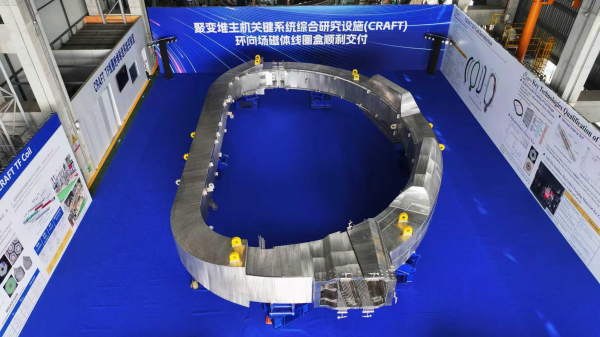
环向场磁体线圈盒

Search documents
中国科学力量再迎突破,未来能源或迎曙光
Sou Hu Cai Jing· 2025-10-13 16:20
Core Viewpoint - The successful development and delivery of the toroidal field magnet coil box marks a significant milestone in China's nuclear fusion research, indicating a potential pathway towards the commercialization of fusion energy [1][3]. Group 1: Technological Advancements - The toroidal field magnet coil box, weighing 400 tons and measuring 21m x 12m, is the largest of its kind globally, surpassing similar components in the ITER project by 1.2 times in size and double in weight [3]. - The development process took over five years, overcoming numerous technical challenges, showcasing China's growing technological innovation and research capabilities in this field [3][5]. - This breakthrough signifies a shift from China being a technology follower to a technology leader in nuclear fusion, reflecting the dedication of countless researchers and experts [3][5]. Group 2: Global Energy Landscape - China's advancements in nuclear fusion technology may reshape the global energy landscape, potentially altering the dynamics of energy competition worldwide [5]. - The success in fusion energy research is seen as a pivotal moment that could lead to a fundamental change in global energy structures over the coming decades [6][8]. - The emergence of China in this domain suggests a reconfiguration of global scientific power, moving away from the traditional dominance of Western nations [5][6]. Group 3: Future Implications - While the delivery of the toroidal field magnet coil box is a significant step, achieving self-sustaining energy output and practical applications still faces numerous technical challenges [5]. - The ongoing pursuit of fusion energy is viewed as a revolutionary solution to global warming and a means to reduce dependence on fossil fuels [6][8]. - The integration of fusion energy into educational curricula may become commonplace, reflecting its potential as a key energy source for future generations [8].

城记 | 一周聚焦:抢抓新兴赛道,长三角未来产业布局“快马加鞭”
Xin Hua Cai Jing· 2025-10-11 09:25
Core Insights - The article emphasizes the importance of cultivating "future industries" as a strategic pivot for leading technological innovation and reshaping industrial patterns, particularly in the context of the ongoing technological revolution and industrial transformation [1] Group 1: Future Industries Development - The Yangtze River Delta region has emerged as a leader in technological innovation in China over the past decade, with a collaborative development model among the three provinces and one city laying a unique foundation for future industry cultivation [1] - Shanghai has introduced several measures to accelerate the innovation of frontier technologies and the cultivation of future industries, aiming to establish itself as a globally influential hub for future industries [5][6] Group 2: Key Technological Advancements - The successful delivery of the ring-shaped magnetic coil box for the CRAFT project marks a significant step towards the commercialization of fusion energy, with the component being the largest of its kind globally, measuring 21m x 12m and weighing 400 tons [2] - The launch of the Kexin Computing Power Scheduling Platform in Wuxi, which manages approximately 7000P of operational computing resources, aims to provide standardized and efficient computing power services to enterprises [3][4] Group 3: Strategic Initiatives and Goals - Shanghai's "Several Measures" aim to systematically and proactively cultivate future industries, targeting the establishment of around 20 leading enterprises in future industry ecosystems by 2027 and fostering several strategic emerging industries by 2030 [6] - The focus areas for development include future manufacturing, information, materials, energy, space, and health, with specific support for technologies such as brain-computer interfaces, quantum computing, and 6G [6]
世界最大环向场磁体线圈盒在安徽合肥交付
Ke Ji Ri Bao· 2025-10-11 03:19
Group 1 - The CRAFT project has achieved significant progress with the successful development and delivery of the toroidal field magnet coil box in Hefei, Anhui Province, marking a key milestone in fusion energy commercialization [1][2] - The toroidal field coil box, measuring 21 meters by 12 meters and weighing 400 tons, is the largest of its kind in the world, exceeding the dimensions of similar components in the ITER project by more than 1.2 times and weighing approximately twice as much [1] - The project team overcame multiple technical challenges over more than five years, including the domestic production of low-temperature stainless steel 316LMn and the development of large-scale forging and thick steel plate manufacturing techniques [1] Group 2 - The successful delivery of the toroidal field coil box is a significant step towards the commercialization of fusion energy, with potential applications in aerospace, energy equipment, and marine engineering [2]
世界最大,正式交付!攻克多项关键技术
Huan Qiu Wang Zi Xun· 2025-10-11 01:52
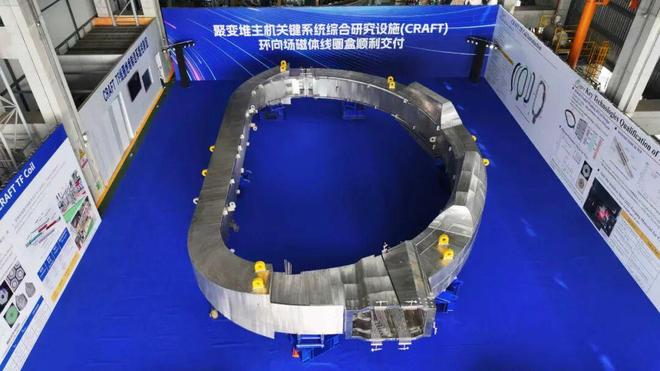
Core Insights - The CRAFT project has achieved significant progress with the successful development and delivery of the toroidal field magnet coil box in Hefei, Anhui Province, marking an important step towards the commercialization of fusion energy [1][3] Group 1: Project Details - The toroidal field coil box is a critical structural component of the toroidal field magnet system, designed to protect the winding of the toroidal field coils and support other superconducting magnets [3] - The coil box is constructed from ultra-low temperature austenitic stainless steel 316LN and 316LMn, measuring 21 meters by 12 meters and weighing 400 tons, making it the largest of its kind in the world [3] - The overall dimensions of the coil box exceed those of similar components in the International Thermonuclear Experimental Reactor (ITER) by more than 1.2 times, and its weight is approximately double that of ITER's equivalent [3] Group 2: Development Timeline and Applications - The project team took over 5 years to overcome multiple key technical challenges from research to manufacturing completion [3] - The successful delivery of the toroidal field coil box represents a significant advancement in fusion energy commercialization, with potential applications in aerospace, energy equipment, and marine engineering [3]
【科技日报】世界最大环向场磁体线圈盒在安徽合肥交付
Ke Ji Ri Bao· 2025-10-11 01:41
Core Insights - The successful delivery of the toroidal field coil box marks a significant step towards the commercialization of fusion energy [2] - The technology developed for the coil box has potential applications in aerospace, energy equipment, and marine engineering sectors [2] Group 1: Project Development - The toroidal field coil box, measuring 21 meters by 12 meters and weighing 400 tons, is the largest of its kind in the world, exceeding the dimensions of similar components in the International Thermonuclear Experimental Reactor (ITER) by more than 1.2 times and weighing about twice as much [1] - The project team took over 5 years to overcome multiple key technical challenges, including the domestication of low-temperature stainless steel 316LMn and the development of large-scale 316LN forgings and ultra-thick steel plates [1] - Advanced manufacturing techniques were developed, such as a combination of laser welding for thick materials and phased array non-destructive testing, to ensure the precision of the coil box welding [1] Group 2: Material and Technology Innovations - The coil box is constructed from ultra-low temperature austenitic stainless steel 316LN and 316LMn materials, showcasing advancements in material science for fusion applications [1] - Precision forming technology for 30-meter-long cooling pipes and the use of low-temperature resin with brazing for pipe installation were also developed, enhancing the overall assembly process [1]