玻尔兹曼机

Search documents
我和辛顿一起发明了复杂神经网络,但它现在需要升级
3 6 Ke· 2025-12-14 23:26
Group 1 - The core idea of the article revolves around the evolution of AI, particularly the contributions of Terrence Sejnowski and Geoffrey Hinton, highlighting the significance of the Boltzmann machine in modern deep learning [1][19] - Sejnowski emphasizes that while AI technology has advanced rapidly, a true understanding of intelligence may require generations of research and patience [6][22] - The conversation touches on the limitations of current AI models, such as ChatGPT, which lack essential components of human cognition, including memory and self-generated thought processes [3][21][38] Group 2 - Sejnowski argues that the current AI models primarily simulate a small part of brain function, specifically the cerebral cortex, and miss out on critical structures like the basal ganglia and hippocampus [4][26][40] - The discussion highlights the need for AI to integrate both cognitive and reinforcement learning, akin to human development, to achieve a more holistic understanding of intelligence [27][28] - The article suggests that understanding the mechanisms of intelligence in various species could lead to a more comprehensive theory of knowledge and understanding, rather than solely focusing on replicating human brain functions [51][52]
AI教父Hinton诺奖演讲首登顶刊,拒绝公式,让全场秒懂「玻尔兹曼机」
3 6 Ke· 2025-09-03 11:29
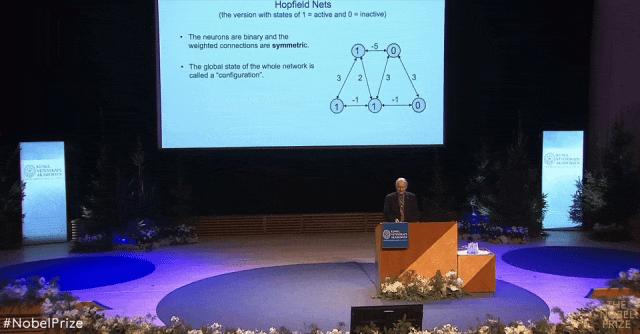
Core Insights - Geoffrey Hinton, Nobel Prize winner in Physics, delivered a lecture titled "Boltzmann Machines" on December 8, 2024, at Stockholm University, focusing on the evolution of neural networks and machine learning [1] - The lecture emphasized the significance of the Boltzmann machine, a learning algorithm that has faded from use compared to the backpropagation algorithm, which is now central to deep learning [3] Group 1: Boltzmann Machines and Neural Networks - Hinton humorously aimed to explain complex technical concepts without using formulas, starting with the Hopfield Network, which consists of binary neurons connected symmetrically [3][6] - The global state of the neural network is referred to as a "configuration," with its "goodness" determined by the sum of weights of active neurons, where energy represents "badness" [5][6] - The Hopfield Network's appeal lies in its ability to associate energy minima with memory, allowing the network to complete partial memory inputs through binary decision rules [11][12] Group 2: Applications and Innovations - Hinton and Terrence Sejnowski innovatively applied the Hopfield Network to interpret sensory inputs, moving beyond mere memory storage [13][14] - They designed a network to convert image lines into activation states of "line neurons," which connect to "3D edge neurons" to ensure only one interpretation is activated at a time [23] - The network's ability to handle ambiguous visual information, such as the Necker cube, illustrates its complexity in processing visual data [19][21] Group 3: Learning Mechanisms - The Boltzmann distribution and machine learning principles suggest that the network approaches "thermal equilibrium," where low-energy states (better interpretations) are more probable [29][31] - Hinton introduced the Boltzmann machine learning algorithm in 1983, which operates in two phases: a waking phase presenting real images and a sleeping phase allowing the network to "dream" [36][38] - The learning process aims to minimize energy configurations derived from real data while maximizing those generated during the dreaming phase [40] Group 4: Restricted Boltzmann Machines (RBM) - Hinton later developed the Restricted Boltzmann Machine (RBM) to accelerate learning by simplifying the waking phase calculations [44][46] - The RBM has been successfully applied in practical scenarios, such as Netflix's movie recommendation system, demonstrating its effectiveness in user preference prediction [50] - The stacking of RBMs creates a hierarchical feature structure, enhancing learning speed and generalization capabilities [55] Group 5: Historical Context and Future Directions - Hinton likened the Boltzmann machine to an "enzyme" in chemistry, catalyzing breakthroughs in deep learning, but eventually becoming less necessary as new methods emerged [58] - He believes that understanding the brain's learning processes, particularly the role of "unlearning" during sleep, will be crucial for future advancements in artificial intelligence [59]

意识在哪儿?
3 6 Ke· 2025-05-06 04:04
Group 1 - The concept of the Boltzmann Brain suggests that in an infinitely old and chaotic universe, random fluctuations could create a brain with complete memories and self-awareness without the need for a complex external world [1][2][3] - The probability of a Boltzmann Brain existing is argued to be higher than that of a low-entropy universe evolving into a complex structure, as the latter requires overcoming significant entropy increase [2][3] - This leads to the unsettling conclusion that human existence might be a fleeting phenomenon resulting from a random quantum fluctuation, challenging fundamental perceptions of reality [5][6] Group 2 - The discussion contrasts the Boltzmann Brain with Laplace's Demon, which represents determinism, suggesting that all thoughts and feelings are predetermined by physical laws [11][12] - Both perspectives imply that free will does not exist, whether through extreme randomness or absolute determinism [12][18] - Kant's philosophy attempts to reconcile these views by suggesting that true freedom exists beyond observable reality, yet this remains a scientific mystery [18][19] Group 3 - The insights from Boltzmann and Darwin regarding how order emerges from disorder provide a different perspective on evolution and consciousness [19][20] - Boltzmann's view redefines survival competition as a struggle for "negative entropy," indicating that life extracts order from its environment to maintain complexity [20] - This suggests that consciousness may be a product of evolutionary processes aimed at better perceiving the world and utilizing resources effectively [21][22] Group 4 - The exploration of consciousness requires a multidisciplinary approach, incorporating insights from cognitive science, philosophy, and neuroscience [40][42] - Various theories, such as Hofstadter's "strange loop," Turing's computationalism, and integrated information theory (IIT), challenge traditional notions of consciousness and its location [42][43][44] - These perspectives indicate that consciousness may not reside in a specific location but rather in the organization and flow of information within a system [46][47] Group 5 - The evolution of AI, particularly through models like the Boltzmann machine, reflects the potential for understanding consciousness through complex information processing [26][31][33] - The Boltzmann machine's design, which incorporates randomness and probabilistic learning, parallels the idea that consciousness may emerge from structured interactions within a chaotic environment [34][38] - This suggests that consciousness could be a result of cumulative processes rather than a singular miraculous event [38][39]