电子墨水屏

Search documents
艰难的“中国版Kindle”,上市前先给股东分了2个亿
Feng Huang Wang· 2026-01-28 06:13
Core Viewpoint - The company Wenshih is challenging Kindle with an open system but is heavily reliant on the monopolistic screen supplier E Ink Technology, revealing concerns over cash flow, performance difficulties, and substantial dividends amid its IPO plans [1] Group 1: Market Dynamics - Following Amazon Kindle's exit from the Chinese market, the electronic paper industry showed unexpected growth, with global electronic paper tablet shipments projected to reach 16.24 million units by Q3 2025, a year-on-year increase of 71.3% [2] - Despite a decline in overall online sales in China by 11.6%, the core e-reader segment saw a significant increase in sales volume by 33.4% and revenue growth of 43.5% to 800 million yuan [2] - Wenshih aims to establish a foothold in overseas markets and submitted its IPO application to the Hong Kong Stock Exchange on January 19, 2026 [2] Group 2: Product Differentiation - Wenshih's BOOXOS system supports multiple formats and third-party applications, distinguishing itself from Kindle's closed ecosystem [3][4] - The company positions itself as a "e-ink tablet" rather than just an e-reader, targeting various use cases in office and education settings [5] - Wenshih has developed proprietary BSR high-refresh technology to enhance user experience, although some users report issues with screen fragility [5][7] Group 3: Supply Chain Dependency - E Ink Technology dominates the global electronic ink market with a market share exceeding 90%, making it a critical supplier for Wenshih [9][10] - Wenshih's procurement from E Ink accounted for 29.1%, 28.1%, and 27.4% of total purchases in 2023, 2024, and the first three quarters of 2025, respectively, indicating a deep dependency [12] - The dual role of E Ink as both supplier and shareholder (owning 4.9% of Wenshih) creates a complex relationship that could pose risks if E Ink alters its supply strategy [12] Group 4: Financial Performance - Wenshih's revenue for 2023, 2024, and the first three quarters of 2025 was 804 million yuan, 1.018 billion yuan, and 799 million yuan, respectively, indicating slow growth [15] - The net profit decreased from 124 million yuan in 2023 to 121 million yuan in 2024, with a further decline of 4.1% to 103 million yuan in the first three quarters of 2025 [15] - The company's cash flow situation worsened significantly, with a net cash flow from operating activities of -41.21 million yuan in the first three quarters of 2025, a drop of over 390% compared to the previous year [15] Group 5: Strategic Challenges - Wenshih faces internal challenges with declining sales of its flagship products, as the sales volume of productivity tablets slightly decreased from 224,000 units in 2023 to 216,000 units in 2024 [16] - The company also contends with external competition from domestic and international brands, including Hanwang and Sony, following Kindle's exit [16] - Despite increased R&D spending, Wenshih has not achieved significant technological breakthroughs, focusing instead on optimizing existing technologies [16] Group 6: Dividend Policy - Wenshih's dividend strategy has raised concerns about its financial health, with total dividends nearing 200 million yuan despite declining profits [19] - The company declared dividends of 10 million yuan in 2023, 90 million yuan in 2024, and 100 million yuan in the first three quarters of 2025, distributing 97% of its net profit for that period [19]


2025年中国电子阅读器行业发展历程、产业链、市场规模、竞争格局及发展趋势研判:数字化阅读普及及便携式阅读设备需求增加,行业市场规模持续增长[图]
Chan Ye Xin Xi Wang· 2025-04-16 01:20
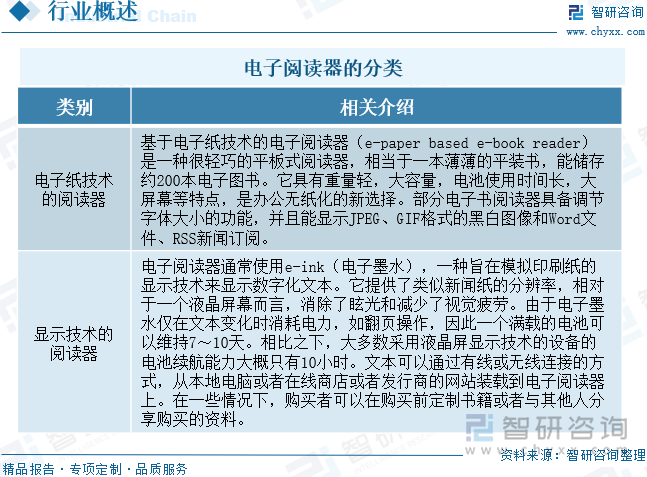
Core Viewpoint - The electronic reader market in China is experiencing stable growth, with a projected market size of approximately 10.066 billion yuan in 2024, driven by innovation from manufacturers and changing consumer reading habits [1][14]. Industry Overview - Electronic readers are portable, low-energy devices designed for displaying digital versions of printed materials, primarily using e-ink technology for a paper-like reading experience [3][4]. - The industry has seen significant advancements since its inception around 2007, with the rise of e-ink technology and the proliferation of smartphones altering reading habits and increasing demand for dedicated reading devices [6][11]. Market Dynamics - The electronic reader market is characterized by a diverse competitive landscape, featuring both international brands like Amazon's Kindle and domestic players such as iReader and Hanvon Technology [17][18]. - The market is supported by a growing digital reading user base, which reached 570 million in 2023, representing a year-on-year growth of 7.53% [13]. Technological Advancements - Recent improvements in e-ink technology have enhanced display quality, energy efficiency, and response times, making electronic readers more appealing for long-term use [24]. - The introduction of new materials and designs has led to lighter and more durable devices, catering to consumer preferences for portability [26]. Consumer Preferences - Consumers are increasingly favoring electronic readers for their portability, customizable reading experiences, and reduced eye strain compared to traditional screens [5][6]. - The market is witnessing a trend towards smart and personalized features, such as intelligent recommendation systems and customizable reading settings [27]. Key Companies - Major players in the electronic reader market include: - **iReader Technology**: Known for its various product lines focusing on light reading and voice features [18]. - **Hanvon Technology**: Offers e-readers that utilize e-ink technology for a comfortable reading experience [19]. - **JDRead**: A product from JD.com featuring a 6-inch e-ink screen and various functionalities [18]. - **Xiaomi**: Launched the Xiaomi Duokan e-reader with advanced display features [18]. - **iFlytek**: Introduced the first color e-reader, expanding the market's offerings [18].