电子阅读器

Search documents
崛起于Kindle废墟之上,文石仍要面对出海硬仗
Hua Er Jie Jian Wen· 2026-02-10 11:56
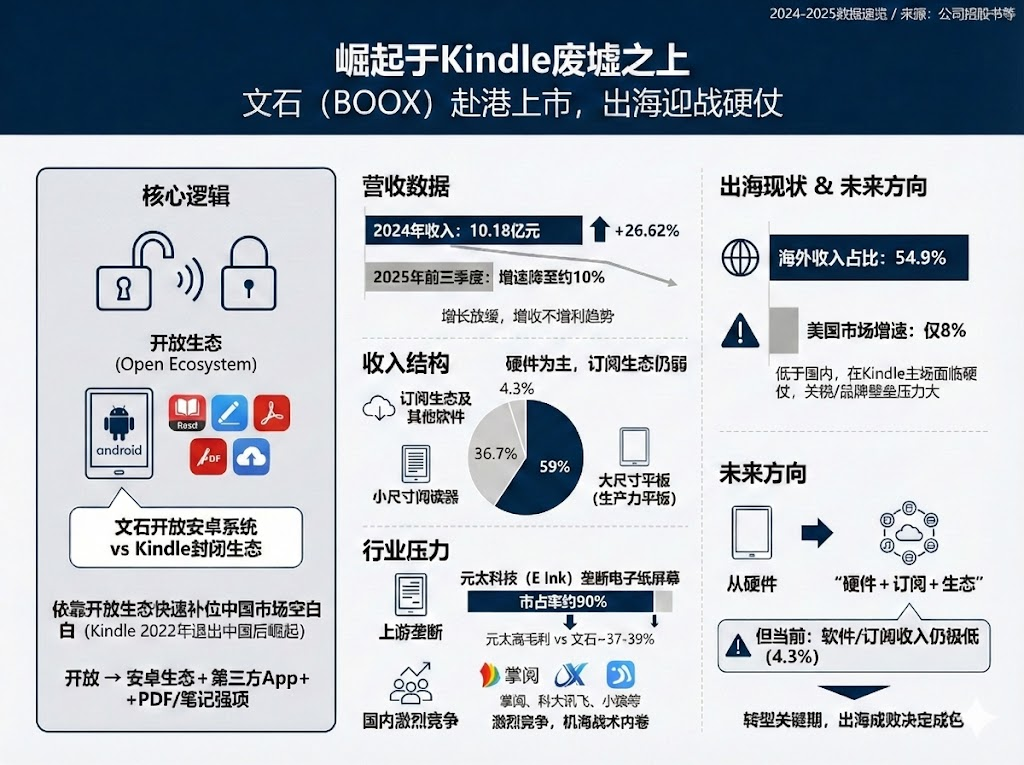
Core Insights - Guangzhou Woxi Technology Co., Ltd. (Woxi) is proving that the e-ink screen business is still viable, as it submits its IPO application to the Hong Kong Stock Exchange after Kindle's exit from the Chinese market [1][6] - Woxi's business model contrasts with Amazon's closed system, focusing on an open system that allows users to download various apps, including WeChat Reading [1][5] - In 2024, Woxi's revenue reached 1.018 billion yuan, a year-on-year increase of 26.62%, capturing a significant market share in the e-ink screen downstream market [1][6] Business Model and Market Position - Woxi's strategy is characterized as "anti-Kindle," emphasizing an open Android ecosystem that supports third-party apps and various file formats, providing a more personalized reading experience [5][6] - The company has released 13 new products in 2024 and plans to launch 9 more in 2025 to keep pace with competitors like iReader [1][6] - Despite capturing part of the market left by Kindle, Woxi faces challenges from competitors and a slow revenue growth rate of about 10% in the first three quarters of 2025, lagging behind the previous year's growth [1][6] Competitive Landscape - The e-ink reader market is competitive, with companies like iReader, iFLYTEK, and Hanvon also vying for market share [6][9] - Woxi claims to be the largest knowledge-focused productivity tool brand in China based on retail revenue, but this position is not firmly established when considering other metrics [7][8] - The market saw 83 new e-paper screen products launched in 2025, with iReader releasing 13 and Woxi releasing 10, indicating intense competition [9] Supply Chain Challenges - Woxi relies heavily on E Ink Holdings for e-paper displays, with procurement from this supplier accounting for 28.1% and 27.4% of total purchases in 2024 and the first three quarters of 2025, respectively [10][11] - E Ink Holdings holds a dominant position in the market, achieving gross and net profit margins of 49.64% and 27.28%, respectively, significantly higher than Woxi's margins [12][13] Growth Strategy and International Expansion - Woxi is transitioning from a hardware-centric model to a more diversified structure that includes hardware, subscriptions, and an ecosystem [16] - The company has developed a note-taking application, StarNote, and plans to open its operating system to attract developers for specialized applications [16][18] - In the first three quarters of 2025, Woxi generated 1.7 billion yuan from Europe, 1.49 billion yuan from the U.S., and 1.17 billion yuan from Asia (excluding China), accounting for 54.9% of total revenue [19] Market Performance - Despite efforts to penetrate the U.S. market, Woxi's revenue growth in this region was only 8% in the first three quarters of 2025, trailing behind domestic growth by over 4 percentage points [21] - Overall, Woxi aims to position itself as a consumer electronics company that can leverage software ecosystems and globalization, similar to Apple, but faces challenges with a revenue growth rate of only 10.31% in the first three quarters of 2025 [22]

年入10亿、全球第二,「中国版Kindle」的故事过气了吗?
36氪· 2026-01-28 01:04
Core Viewpoint - The article discusses the impact of Amazon's Kindle exit from the Chinese market, highlighting the opportunity it presents for domestic players like Guangzhou Wenshi Information Technology Co., Ltd. (Wenshi BOOX) to capture market share and innovate in the e-ink display sector [6][25]. Group 1: Company Overview - Wenshi BOOX submitted its IPO prospectus to the Hong Kong Stock Exchange in January 2026, aiming to tell a "Chinese version of Kindle" success story [6]. - In 2024, Wenshi's revenue reached 1.02 billion yuan, a year-on-year increase of 26.6%, with over 50% of its revenue coming from overseas markets, which grew by 33.8% [8]. - Wenshi has diversified its product offerings beyond pure reading devices, covering sizes from 6 inches to 25.3 inches, with productivity tablets contributing over 50% of its revenue [9]. Group 2: Financial Performance - Despite a 10% revenue increase in the first nine months of 2025, Wenshi's net profit declined by 4% [10]. - The company's sales expenses rose from 9.1% to 13.9%, indicating a need for high marketing investments to compete in a crowded market [10][24]. - Wenshi's adjusted net profits for 2023, 2024, and the first nine months of 2025 were 120 million yuan, 130 million yuan, and 120 million yuan, respectively [23]. Group 3: Market Position and Strategy - The global market for knowledge-focused productivity tools is projected to grow from 10.7 billion yuan in 2020 to 29.1 billion yuan in 2024, with Wenshi being the second-largest globally and the largest in China [26][27]. - Wenshi's strategy includes positioning itself as a "knowledge-focused productivity tool" rather than just a reading device, with three main revenue sources: productivity tablets, high-speed readers, and software services [17][29]. - The company has emphasized AI and ecosystem development in its fundraising efforts, recognizing the need to address its software shortcomings [14][22]. Group 4: Competitive Landscape - The exit of Kindle has led to increased competition in the e-ink market, with various players adopting different strategies, from conservative to aggressive approaches [29]. - Wenshi's competitive advantage lies in its comprehensive product range and global market presence, but it faces challenges in content ecosystem and vertical technology [30][31]. - The supply chain risk is significant, as over 90% of e-paper module production is controlled by a single supplier, E Ink Holdings, which also holds a stake in Wenshi [31].

61岁女老板,干出“中国版kindle“,冲刺IPO
创业邦· 2026-01-21 03:45
Core Viewpoint - The article discusses the upcoming IPO of Guangzhou Wenstone BOOX, a company specializing in digital reading devices, particularly e-readers, and highlights its business model, revenue sources, and market challenges [3][4]. Group 1: Company Overview - Wenstone BOOX submitted its IPO application to the Hong Kong Stock Exchange on January 19, 2026, aiming to raise funds for product development, market expansion, and operational upgrades [3]. - The company generates 60% of its revenue from overseas markets, with nearly 20% coming from the U.S. market [4][22]. - The main products include the BOOX series e-readers, with a focus on productivity tablets, which accounted for 67.7%, 54.9%, and 59% of revenue in 2023, 2024, and 2025 respectively [16][19]. Group 2: Financial Performance - Revenue for Wenstone BOOX was 804 million RMB in 2023, projected to reach 1.018 billion RMB in 2024, and 799 million RMB in the first three quarters of 2025 [19][21]. - Profit figures showed a decline, with profits of 124 million RMB in 2023, 121 million RMB in 2024, and 103 million RMB in the first three quarters of 2025, indicating a downward trend [19][21]. - The increase in marketing and R&D expenses has outpaced revenue growth, with sales and distribution expenses rising from 9.1% of revenue in 2023 to 14.2% in 2024 [19][22]. Group 3: Market Position and Competition - The e-reader market is highly competitive, with major players including Amazon and Kobo, alongside domestic competitors like Hanwang Technology and iReader Technology [28]. - Wenstone BOOX differentiates itself through proprietary technology and high-performance open systems, such as the BOOX Super Refresh (BSR) technology, which enhances display performance [28][31]. - The company has established a strong user community, with nearly 38.5% of early BOOX OS users remaining active after nine years, contributing to user loyalty [24]. Group 4: Investment and Growth Strategy - Wenstone BOOX has attracted investments from notable firms, including Lenovo Group and Chuanqi Optoelectronics, to support R&D and market expansion [24][25]. - The company aims to leverage its international presence, with overseas markets contributing 56.2%, 59.4%, and 59.5% of total revenue in recent years [22]. - The strategic focus includes enhancing product capabilities and expanding into new markets, particularly in North America and Europe [34].

王传福背后的男人:投资250万狂赚1000亿,锂矿帝国大掌门
Tai Mei Ti A P P· 2025-12-24 08:28
Group 1 - The lithium carbonate market has experienced a significant surge, with prices reaching 111,400 yuan per ton, marking a 14% increase in a single week and the highest level in 18 months [1][2] - The recent price increase is attributed to the delayed resumption of lithium mining in Jiangxi, which has led to heightened market activity [1] - Rongjie Co., Ltd. (002192.SZ), under the leadership of entrepreneur Lv Xiangyang, is positioned to benefit from this price surge due to its ownership of the largest spodumene mine in Asia [4][5] Group 2 - Rongjie Co., Ltd. reported a revenue of 510 million yuan for the first three quarters of 2025, a 26% year-on-year increase, but a 21% decline in net profit attributable to shareholders [6] - However, the third quarter alone showed a remarkable recovery with a revenue of 210 million yuan, a 35% increase year-on-year, and a net profit of 58.58 million yuan, a staggering 249% increase [7] - The company is expanding its operations by increasing mining capacity and investing in lithium-ion battery material production, aiming to create a complete industry chain from mining to battery production [7][8] Group 3 - Lv Xiangyang has built a vast business empire, controlling or holding stakes in 236 companies with a total market value exceeding 900 billion yuan as of 2022 [10] - His investments span the lithium battery supply chain, including companies like Rongda Lithium Industry and Dongguan Derui, which have been crucial in supporting Rongjie Co., Ltd. during challenging times [10][11] - Lv's investment strategy involves leveraging real estate profits to fund industrial ventures and financial investments, showcasing a diversified approach to wealth accumulation [12] Group 4 - The investment in BYD by Lv Xiangyang in 1995, amounting to 2.5 million yuan, has yielded returns exceeding 100 billion yuan, demonstrating a remarkable investment acumen [13][14] - This investment is highlighted as a significant success story in Chinese business history, showcasing the importance of recognizing potential in emerging industries [13][15] - The narrative emphasizes the value of investing in people and relationships, as the initial investment not only provided financial returns but also fostered a long-term partnership between Lv and his cousin Wang Chuanfu [16]



2025年中国电子阅读器行业发展历程、产业链、市场规模、竞争格局及发展趋势研判:数字化阅读普及及便携式阅读设备需求增加,行业市场规模持续增长[图]
Chan Ye Xin Xi Wang· 2025-04-16 01:20
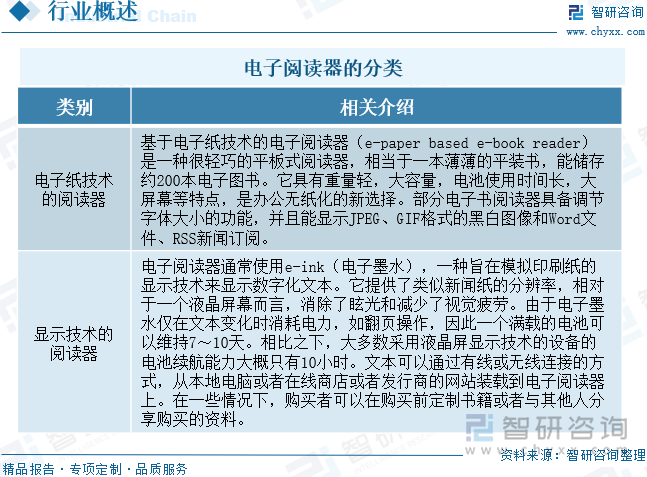
Core Viewpoint - The electronic reader market in China is experiencing stable growth, with a projected market size of approximately 10.066 billion yuan in 2024, driven by innovation from manufacturers and changing consumer reading habits [1][14]. Industry Overview - Electronic readers are portable, low-energy devices designed for displaying digital versions of printed materials, primarily using e-ink technology for a paper-like reading experience [3][4]. - The industry has seen significant advancements since its inception around 2007, with the rise of e-ink technology and the proliferation of smartphones altering reading habits and increasing demand for dedicated reading devices [6][11]. Market Dynamics - The electronic reader market is characterized by a diverse competitive landscape, featuring both international brands like Amazon's Kindle and domestic players such as iReader and Hanvon Technology [17][18]. - The market is supported by a growing digital reading user base, which reached 570 million in 2023, representing a year-on-year growth of 7.53% [13]. Technological Advancements - Recent improvements in e-ink technology have enhanced display quality, energy efficiency, and response times, making electronic readers more appealing for long-term use [24]. - The introduction of new materials and designs has led to lighter and more durable devices, catering to consumer preferences for portability [26]. Consumer Preferences - Consumers are increasingly favoring electronic readers for their portability, customizable reading experiences, and reduced eye strain compared to traditional screens [5][6]. - The market is witnessing a trend towards smart and personalized features, such as intelligent recommendation systems and customizable reading settings [27]. Key Companies - Major players in the electronic reader market include: - **iReader Technology**: Known for its various product lines focusing on light reading and voice features [18]. - **Hanvon Technology**: Offers e-readers that utilize e-ink technology for a comfortable reading experience [19]. - **JDRead**: A product from JD.com featuring a 6-inch e-ink screen and various functionalities [18]. - **Xiaomi**: Launched the Xiaomi Duokan e-reader with advanced display features [18]. - **iFlytek**: Introduced the first color e-reader, expanding the market's offerings [18].