电源PCB

Search documents
未知机构:这一轮三次电源的变化里产业链的地位从基板供应转向了功能-20260304
未知机构· 2026-03-04 02:30
Summary of Conference Call Notes Industry Overview - The focus is on the power PCB (Printed Circuit Board) industry, which is undergoing a significant transformation from a "substrate supplier" to a "functional carrier solution provider" [1] - Power PCB manufacturers are evolving from simple suppliers to solution providers that engage in preliminary research with power companies, indicating a more central role in the industry [1] Key Points and Arguments - The transition in the power PCB industry involves a shift from traditional thick copper boards to embedded power module PCBs, marking a significant change in the role of power PCBs [1] - Previously, power PCBs operated under a horizontal power supply model, but with the shift to vertical power supply, the role of PCBs has changed from merely carrying functions to packaging functions [1] - This transition requires deep technical expertise in embedded technology and HDI (High-Density Interconnect) technology, highlighting the increasing complexity and specialization in the industry [1] - Future IVR (Integrated Voltage Regulator) technology solutions will necessitate the integration of IVR modules into chip architectures through Msap (Modified Semi-Additive Process) technology, which presents high technical barriers [1] Growth Potential - The inflation logic of generational ASP (Average Selling Price) is expected to bring considerable performance growth for related companies, driven by dual factors of power enhancement and process upgrades in power PCBs [2] - There is an anticipated acceleration in the TDP (Thermal Design Power) growth trend of end-user products, which will lead to an increase in the value of single-chip PCBs [2] - The incorporation of more embedded, HDI, and even SLP (Substrate-Like PCB)/Msap processes will further enhance the value of power PCBs, indicating a relatively certain ASP inflation logic in the medium term [2]
未知机构:广发军工重视电源PCB的单瓦价值量通胀概念电源PCB是一个未来强通-20260304
未知机构· 2026-03-04 02:30
Summary of Conference Call on Power PCB Industry Industry Overview - The focus is on the power PCB (Printed Circuit Board) market, which is anticipated to experience strong inflation and high growth in the future [1] - The concept of power PCB includes primary, secondary, and tertiary power PCBs, with secondary and tertiary being the core growth areas [1] Key Points - **Primary Power PCB**: Refers to AC/DC power PCBs that can carry higher currents through processes like gold finger technology, but there are no fundamental changes in size or structure [1] - **Secondary Power PCB**: Utilizes heavy copper and HDI (High-Density Interconnect) technology to ensure efficient current distribution and stable power supply. Specifications include 12-30 layers, thickness of 3-5mm, and 4-5 ounces of heavy copper technology combined with HDI, forming standardized modules [1] - **Tertiary Power PCB**: Represents the core changes in the current industrial trend, requiring complex embedded, HDI, and Msap (Modified Semi-Additive Process) technologies, marking the highest level of miniaturization in power PCBs [1] Market Potential - The market for power PCBs is expected to grow rapidly alongside the increasing power consumption of AI chips. For instance, Google's past unit value was around 0.5 yuan per watt, while AMD's was approximately 0.7-0.8 yuan per watt. Future advancements in PCB technology by companies like NVIDIA may further increase this unit value [2] - The power consumption of chips is significant, with the NVRubinUltra series reaching 3600W and the Feynman architecture potentially exceeding 5000W [2]
未知机构:广发军工重视电源PCB的单瓦价值量通胀概念电源PCB是一个未来强通胀-20260304
未知机构· 2026-03-04 02:25
Summary of Conference Call on Power PCB Market Industry Overview - The focus is on the power PCB (Printed Circuit Board) market, which is anticipated to experience strong inflation and high growth in the future [1] - The power PCB market is linked to the increasing power consumption of AI chips, indicating a significant market expansion potential [2] Key Points and Arguments - The concept of power PCB includes three categories: - **First Power PCB**: AC/DC power PCBs that can carry higher currents through processes like gold finger technology, but with no fundamental changes in size or structure [1] - **Second Power PCB**: Utilizes heavy copper and HDI (High-Density Interconnect) technology to ensure efficient current distribution and stable power supply, featuring 12-30 layers, 3-5mm thickness, and 4-5 ounces of heavy copper technology [1] - **Third Power PCB**: Represents the core changes in the current industrial trend, requiring complex embedded, HDI, and Msap (Modified Semi-Additive Process) technologies, marking the highest level of miniaturization for power PCBs [1] - The market space for power PCBs is expected to grow rapidly alongside the increase in AI chip power consumption: - For instance, Google's past single watt value was around 0.5 yuan/watt, while AMD's was approximately 0.7-0.8 yuan/watt. Future developments by NV may lead to even more precise PCB processes, potentially increasing the single watt value further [2] - The power consumption of AI chips is significant, with the NVRubinUltra series reaching 3600W and the Feynman architecture potentially exceeding 5000W [2] Additional Important Insights - The overall market for power PCBs can be summarized as the product of single watt value (enhanced by complex processes) and wattage (driven by the rapid increase in AI chip power consumption) [2]
未知机构:这一轮三次电源的变化里产业链的地位从基板供应转向了功-20260304
未知机构· 2026-03-04 02:25
Summary of Conference Call Notes Industry Overview - The focus is on the power PCB (Printed Circuit Board) industry, specifically the transition from traditional roles to more integrated solutions within the power supply chain [1][2]. Key Points - The power PCB manufacturers have shifted from being simple suppliers to becoming solution providers that engage in preliminary research with power companies, indicating a more central role in the industry [1]. - The evolution of power PCBs is marked by a transition from traditional thick copper boards to embedded power module PCBs, reflecting a significant change in the industry’s positioning [1]. - The previous horizontal power supply model utilized standard thick copper PCBs, while the new vertical power supply model requires PCBs to transition from merely carrying functions to packaging functions, necessitating deep technical expertise in embedded technology and HDI (High-Density Interconnect) technology [1]. - Future IVR (Integrated Voltage Regulator) technology solutions will require PCBs to encapsulate IVR modules within chip architectures using Msap (Modified Semi-Additive Process) technology, which presents high technical barriers [1]. Growth Drivers - The ASP (Average Selling Price) inflation logic is expected to bring substantial growth to related companies, driven by the dual forces of power enhancement and process upgrades in power PCBs [2]. - There is an anticipated acceleration in the TDP (Thermal Design Power) growth trend across various end-user products, which will lead to an increase in the value of single-chip PCBs [2]. - The integration of more embedded, HDI, and even SLP (Substrate-Like PCB)/Msap processes will further enhance the value of power PCBs, indicating a relatively certain ASP inflation logic in the medium term [2].
观点全追踪(3月第1期):晨会精选-20260302
GF SECURITIES· 2026-03-01 23:30
Core Insights - The report highlights the evolution of power PCBs from a single substrate role to a "functional carrier board," with high-density integration being a core trend. The demand for high integration and verticalization in onboard power is driving revolutionary changes in PCBs [3]. Industry Analysis - The report discusses the transition of power PCBs towards high-density, passive component embedding, with examples such as Zhongfu Circuit integrating 14-18 layers within a 17x23mm size, requiring advanced PCB technologies to support over 800W power transmission [3]. - It emphasizes the embedding of power modules into PCBs to achieve Integrated Voltage Regulation (IVR) functionality, moving from traditional dispersed power management components to highly integrated solutions within a single chip or package [3]. - The report notes that the future of power PCBs will involve adopting mSAP technology for finer line widths and spacing to facilitate the packaging and embedding of IVR functions, indicating a shift towards more multifunctional roles for power PCBs [3].
未知机构:威尔高正式接到谷歌电源订单英伟达gb300rubin电源pcb核心玩家-20260204
未知机构· 2026-02-04 02:15
Company and Industry Summary Company: 威尔高 (Weilgao) Key Points - **Google Power Order**: The company has officially received an order for over 200 million yuan from Google for primary power supplies, with secondary power supply projects currently in coordination [1][2][3] - **GB300/Rubin Progress**: The progress on the GB300 and Rubin projects is reported to be smooth, indicating a positive trajectory in product development and delivery [1][2][3] - **Revenue Growth Forecast**: The company anticipates a compound annual growth rate (CAGR) of 50% for revenues in the years 2025, 2026, and 2027, with projected revenues of 15 million, 24 million, and 36 million respectively [1][2][3] - **Profit Expectations**: Profit is expected to increase as the utilization rate of the Thailand factory improves and the proportion of power supply products rises, with profit forecasts of over 3 million and 5 million for the years 2026 and 2027 respectively [1][2][3]


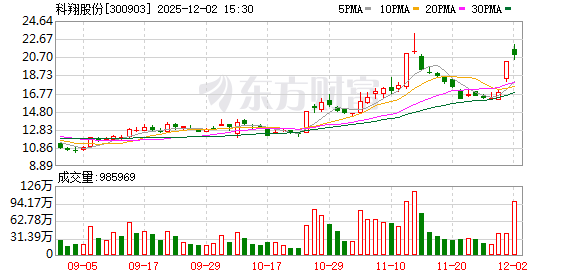
科翔股份:电源PCB是公司主力产品之一
Zheng Quan Ri Bao· 2025-12-02 10:37
Core Viewpoint - The company, Kexiang Co., announced its strength in the power PCB segment, highlighting its leading position in the PCB industry and its capability to produce thick copper boards and aluminum substrates [2]. Group 1: Company Overview - Kexiang Co. identifies power PCB as one of its main and advantageous products, positioning itself among the top players in the PCB industry [2]. - The production of power PCBs primarily takes place at the company's facility in Ganzhou, where it specializes in thick copper boards and aluminum substrates [2]. - The company has achieved the capability for mass production of 12oz thick copper boards, indicating a significant manufacturing advancement [2].