百服咛

Search documents
超10亿元!上海医药“抛售”合资药企股权
Xin Lang Cai Jing· 2026-02-05 12:24
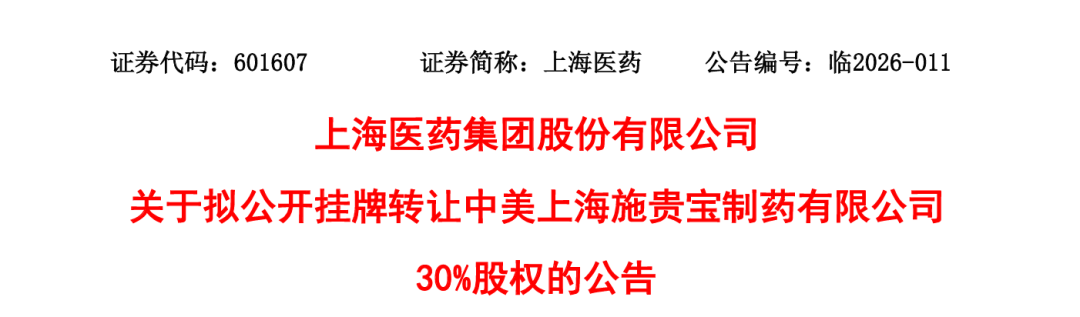
Core Viewpoint - Shanghai Pharmaceuticals announced the intention to publicly transfer 30% of its stake in China-U.S. Shanghai Bristol-Myers Squibb Pharmaceutical Co., Ltd. (hereinafter referred to as "China-U.S. Bristol-Myers Squibb") through a property rights transaction, with a minimum listing price of 1.023 billion yuan [1][4]. Group 1: Company Overview - China-U.S. Bristol-Myers Squibb, established in 1982, is a well-known Sino-U.S. joint venture pharmaceutical company with a registered capital of 18.44 million USD. The shareholding structure includes Bristol-Myers Squibb (China) Investment Co., Ltd. holding 60%, Shanghai Pharmaceuticals holding 30%, and China National Pharmaceutical Group Asset Management Co., Ltd. holding 10% [2][5]. - The company has launched nearly 30 products in China, covering prescription drugs for cardiovascular, metabolic, and antibiotic treatments, as well as over-the-counter products like pain relievers and multivitamins [2][5]. Group 2: Financial Performance - In 2016, China-U.S. Bristol-Myers Squibb achieved a historical peak with revenues of 4.724 billion yuan and a net profit of 622 million yuan. However, the company's operational performance has declined since then [2][5]. - For the year 2024, the company reported revenues of 1.795 billion yuan and a net profit of 248 million yuan. In the first three quarters of 2025, revenues further declined to 1.096 billion yuan, with a net profit of only 87.11 million yuan [2][5][7]. Group 3: Share Transfer and Market Strategy - In September 2025, it was reported that Bristol-Myers Squibb signed an agreement to sell its 60% stake in China-U.S. Bristol-Myers Squibb to an affiliate of Hillhouse Capital. This move is aimed at allowing Bristol-Myers Squibb to focus on key growth areas while leveraging local manufacturing and market advantages [3][6]. - The transfer of 30% of the stake by Shanghai Pharmaceuticals indicates a potential comprehensive adjustment in the shareholding structure of this over 40-year-old joint venture pharmaceutical company. The minimum price for the stake transfer is set at 1.023192 billion yuan, reflecting a strategic decision to maximize asset value and protect the interests of all shareholders, especially minority shareholders [3][6].

挂牌底价10.23亿元,上海医药拟清仓中美施贵宝
Huan Qiu Lao Hu Cai Jing· 2026-02-05 07:04
Core Viewpoint - Shanghai Pharmaceuticals plans to transfer its 30% stake in China Bristol-Myers Squibb through a public listing, with a minimum transfer price of 1.023 billion yuan [1] Group 1: Stake Transfer Details - The current ownership of China Bristol-Myers Squibb consists of three parties: 60% by Bristol-Myers Squibb (China) Investment Co., Ltd., 30% by Shanghai Pharmaceuticals, and 10% by China National Pharmaceutical Group Asset Management Co., Ltd. [1] - If the transfer is successful, Shanghai Pharmaceuticals will no longer hold any stake in China Bristol-Myers Squibb [1] - Bristol-Myers Squibb is also planning to transfer its 60% stake, with potential buyers expected to submit confirmation bids by June 2025, valuing the entire company at 480 million USD [1] Group 2: Financial Performance of China Bristol-Myers Squibb - The company has experienced a decline in performance due to centralized procurement and competition, with revenues of 1.795 billion yuan and a net profit of 248 million yuan in 2024 [2] - For the first three quarters of 2025, revenues dropped to 1.096 billion yuan and net profit to approximately 87.12 million yuan, significantly lower than the peak revenues of 4.724 billion yuan and net profits of 622 million yuan in 2016 [2] Group 3: Shanghai Pharmaceuticals' Strategic Moves - Shanghai Pharmaceuticals has been optimizing its assets, having invested nearly 1 billion yuan to gain further control of Huang Pharmaceutical last year, acquiring several traditional Chinese medicine products [2] - The company has also made acquisitions of multiple DTP pharmacy enterprises through its subsidiary, Shanghai Pharmaceuticals Cloud Health platform [2] - In terms of R&D, Shanghai Pharmaceuticals has increased its investment, with a total of 1.729 billion yuan in R&D for the first three quarters of 2025, and currently has 57 new drug pipelines, including 45 innovative drugs [2] Group 4: Financial Performance of Shanghai Pharmaceuticals - For the first three quarters of 2025, Shanghai Pharmaceuticals reported revenues of 215.072 billion yuan, a year-on-year increase of 2.60%, and a net profit attributable to shareholders of 5.147 billion yuan, up 26.96% [2] - However, the net profit after deducting losses was 3.979 billion yuan, reflecting a year-on-year decrease of 1.85% [2]
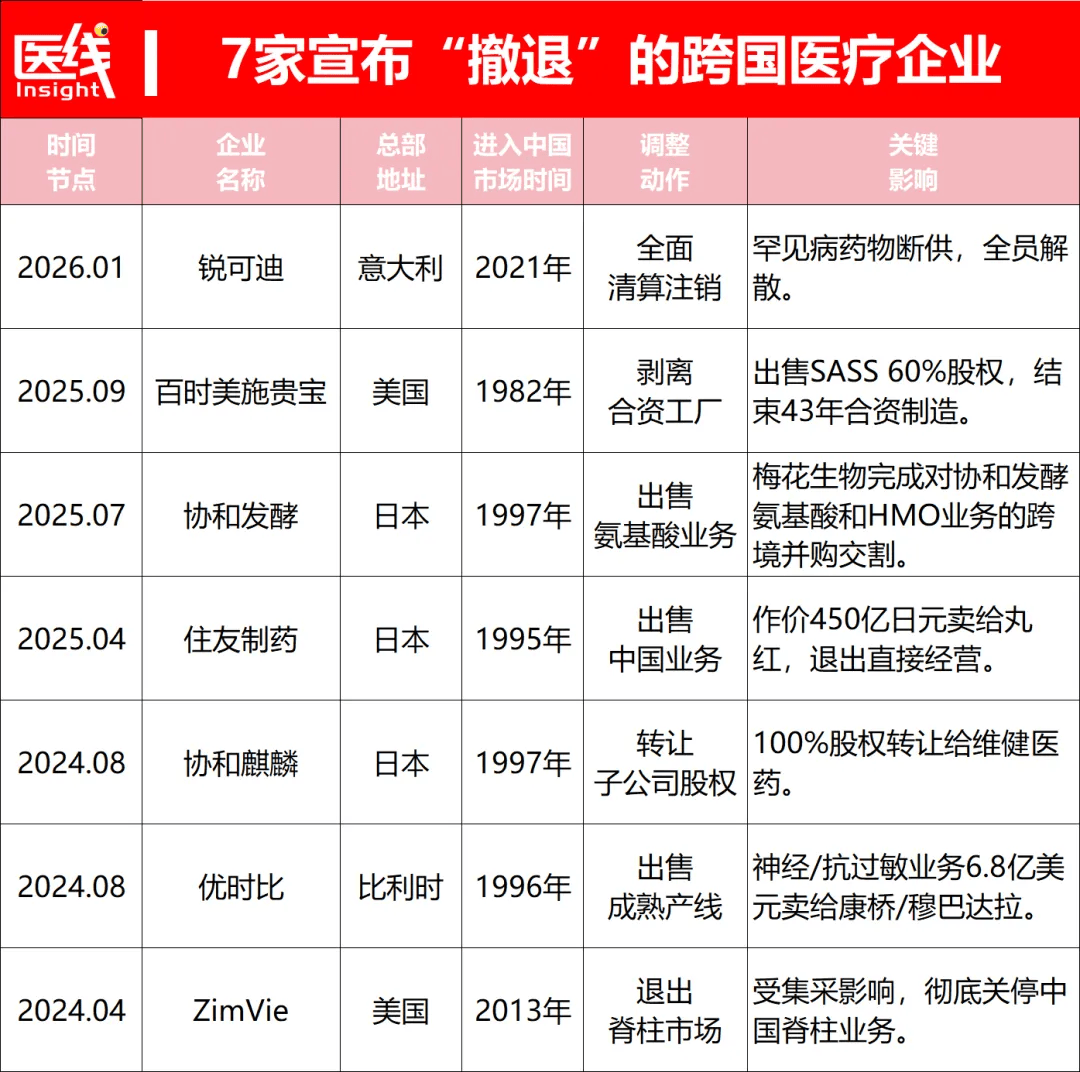
短短两年内,7家跨国医疗巨头退出中国市场
Sou Hu Cai Jing· 2026-01-27 02:13
Core Viewpoint - The article discusses the significant withdrawal of multinational pharmaceutical companies from the Chinese market, highlighting a trend of strategic exits and the underlying reasons for these decisions. Group 1: Company Withdrawals - Italian pharmaceutical company Recordati announced the liquidation of its subsidiary in China, signaling a complete cessation of operations and a harsh reality for patients relying on its rare disease treatments [1] - At least seven multinational medical companies have made drastic decisions to exit the Chinese market within two years, including major players like Bristol-Myers Squibb and Sumitomo Pharma [2][3] - The average duration of these companies' presence in China was nearly 26 years, marking a complete historical cycle from entry to exit [3] Group 2: Reasons for Withdrawal - The first category of withdrawal reasons includes business failures, exemplified by Recordati and ZimVie, where high-priced rare disease drugs could not gain reimbursement support, leading to unsustainable operations [6][10] - The second category involves strategic divestitures for survival, as seen with companies like Sumitomo Pharma and Kyowa Kirin, which sold their businesses to reduce operational burdens while retaining rights to future drug developments [15][20] - The third category highlights the downsizing and restructuring of major companies like Bristol-Myers Squibb and UCB, which are shifting focus from low-margin products to high-risk, high-reward innovation drug sectors [21][24] Group 3: Market Dynamics - The traditional profit model for multinational pharmaceutical companies in China has collapsed due to price reductions from centralized procurement, with average price drops exceeding 50% and in some cases over 90% [31][32] - Local innovation has intensified competition, with domestic biotech companies rapidly developing products that challenge multinational firms, leading to a price war that many foreign companies cannot sustain [33][35] - Cultural conservatism within Japanese firms has contributed to their higher exit rates, as their slower decision-making processes hinder responsiveness to market changes [36] Group 4: Future Predictions - The trend of mid-sized multinational companies selling off their operations in China is expected to continue, with more companies likely to engage in divestitures or licensing agreements [40] - Multinational companies are anticipated to shift from selling drugs to acquiring early-stage biotech firms, reflecting a change in their operational focus in China [41] - The era of joint-venture pharmaceutical factories is coming to an end, with future production likely to be outsourced or divested, except for biologics that may still require local manufacturing [42][43]