
硅光晶圆

Search documents
预警!2026 半导体行情,或将颠覆认知
是说芯语· 2026-03-22 08:14
Core Viewpoint - The semiconductor industry is expected to experience significant price increases and shortages by 2026, driven by supply chain constraints and rising demand, particularly in AI applications [1][14]. Group 1: Material Shortages and Price Increases - Silicon oxide is facing a supply gap of 40%, with a shortage of 1.5 million wafers this year and prices increasing by over 50%, expected to remain in short supply until 2028 [4][5]. - Molybdenum, essential for semiconductor targets, has seen an 80% price increase due to a shortage of 12,000 tons, with expectations of continued shortages until 2027 [6][7]. - Photoresists are experiencing severe supply constraints, with a shortage of 12,000 tons this year and prices doubling, projected to worsen with a 15,000-ton shortage next year [8][9]. - High-end electronic fabrics are in high demand, with a shortage of 50% and prices doubling, expected to last until 2028 [10]. - High Bandwidth Memory (HBM) has been completely sold out for the year, with prices doubling and a 60% supply gap due to high demand from AI chips [11][12]. - Silicon photonic wafers are facing a 40% price increase and a shortage of 800,000 wafers, with supply issues expected to persist until 2027 [13]. Group 2: Market Dynamics and Price Trends - The current price increases are attributed to a combination of raw material shortages, geopolitical factors, and surging AI demand, indicating a significant shift in the market rather than temporary fluctuations [14]. - Major companies like Texas Instruments and Infineon have announced price hikes of up to 85% starting April 1, with domestic firms also increasing prices by 10%-20%, and some up to 80% [15].


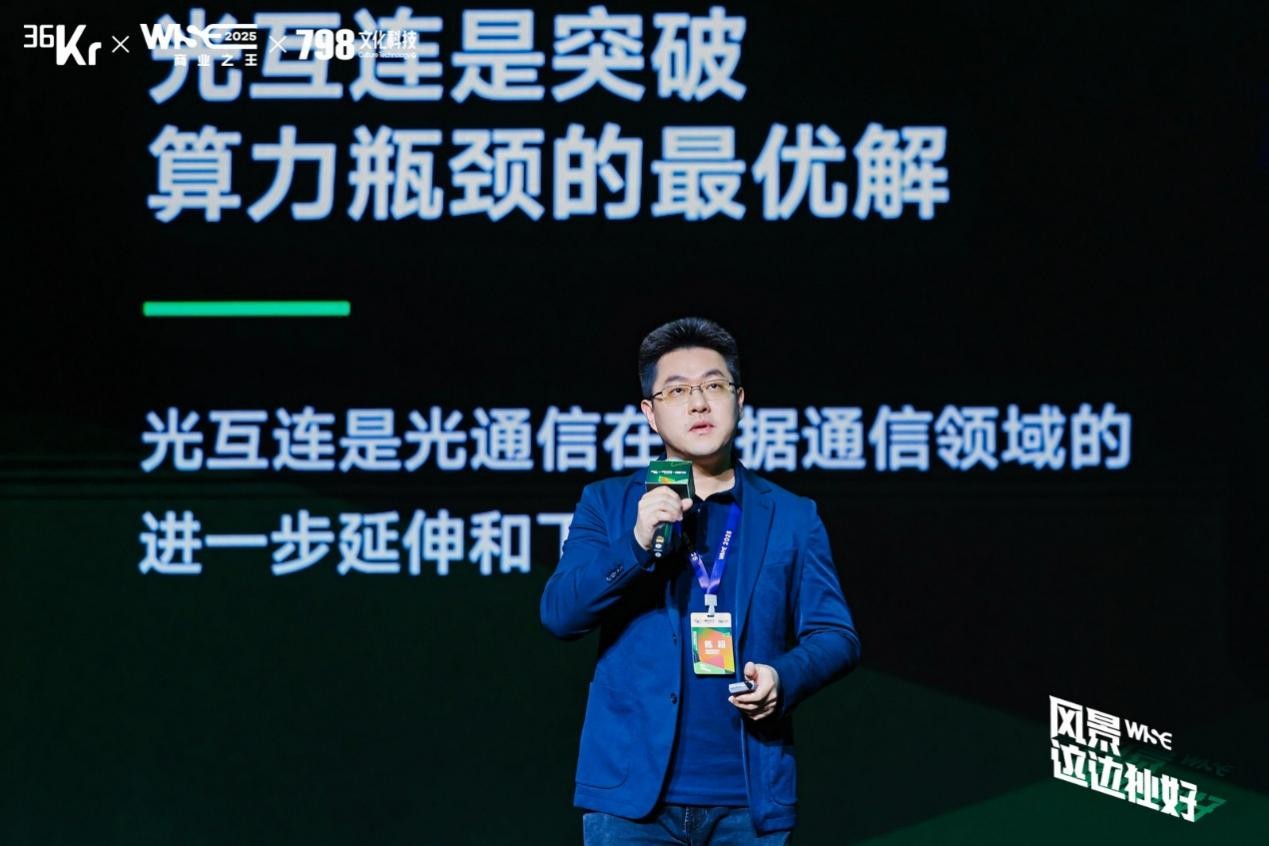
光联芯科CEO 陈超:光互连是通往AGI的必由之路|WISE2025 商业之王
3 6 Ke· 2025-12-04 02:35
Group 1: Event Overview - The 36Kr WISE 2025 Business King Conference, recognized as an annual technology and business trendsetter, took place in Beijing on November 27-28 [1] - This year's WISE transformed from a traditional industry summit into an immersive experience using "tech short dramas" to convey insights on trends and business practices [1] Group 2: AI Development and Challenges - AI development has significantly accelerated in the past decade, driven by a more than 1 billion times increase in computing power, with year-on-year growth approaching 10 times [4] - The evolution of AI is heavily reliant on computing power, with predictions indicating that achieving Artificial General Intelligence (AGI) will require approximately 10^41 FLOPs, while current capabilities are around 10^25 FLOPs, indicating a gap of about 10^16 [4][5] - Two major challenges facing the computing power industry are bandwidth limitations and energy consumption, with interconnect bandwidth growth lagging significantly behind computing power growth [5][7] Group 3: Interconnect Bandwidth and Energy Consumption - The performance of computing clusters is severely limited by interconnect bandwidth, which has only increased 30 times over the past 20 years, compared to a 60,000 times increase in chip computing power [5] - Current data centers, such as those being developed by OpenAI and Musk's xAI, require energy comparable to nuclear power plants, highlighting the unsustainable nature of current energy demands for computing [7] Group 4: Optical Interconnect Solutions - Optical interconnects are proposed as the optimal solution to overcome computing power bottlenecks, allowing for high bandwidth and low energy consumption [8] - The company aims to provide next-generation optical interconnect solutions that enable direct optical connections between chips, significantly enhancing bandwidth efficiency [8][9] - The vision includes creating a domestic semiconductor ecosystem that can potentially surpass foreign competitors in overall computing cluster performance and energy efficiency [9]
全球算力基建加速,密集催化提升预期
2025-09-22 00:59
Summary of Key Points from Conference Call Industry Overview - The telecommunications industry is experiencing accelerated infrastructure development, driven by significant investments from large domestic and international companies, as well as technological innovations [3][4] - Emerging technologies such as CPO, OIO, and hollow fiber optics are gaining attention, further propelling industry growth, particularly in the optical communication sector [3] Company Insights - Leading companies in the telecommunications sector, such as Xuchuang and Xinyi, currently have relatively low valuations, but their Q3 performance is expected to exceed market expectations, potentially boosting their market value [1][4] - The supply chain for silicon photonics is rapidly expanding, with suppliers like Tower planning to significantly increase production capacity by June next year [1][6] - Companies like Xuchuang and Yuanjie are anticipated to maintain stable growth due to the increasing penetration of silicon photonics [8] Emerging Technologies - New technologies like OCS and CPU are impacting the telecommunications industry but will not completely replace traditional technologies. Leading companies are expected to maintain their strong positions while benefiting from the growth of second-tier companies like Cambridge and Huylv [5] - The introduction of liquid cooling technology is necessary due to increased power consumption of optical modules in the 3.2T era [10][11] Market Dynamics - The domestic market is more event-driven, focusing on short-term catalysts, while the overseas market emphasizes long-term investment value based on industry trends and performance [7] - The upcoming Huawei super node architecture is expected to generate significant demand for 800G connections, benefiting companies like Guangxun Technology and Huagong Technology [12][20] Future Outlook - The silicon photonics supply chain is projected to grow robustly, with significant increases in production capacity expected in the near future [6][8] - The next generation of optical interconnect technologies, such as CPC and CPU, is being actively discussed, with potential advancements in materials and electrical connection architectures [9] - Key events like the ECOC conference and OCP summit are anticipated to catalyze developments in the overseas computing power chain [13] Investment Recommendations - It is advisable to focus on leading companies in the main sectors while also monitoring second-tier companies for breakthrough opportunities and the long-term trading potential brought by new technologies [1][7][20]


