
碳寻计划

Search documents
企业谈“价值”不能只盯利润表 ESG从理念走向经营是重要课题
Nan Fang Du Shi Bao· 2025-12-18 23:09
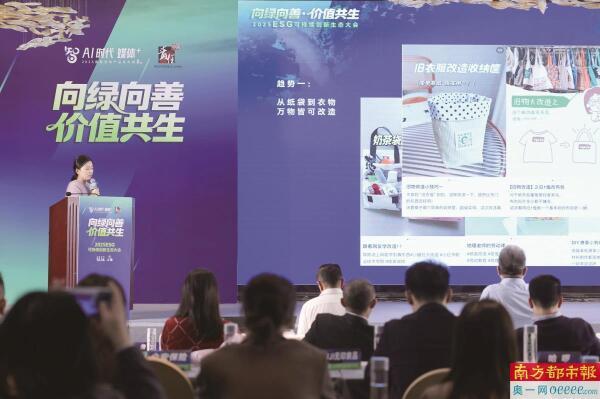
Core Insights - The "2025 Top Ten Sustainable Green Lifestyles" was unveiled at the ESG Sustainable Innovation Ecological Conference held in Shanghai, organized by Southern Metropolis Daily and supported by Shanghai University of Finance and Economics and Miaoying Technology [2][3] - The conference featured the release of the "2025 ESG Sustainable Innovation Trend Insight Report," which focuses on 12 topics related to environment, society, and governance (ESG) and collects excellent ESG case studies from various industries [4][9] Group 1: ESG Conference Highlights - The conference achieved "net zero" emissions by implementing a carbon neutrality mechanism, including using recycled materials for trophies and encouraging green transportation for attendees [5][6] - The event emphasized the importance of ESG as a critical standard for measuring sustainable and high-quality development in enterprises, reflecting the evolution of ESG in China over the past two decades [5][9] Group 2: ESG Practices and Trends - The report highlights the unique characteristics of local enterprises in implementing ESG, with a focus on the importance of leadership support, employee engagement, and effective communication in successful green initiatives [9] - Challenges faced by companies include high costs, technical difficulties, insufficient market demand, and regulatory constraints [9] Group 3: Sustainable Lifestyles - The "2025 Top Ten Sustainable Green Lifestyles" includes practices such as "shared" consumption, clothing upcycling, and green low-carbon travel, making sustainability a tangible part of daily life for young people [10] - The report's materials were designed to be eco-friendly, with no printed versions, and included seed paper bookmarks that can grow into plants [10] Group 4: ESG Innovation Awards - The conference recognized outstanding ESG practices through awards, with notable projects including Tencent's "Carbon Search Plan" and Baidu's "AI for the Elderly" initiative [11] - The awards aimed to promote green development and highlight exemplary cases in various sectors, including environmental friendliness and social contribution [11] Group 5: Expert Discussions on ESG - Experts discussed the transition from Corporate Social Responsibility (CSR) to ESG, emphasizing the need for a structured approach to integrate ESG into business models and risk management [7][14] - The roundtable highlighted the importance of supply chain management and the role of technology in enhancing ESG practices across industries [15][17]

腾讯“碳寻计划”二期全球50强名单发布 助力前沿低碳技术落地应用
Zhong Guo Jing Ji Wang· 2025-10-30 13:21
Core Insights - Tencent's "Carbon Seeking Program" aims to bridge the gap between research and application in climate innovation, promoting collaboration to address climate change [2][3] - The second phase of the program received over 660 climate innovation proposals from 54 countries, with a significant representation from Chinese teams [1][2] Group 1: Program Overview - The "Carbon Seeking Program" was initiated by Tencent in 2023, focusing on advancing cutting-edge low-carbon technologies towards large-scale application [2] - The program offers a total of 200 million yuan in catalytic funding for the top 50 teams, which will also gain access to industry and expert resources [2] Group 2: Selection Process - The selection process for the top 50 teams involved 87 judges, nearly half of whom were from overseas, evaluating based on technology, application, and commercial viability [1] - The final list includes over 40% teams from China, followed by teams from North America and Europe, as well as three teams from Africa [1] Group 3: Technological Innovations - Notable innovations include Andean's "microbial carbon mineralization" technology, which converts CO2 into minerals, enhancing soil fertility and crop yield [1] - Chinese teams developed an adsorbent using basalt and diatomite to capture CO2 directly from the air, which is then mineralized and permanently stored underground [1] Group 4: Initial Outcomes - The first phase of the program has already shown preliminary results, with a project on CO2 rapid mineralization and storage technology underway in Shanghai [3]

腾讯“碳寻计划”二期全球50强名单发布,以全球方案解决全球问题
Cai Jing Wang· 2025-10-29 17:02
Core Insights - Tencent's "Carbon Seeking Plan" has launched its second phase, identifying 50 global teams from 12 countries and regions that are exploring diverse technological solutions to address the climate crisis [1][3] - The initiative aims to support promising early-stage climate technology solutions and facilitate their application [3] Group 1: Technological Innovations - Andes, a company focusing on soil microorganisms, has discovered a cutting-edge carbon sequestration technology called microbial carbon mineralization, which converts atmospheric CO2 into minerals, enhancing soil fertility and crop yield while storing carbon for thousands of years [1] - China University of Mining and Technology and the Wuhan Institute of Rock and Soil Mechanics are developing an adsorbent using basalt and diatomite, which captures CO2 directly from the air and injects it into underground basalt for permanent storage [1] Group 2: Program Expansion and Evaluation - The second phase of the "Carbon Seeking Plan" has expanded its selection criteria globally, receiving over 660 climate innovation proposals from 54 countries and regions, with nearly half of the evaluators being from overseas [3] - The evaluation process is based solely on technology, application, and commercial viability, resulting in a list of 50 leading low-carbon technology teams, with over 40% of the teams coming from China [3] Group 3: Funding and Support - The selected 50 climate innovation teams are competing for a total of 200 million RMB in catalytic funding, with the winning teams gaining access to Tencent's industrial and expert resources [3] - The initiative aims to help these cutting-edge low-carbon technologies transition from laboratory settings to practical applications, addressing the "valley of death" in technology commercialization [3]