神经元定位系统

Search documents
2025年中国脑机接口行业上游市场分析 脑电电极以无创电极为主【组图】
Qian Zhan Wang· 2026-02-03 08:08
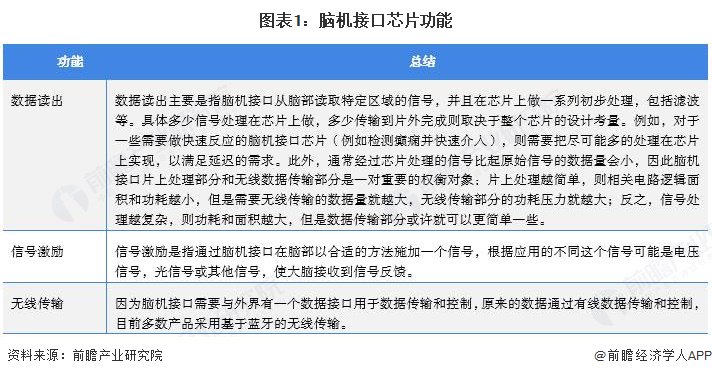
Core Insights - The article discusses the development prospects and investment opportunities in the brain-computer interface (BCI) industry, highlighting key players and technological advancements in the field [1] Group 1: Market Overview - The BCI hardware mainly consists of brain signal acquisition devices and BCI chips, with invasive chips requiring higher standards than non-invasive ones [1] - The BCI chip market is becoming increasingly competitive, with major players like Neuralink and NeuroSky launching specialized chips [4] - Hainan University has developed a series of core technologies and products for implantable BCIs, including high-throughput neural signal acquisition chips, which signify a move towards self-sufficiency in BCI technology in China [4][6] Group 2: Chip Analysis - Invasive BCI chips perform data readout and signal stimulation, with design considerations affecting the balance between on-chip processing and wireless data transmission [2] - The article mentions specific chips developed by various companies, including the SX-R128S4, SX-S32, and SX-WD60 from Hainan University, which together form a closed-loop technology covering the entire BCI chain [6] Group 3: EEG Acquisition Devices - EEG acquisition devices are categorized into non-invasive and invasive electrodes, with non-invasive electrodes being less accurate due to noise interference [7] - As of October 2025, 50 EEG electrode products have received NMPA certification in China, with 84% being domestically produced [9] - Among the certified products, non-invasive electrodes dominate, accounting for 74%, while invasive electrodes have seen an increase in market share compared to 2024 [11]

盘前情报丨国常会定调股市、楼市;商务部:将扩大对广东等自贸试验区改革任务授权,赋予新改革试点任务
2 1 Shi Ji Jing Ji Bao Dao· 2025-04-21 00:46
Market Performance - The A-share market saw mixed performance in the past week, with the Shanghai Composite Index closing at 3276.73 points, up 1.19% for the week, while the Shenzhen Component Index fell 0.54% to 9781.65 points, and the ChiNext Index decreased 0.64% to 1913.97 points [2] - Approximately 42% of stocks experienced gains during the week, with 113 stocks rising over 15% and 32 stocks declining more than 15% [2] Sector Performance - The leading sectors for gains included internet e-commerce, food processing, real estate, banking, and textile manufacturing, while sectors that saw declines included agriculture, aquaculture, military electronics, shipping, and photovoltaic equipment [2] Government Initiatives - The State Council meeting on April 18 emphasized the need to stabilize the stock market and promote the healthy development of the real estate market, alongside measures to support employment and domestic demand [4] - The meeting highlighted the importance of targeted support for foreign investment and the need for effective implementation of policies to ensure they reach businesses and the public [4] Trade and Economic Policies - The U.S. government is considering forming a task force to address the supply chain crisis caused by high tariffs on Chinese goods, indicating a potential shift in trade policy [5] - The Ministry of Commerce announced plans to expand reform tasks for free trade zones in Guangdong, Tianjin, and Fujian, aiming to enhance their role in national strategies and respond to external risks [6][7] Technology and Innovation - Hainan University announced breakthroughs in brain-computer interface technology, achieving full-chain autonomy in chip development, which is expected to enhance China's capabilities in this field [8] - The cross-border e-commerce platform Dunhuang.com has seen a significant increase in user engagement, with over 278,000 registered suppliers and a surge in new buyer registrations [8][9] Investment Opportunities - The human-shaped robot market is anticipated to grow, with the upcoming launch of the "Tian Gong 2.0" robot expected to be priced similarly to entry-level cars, indicating a potential investment opportunity in the robotics sector [10] - The surge in demand for high-cost performance products among U.S. consumers is expected to drive continued growth in cross-border e-commerce platforms [9]