稀土精矿

Search documents
稀土磁材行业周报:本周板块反弹,产业链价格有望逐步企稳-20260329
Xiangcai Securities· 2026-03-29 13:08
Investment Rating - The industry investment rating is maintained at "Overweight" [3][41] Core Views - The rare earth magnetic materials industry rebounded by 1.42% this week, outperforming the benchmark (CSI 300) by 2.84 percentage points [5][12] - The industry valuation (TTM P/E) slightly decreased by 0.37x to 73.56x, currently at 85.6% of its historical percentile [5][12] - The prices of rare earth concentrates remained stable overall, with praseodymium and neodymium prices stabilizing after a decline, while dysprosium and terbium prices continued to show weakness [6][9] - The supply side of rare earths is experiencing a downward trend in operating rates among mineral separation enterprises, with expectations of increased waste supply to partially offset the reduction in raw ore supply [10][40] Summary by Sections Industry Performance - Over the past month, the industry has shown a relative return of -20%, a 4% return over three months, and a 48% return over the past year [4] - Absolute returns are -24% for one month, 1% for three months, and 63% for twelve months [4] Market Trends - The rare earth magnetic materials industry is expected to stabilize as downstream inventory gradually decreases, with potential support for market prices [10][40] - The demand side is experiencing a temporary decline in orders, primarily due to previous price drops causing delays in downstream purchases, but overall demand remains stable with potential for concentrated release in the future [10][40] Investment Recommendations - The report suggests focusing on upstream rare earth resource companies that may benefit from valuation premiums and stable profits due to policy support and strategic value positioning [10][44] - It also recommends paying attention to downstream magnetic material companies with good customer structures and full capacity utilization, such as Jinli Permanent Magnet, as rare earth prices are expected to continue their upward trend [10][44]
湘财证券晨会纪要-20260327
Xiangcai Securities· 2026-03-27 01:00
Industry Overview - The rare earth magnetic materials industry experienced a decline of 10.25% this week, underperforming the benchmark by 8.06 percentage points [4] - The industry valuation (TTM P/E ratio) decreased to 73.94x, which is at 86% of its historical percentile [4] Price Movements - Prices for rare earth concentrates and praseodymium-neodymium saw significant declines, with mixed carbonate rare earth ore prices dropping by 8.7%, 10%, and 11.43% for different regions [5] - The average price of praseodymium-neodymium oxide fell by 11.88%, while the metal price decreased by 10.1% [5] - Dysprosium and terbium prices also continued to decline, with dysprosium oxide down by 4.47% and terbium oxide down by 2.33% [5] - The price of sintered neodymium-iron-boron (N35) decreased by 5.57%, and H35 by 4.01% [5] Supply and Demand Dynamics - The supply side remains stable with limited capacity increases, while demand is relatively stable with normal production levels in neodymium-iron-boron enterprises [6][7] - Short-term price adjustments are expected as downstream inventory reduction is prioritized, with limited room for further price declines anticipated [7] Investment Recommendations - The industry maintains an "overweight" rating, with expectations of continued support from policy and strategic value positioning despite short-term valuation pressures [8] - Focus on upstream rare earth resource companies is recommended due to policy support and stable profitability, while downstream magnetic material companies with strong customer structures and growth potential should also be monitored [8]
湘财证券晨会纪要-20260312
Xiangcai Securities· 2026-03-12 00:29
Industry Overview - The rare earth magnetic materials industry experienced a significant decline of 11.35% this week, underperforming the benchmark by 10.28 percentage points [2] - The industry valuation (TTM P/E ratio) decreased to 87.01x, which is at the 93.2% historical percentile [2] - Prices for rare earth concentrates have generally retreated, with praseodymium and neodymium prices also declining, while neodymium-iron-boron (NIB) sintered block prices remained stable [2][3] Price Movements - The average price of praseodymium-neodymium oxide fell by 3.69%, and the average price of praseodymium-neodymium metal decreased by 2.8% this week [3] - Dysprosium and terbium prices also saw reductions, with dysprosium oxide down by 6.83% and dysprosium metal down by 5.7% [3] - The average price of neodymium-iron-boron N35 remained stable, indicating a lack of upward pressure from the upstream rare earth raw material market [3] Supply and Demand Dynamics - The supply side remains tight, with stable operations in separation enterprises but limited production capacity, leading to insufficient overall output [4] - Demand from neodymium-iron-boron enterprises is stable, with decent order volumes, although short-term procurement is limited [4] - The overall demand outlook is positive, with expectations for stable growth in the end market, particularly in the context of new energy vehicle production [4] Investment Recommendations - The industry maintains an "overweight" rating, with expectations of short-term valuation pressure but a long-term recovery potential due to stable demand and limited supply growth [5] - Continued focus on upstream rare earth resource companies is advised, as they are expected to benefit from valuation premiums and stable profitability [5] - Downstream magnetic material companies, particularly those with strong customer structures and new growth opportunities, are also recommended for attention [5]
稀土磁材行业周报:本周板块走势大幅回落,产业链价格整体回调-20260308
Xiangcai Securities· 2026-03-08 14:36
Investment Rating - The industry investment rating is maintained at "Overweight" [3][10] Core Views - The rare earth magnetic materials industry experienced a significant decline of 11.35% this week, underperforming the benchmark by 10.28 percentage points [5][12] - The industry valuation (TTM P/E) decreased to 87.01x, which is at the 93.2% historical percentile [5][12] - The prices of rare earth concentrates have generally retreated, with specific declines noted in praseodymium and neodymium prices, while the price of neodymium-iron-boron blanks remained stable [6][9] - Supply remains tight in the rare earth sector, with stable operations in separation enterprises, but overall production growth is insufficient due to capacity constraints [10][37] - Demand is stable, with decent orders from neodymium-iron-boron enterprises, and expectations for overall demand in the end market are positive [10][37] - The industry faces short-term valuation pressure due to declining market risk appetite, but medium to long-term supply constraints and stable demand growth are expected to support prices [10][38] Summary by Sections Industry Performance - Over the past month, the industry has shown a relative return of 8%, a 3-month return of 16%, and a 12-month return of 73% [4] - Absolute returns for the same periods are 9%, 17%, and 91% respectively [4] Price Trends - The average price of domestic mixed rare earth carbonate decreased by 1.96%, while prices for specific rare earth minerals also saw declines [9][15] - The average price of praseodymium oxide fell by 3.69%, and the average price of praseodymium metal decreased by 2.8% [18][21] - Dysprosium and terbium prices also saw significant reductions, with dysprosium oxide down 6.83% and terbium oxide down 3.08% [21][25] Investment Recommendations - The report suggests continued focus on upstream rare earth resource companies due to policy support and strategic value positioning [10][38] - It also recommends attention to downstream magnetic material companies with strong customer structures and potential growth points, such as Jinli Permanent Magnet [10][41]
金属行业周报:强推电解铝配置和涨价品种-20260308
CMS· 2026-03-08 06:32
Investment Rating - The report maintains a strong recommendation for investing in electrolytic aluminum and price-increasing varieties [1][2]. Core Viewpoints - The macro environment is currently unfavorable for non-ferrous metals due to rising oil prices and inflation expectations, with a short-term bearish outlook. However, the medium to long-term bullish perspective remains unchanged, with a focus on adjusting positions for accumulation opportunities [1]. - The ongoing conflict in Iran is disrupting aluminum supply, leading to an expansion in electrolytic aluminum profits. The report continues to recommend price-increasing varieties and emphasizes the importance of new materials related to technological growth [1]. Industry Overview - The non-ferrous metal sector has seen a significant performance increase, with a 1-month absolute performance of 8.5%, 6-month performance of 52.3%, and a 12-month performance of 91.2% [3]. - The report highlights the largest gainers and losers in the sector, with Feinan Resources (301500) showing a weekly increase of 14.36% and Shenghe Resources (600392) experiencing a decline of 17.04% [2][3]. - Tungsten prices have risen by 12.71% due to geopolitical tensions and supply concerns, while tin prices have decreased by 6.94% due to macroeconomic pressures and weak demand [3][4]. Specific Metal Insights - Copper: The report notes a significant increase in domestic and international inventories, with a cautious outlook on the recovery pace post-holiday. The long-term view on copper prices remains bullish, with suggested investments in companies like Zijin Mining and Jiangxi Copper [4]. - Aluminum: As of March 5, domestic electrolytic aluminum ingot inventory reached 1.256 million tons, a 9.9% increase. The report anticipates that the ongoing conflict in the Middle East may impact the annual balance sheet, leading to sustained price increases [4]. - Tin: The report indicates that supply issues in Myanmar are stabilizing, with a strong support for tin prices in the near term [4]. - Nickel: Supply disruptions are expected to tighten the nickel market in the medium to long term, with current prices being 32% below historical highs [4]. Price Trends and Forecasts - The report maintains a target price of $6,000 per ounce for London gold within the year, driven by expanding U.S. fiscal deficits and inflationary pressures [4]. - The report also highlights the potential for lithium prices to rise due to supply constraints expected in 2026, alongside a bullish outlook for cobalt prices due to ongoing supply issues in the Democratic Republic of Congo [4].
稀土磁材行业周报:本周行业市场表现强势,产业链价格整体强势-20260301
Xiangcai Securities· 2026-03-01 14:27
Investment Rating - The industry rating is maintained at "Overweight" [3][10] Core Views - The rare earth magnetic materials industry experienced a significant increase of 12.72% this week, outperforming the benchmark (CSI 300) by 11.64 percentage points. The industry valuation (TTM P/E) rose to 96.91x, which is at 96.4% of its historical percentile [5][12] - The prices of rare earth concentrates have generally increased, with praseodymium and neodymium prices rising significantly. Dysprosium and terbium prices also showed strong performance, while the price of sintered neodymium-iron-boron blanks continued to rise [6][9][40] - The supply of rare earths remains tight, with stable operations in separation enterprises, but some production is constrained by environmental assessments. Demand is gradually increasing as downstream neodymium-iron-boron enterprises resume operations, leading to a potential release of orders [44][45] Summary by Sections Market Performance - The rare earth magnetic materials industry saw a 12.72% increase this week, outperforming the CSI 300 by 11.64 percentage points. The industry valuation increased to 96.91x, reflecting a strong market position [5][12] Price Trends - Rare earth concentrate prices have generally risen, with domestic mixed carbonate rare earth ore prices increasing by 4.08%, and praseodymium-neodymium prices rising by 3.53% and 5.94% respectively. Dysprosium and terbium prices also saw significant increases [9][18][22] Investment Recommendations - The report maintains an "Overweight" rating for the industry, highlighting the strategic importance of rare earth metals in the current international context. The supply side is expected to remain constrained, while demand continues to show stable growth. Investors are advised to focus on upstream rare earth resource companies and downstream magnetic material enterprises with strong customer structures and growth potential [10][46]
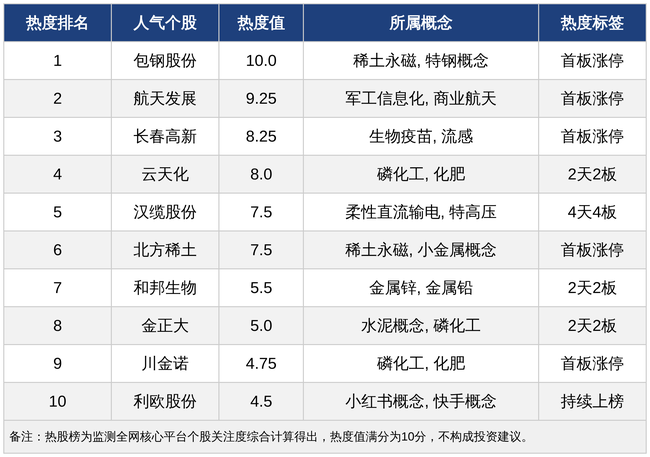
今日十大热股:包钢股份领衔稀土板块爆发,长春高新全球首款儿童小阴茎治疗软膏获批临床
Jin Rong Jie· 2026-02-26 01:27
Market Overview - On February 25, the Shanghai Composite Index rose by 0.72% to 4147.23 points, the Shenzhen Component Index increased by 1.29% to 14475.86 points, and the ChiNext Index climbed by 1.41% to 3354.82 points. The total trading volume in the Shanghai and Shenzhen markets reached 2.46 trillion yuan, an increase of approximately 260.48 billion yuan compared to the previous trading day. A total of 3540 stocks rose, 1529 fell, and 121 remained unchanged, with thematic sectors showing strong performance [1]. Popular Stocks - The top ten popular stocks in A-shares include Baogang Group, Aerospace Development, Changchun High-tech, Yuntianhua, Hancable, Northern Rare Earth, Hebang Biotechnology, Jinzhengdai, Chuanjinnuo, and Lioo [1][2]. Baogang Group - Baogang Group's market attention is driven by its advantages in rare earth resources and the effectiveness of its strategic transformation. The price of rare earth concentrate has been raised for the sixth consecutive time, indicating an improvement in its bargaining power within the rare earth industry chain. The production of rare earth steel reached a historical high of 1.5 million tons, supported by its exclusive supply rights from the world's largest rare earth mine [3]. Aerospace Development - Aerospace Development's rise in popularity is attributed to dual advancements in governance optimization and strategic layout. The company has recently completed a standardized board of directors' restructuring and revised several management systems. Its subsidiary, Aerospace Tianmu, is advancing the "Tianmu No. 1" satellite project through capital increase and expansion, enhancing its strategic positioning in military informationization and commercial aerospace [3]. Changchun High-tech - Changchun High-tech is gaining attention due to significant breakthroughs in the innovative drug sector. The company has received clinical approval for the world's first ointment for treating pediatric micropenis and has strong sales for its IL-1β monoclonal antibody. Additionally, it secured a $1.365 billion overseas business development contract, marking a substantial business increment [4]. Yuntianhua - Yuntianhua's market interest stems from its resource advantages and external demand. The company possesses nearly 800 million tons of phosphate reserves with a self-sufficiency rate of 100%. The production of its 100,000-ton iron phosphate project has commenced, and the upcoming spring farming season is expected to boost phosphate fertilizer demand [4]. Hancable - Hancable's popularity is driven by technological advantages underpinned by policy support. The State Grid's investment plan of 4 trillion yuan is expected to stimulate demand for high-end cables, particularly in ultra-high voltage and flexible direct current sectors. The company has core technologies in ±535kV submarine cables and has optimized its governance structure to enhance competitiveness [5]. Northern Rare Earth - Northern Rare Earth's market focus is influenced by policy, supply-demand dynamics, and performance. As a leader in the rare earth industry, the company benefits from national protection policies and the tightening of supply controls, which have improved the supply-demand balance and driven up rare earth prices. The company's net profit is expected to increase by 116.67% to 1.346 billion yuan [5]. Hebang Biotechnology - Hebang Biotechnology's rise is linked to resource layout and positive business developments. The company has obtained exploration rights for over 1,000 square kilometers of gold mines in Australia and is advancing multi-metal mining projects in Xinjiang. Its methionine business is experiencing growth, and external factors such as rising commodity prices are enhancing profitability [6]. Jinzhengdai, Chuanjinnuo, and Lioo - Jinzhengdai is benefiting from increased attention in the fertilizer industry, with rising domestic urea prices and improved governance structure. Chuanjinnuo is seeing a significant profit increase of 144%-180% due to international phosphate prices exceeding $700 per ton. Lioo has capitalized on AI marketing and liquid cooling server trends, achieving a net profit increase of 469.1% [6].


午报三大指数均涨超1%,稀土、化工等涨价题材持续爆发
Xin Lang Cai Jing· 2026-02-25 04:27
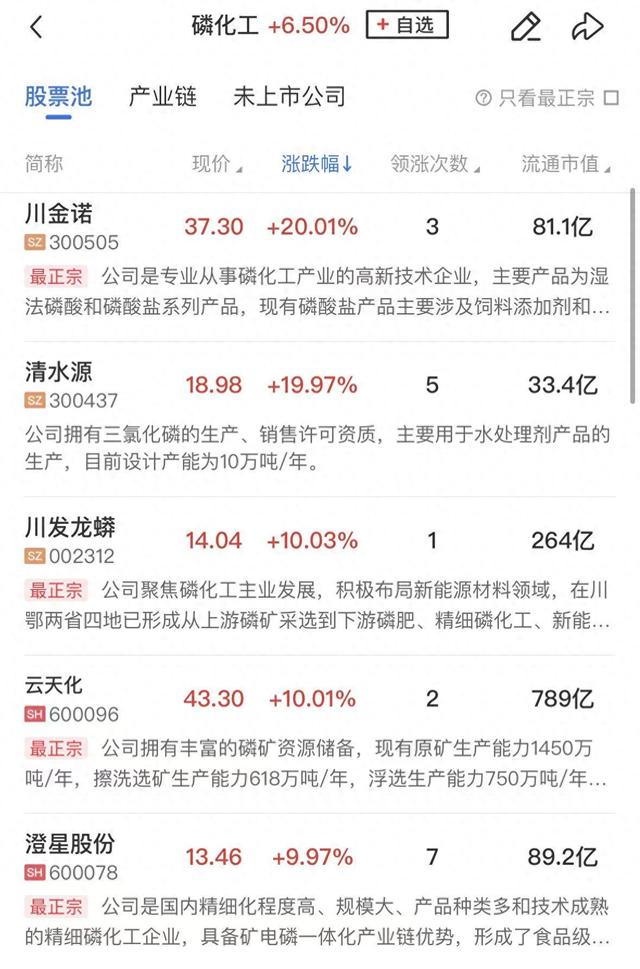
Market Overview - The market experienced a strong upward trend in early trading, with all three major indices rising over 1%. The total trading volume in the Shanghai and Shenzhen markets reached 1.52 trillion yuan, an increase of 10.4 billion yuan compared to the previous trading day [1] - Nearly 4,000 stocks in the market saw gains, driven by price increase catalysts in sectors such as rare earths, phosphate chemicals, shipping, and oil and gas [1][8] - The Shanghai Composite Index rose by 1.2%, the Shenzhen Component Index increased by 1.47%, and the ChiNext Index gained 1.43% [1] Sector Performance Rare Earths - The rare earth permanent magnet sector was notably active, with stocks like Northern Rare Earth and Baotou Steel rising to their daily limits. Heavy rare earth prices surged, with prices for yttrium reaching $850 per kilogram and dysprosium at $1,100 per kilogram, marking the highest levels since 2015 [3][18] - Analysts predict that the domestic rare earth prices will continue to rise, with expectations of sustained high growth in the rare earth industry through the first quarter of 2026 [3][18] Phosphate Chemicals - The phosphate chemical sector maintained its strong performance, with stocks such as Chengxing Phosphate and Liuguo Chemical achieving consecutive daily limits. The international price of phosphate fertilizers has exceeded $700 per ton due to supply chain restructuring [2][3] - Supply constraints from environmental policies and increasing demand from the new energy sector are tightening the supply-demand balance in the phosphate market [3] Lithium Mining - Lithium mining stocks also performed well, with companies like Dazhong Mining and Yongshan Lithium Industry hitting their daily limits. The price of lithium carbonate futures reached 170,000 yuan per ton, reflecting a nearly 5% increase [6][7] - UBS reports suggest that the global lithium market may enter a third super cycle, with demand expected to double to 3.4 million tons by 2030 [7] Shipping - The shipping sector saw significant price increases, with the cost of renting a super-large oil tanker to transport crude oil from the Middle East to China exceeding $170,000 per day, tripling since the beginning of the year [29] Stock Highlights - A total of 68 stocks hit their daily limits in early trading, with a limit-up rate of 82%. Notable stocks included Yunnan Tin and Huayou Cobalt, which are linked to the lithium and phosphate sectors [1][9] - The stock performance was driven by strong fundamentals and market sentiment surrounding price increases in key commodities [1][8]


湘财证券晨会纪要-20260225
Xiangcai Securities· 2026-02-25 00:24
Industry Overview - The rare earth magnetic materials industry saw an increase of 8.84% in the week before the holiday, outperforming the benchmark by 8.48 percentage points [4] - The industry valuation (TTM P/E ratio) rebounded to 86.39x, currently at 93.3% of its historical percentile [4] Price Trends - Rare earth concentrate prices showed a steady increase, with the average price of mixed carbonate rare earth ore remaining stable, while imported monazite prices rose by 6.72% [5] - The price of praseodymium and neodymium saw significant increases, with praseodymium oxide prices up by 12.21% and praseodymium metal prices up by 10.38% [5] - Dysprosium and terbium prices also increased, with dysprosium oxide prices rising by 5.73% and terbium oxide prices by 3.49% [5] - The price of sintered neodymium-iron-boron magnets continued to rise, with N35 and H35 grades increasing by 1.73% and 1.23% respectively [5] Supply and Demand Dynamics - The supply side remains stable with upstream production normal during the holiday, while downstream neodymium-iron-boron enterprises are on break, leading to reduced market consumption [8] - Post-holiday, there is an expectation for increased raw material demand as production resumes in downstream sectors [8] - The demand for new energy vehicles is experiencing a marginal decline, while wind power installations are expected to release some demand [8] Investment Recommendations - The industry maintains an "overweight" rating, supported by high valuation levels and potential policy easing post-holiday [9] - Focus on upstream rare earth resource companies due to policy support and stable pricing trends, which may lead to valuation premiums and stable profits [9] - Downstream magnetic material companies are expected to see profit recovery, particularly those with strong customer structures and new growth opportunities [9]
因中国不回信,被晾多天的莫迪,怒砸700亿要取代中国稀土地位?
Sou Hu Cai Jing· 2026-02-05 08:50
Group 1 - The core message of the article highlights India's ambition to enhance its rare earth mineral supply chain to boost manufacturing capabilities, with a significant funding proposal of over 700 billion rupees (approximately 7.88 billion USD) aimed at supporting local enterprises in the rare earth sector [1][6][31] - India is actively engaging in international partnerships for critical minerals, having established collaborations with countries like Australia and Mozambique, indicating a strategic positioning in the global mineral landscape [6][29] - Despite possessing the world's third-largest rare earth reserves, India's challenges include environmental concerns, social issues related to mining, and the need for substantial investment to realize its goals [7][31] Group 2 - The article outlines three major challenges facing India's rare earth industry: the difficulty of technology transfer from laboratory success to mass production, safety concerns related to mining operations, and the inadequacy of production capacity compared to China [11][15][19] - India's current production capacity is limited, with a recent facility in Pune achieving only 15 tons per month, which is significantly lower than the hundreds or thousands of tons produced by many Chinese companies [19][22] - The lack of skilled workforce and a complete industrial chain further complicates India's efforts, as it currently only controls parts of the rare earth production process, leading to reliance on imports for high-value products [21][22] Group 3 - To address these challenges, India is exploring alternative technologies and developing a "rare earth corridor" concept to integrate resource locations, processing areas, and logistics, aiming to create a cohesive industrial ecosystem [25][27] - The collaboration with Australia is seen as a potential solution, as both countries have complementary needs in terms of resources and processing capabilities, although progress has been slow [29] - The effectiveness of the 700 billion rupee incentive plan remains uncertain, as it will require time to determine whether it can genuinely support India's ambitions in the global rare earth market [31]