
稀土价格上涨

Search documents
国投证券:稀土供需格局重塑 价格中枢或上移
智通财经网· 2026-02-27 01:49
Core Viewpoint - The rare earth industry is experiencing a significant supply-demand mismatch, with supply rigidities highlighted by China's dominance in the separation and smelting capacity, while demand is expanding due to increased usage in high-end applications such as electric vehicles and wind power [1][2][3][4]. Supply Dominance - China holds an absolute dominant position in rare earth supply, with an expected 51% share of the global rare earth reserves exceeding 85 million tons by 2025. China's separation capacity is projected to account for nearly 90% of global capacity, with top-tier technology ensuring control over rare earth oxide production [2]. - The short-term overseas supply increase is unlikely to compensate for China's dominance, with core overseas supplier Lynas expected to produce only 8,000 tons of praseodymium-neodymium oxide by 2025 [2]. Policy Tightening - The rare earth industry is experiencing significant and ongoing policy tightening, with mining and smelting separation growth rates expected to drop to 12.5% and 10.43% respectively in 2024. The introduction of the "Interim Measures for the Total Control of Rare Earth Mining and Smelting Separation" in 2025 will include controls on overseas imported ore smelting quotas [3]. - The consolidation of the industry is progressing, with Northern Rare Earth and China Rare Earth Group controlling 100% of the national mining quotas by 2024, further compressing supply elasticity and supporting price increases [3]. Demand Expansion - Global demand for praseodymium-neodymium oxide is expected to grow at a rate of 8.39% year-on-year by 2026, driven primarily by the electric vehicle sector, which is projected to increase neodymium-iron-boron demand by 10% to 81,312 tons [4]. - Wind power installations are also contributing to demand growth, with a 6% increase in neodymium-iron-boron demand expected, reaching 40,666 tons. Other sectors such as industrial robots and energy-saving elevators are anticipated to see steady demand growth of 8% and 5% respectively [4]. Supply-Demand Mismatch - The supply-demand balance for praseodymium-neodymium oxide is expected to remain tight, with total supply projected at 116,500 tons and total demand at 111,300 tons in 2025, resulting in a supply-demand gap of only 5,229 tons. This gap is expected to widen to -5,393 tons by 2026 [5]. - The combination of domestic quota controls and slow overseas production increases will create rigidities in supply, while demand continues to expand in high-growth sectors, providing strong upward momentum for prices [5]. Investment Focus - Key investment targets in the rare earth sector include China Rare Earth, Shenghe Resources, Northern Rare Earth, Huahong Technology, and Baotou Steel. In the magnetic materials sector, notable companies include Jinchuan Group, Ningbo Yunsheng, Zhenghai Magnetic Materials, Galaxy Magnet, and Zhongke Sanhuan [5].
稀土价格指数年内涨超30% 供需共振推动“工业黄金”涨价
Zheng Quan Ri Bao Wang· 2026-02-12 13:12
Group 1 - The core viewpoint of the news is that rare earth prices have surged significantly in early 2026, driven by supply-demand dynamics, with the rare earth price index rising by 33.64% from 217 on December 31, 2025, to 290 on February 12, 2026 [1] - The increase in rare earth prices is attributed to low inventory levels and strong market expectations, leading to preventive stocking behaviors among companies due to short-term production constraints [1] - Specific rare earth products have seen substantial price increases, with praseodymium oxide reaching 890,000 yuan/ton (up 43.55%), neodymium oxide at 880,000 yuan/ton (up 41.94%), and neodymium metal at 1,060,000 yuan/ton (up 39.47%) [1] Group 2 - Looking ahead, it is anticipated that as upstream companies resume operations, the supply-demand relationship may gradually improve, leading to a stabilization of prices with potential narrow fluctuations [2] - The long-term demand for rare earths is expected to grow due to the booming development of emerging industries such as electric vehicles, wind power, industrial motors, robotics, and drones [2] - The rare earth industry in China has entered a highly concentrated phase, with leading companies enhancing their core competitiveness through continuous technological innovation and industrial system development [2] Group 3 - China holds a dominant and irreplaceable position in the global rare earth industry chain, possessing advantages in resource reserves, extraction capabilities, and advanced refining and separation technologies [3] - The leading companies in China's rare earth sector are expected to further consolidate their market positions due to significant resource and cost advantages, as well as comprehensive industry chain layouts from extraction to high-end material manufacturing [3]


金力永磁港股走高,稀土价格持续攀升,机构称板块将演化估值业绩双升
Zhi Tong Cai Jing· 2026-02-11 03:49
Core Viewpoint - The rare earth market is experiencing a price increase for key products, driven by stable demand and supply constraints expected to persist through 2026 [3] Price Movements - As of February 10, the average price of praseodymium-neodymium oxide is 850,200 CNY/ton, up by 51,400 CNY/ton - The average price of praseodymium-neodymium metal is 1,016,000 CNY/ton, up by 39,700 CNY/ton - The average price of dysprosium oxide is 1,412,200 CNY/ton, up by 11,400 CNY/ton - The average price of terbium oxide is 6,234,300 CNY/ton, up by 20,000 CNY/ton [3] Market Outlook - According to Guotou Securities, the rare earth prices have been rising since January, with expectations of a new inventory replenishment cycle starting due to stable demand and supply constraints [3] - Guojin Securities believes that the rare earth sector will continue to see both valuation and performance improvements, with 2026 being a critical year for resolving competition among peers in the industry [3]

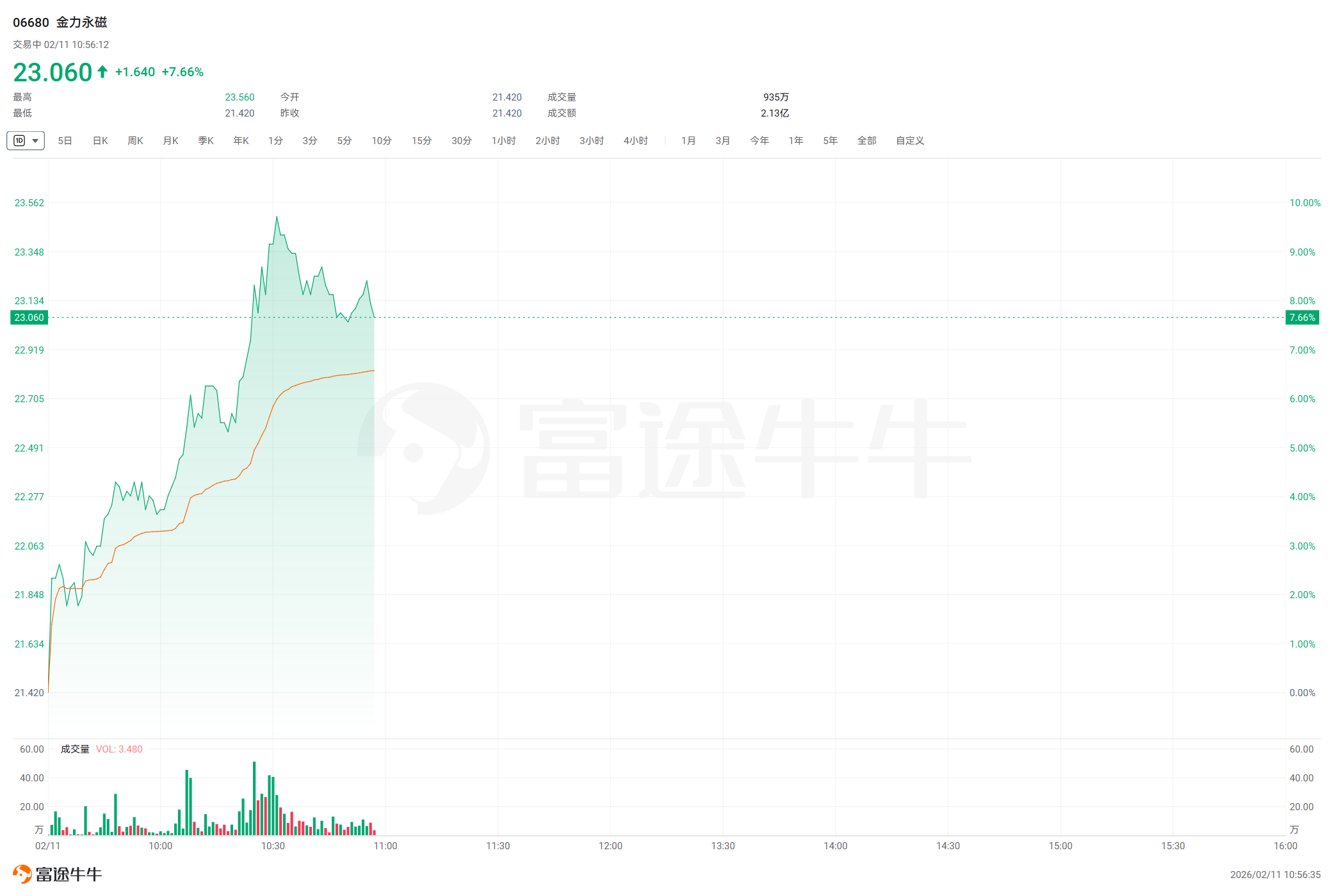
金力永磁午前涨逾7% 机构称稀土板块将演化估值业绩双升
Xin Lang Cai Jing· 2026-02-11 03:32
Core Viewpoint - The stock price of Jinli Permanent Magnet (06680) has increased significantly, reflecting a positive market sentiment towards rare earth products, driven by rising prices and anticipated demand growth in the sector [5]. Group 1: Stock Performance - Jinli Permanent Magnet's stock price rose by over 9% during the trading session, with a current price of 22.84 HKD, marking a 6.63% increase and a trading volume of 237 million HKD [5]. Group 2: Rare Earth Market Trends - As of February 10, the prices of major rare earth products have shown an upward trend, with praseodymium-neodymium oxide averaging 850,200 CNY/ton, up by 51,400 CNY/ton; metallic praseodymium-neodymium at 1,016,000 CNY/ton, up by 39,700 CNY/ton; dysprosium oxide at 1,412,200 CNY/ton, up by 11,400 CNY/ton; and terbium oxide at 6,234,300 CNY/ton, up by 20,000 CNY/ton [5]. - According to Guotou Securities, the rare earth prices have been on the rise since January, with expectations of stable growth in both domestic and international demand, potentially initiating a new inventory replenishment cycle [5]. - Guotong Securities also notes that the rare earth market is less influenced by macroeconomic sentiment, suggesting a focus on sector allocation opportunities [5]. - Guojin Securities believes that the rare earth sector will continue to evolve with both valuation and performance improvements, with 2026 being a critical year for resolving competition among key industry players [5].
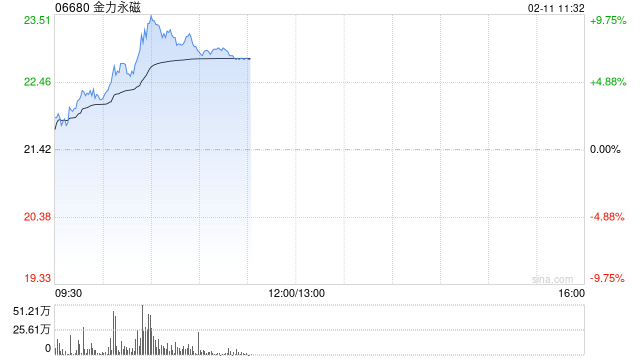
港股异动 | 金力永磁(06680)涨超9% 稀土价格持续攀升 机构称板块将演化估值业绩双升
智通财经网· 2026-02-11 02:42
Core Viewpoint - The stock price of JINLI Permanent Magnet (06680) has increased by over 9%, reaching HKD 23.36, with a trading volume of HKD 1.57 billion, driven by rising rare earth prices [1] Group 1: Rare Earth Market Trends - As of February 10, the prices of mainstream rare earth products have generally risen, with praseodymium-neodymium oxide averaging CNY 850,200 per ton, up CNY 51,400 per ton; praseodymium-neodymium metal averaging CNY 1,016,000 per ton, up CNY 39,700 per ton; dysprosium oxide averaging CNY 1,412,200 per ton, up CNY 11,400 per ton; and terbium oxide averaging CNY 6,234,300 per ton, up CNY 20,000 per ton [1] - Since January, rare earth prices have been on the rise, with expectations of stable growth in both domestic and international demand, potentially initiating a new round of inventory replenishment [1] Group 2: Future Outlook - Guotou Securities anticipates that the rigid constraints of the whitelist and quota indicators will limit supply in 2026, while demand is expected to grow steadily, leading to an increase in the central price of rare earths [1] - Guojin Securities believes that the rare earth sector will continue to evolve with both valuation and performance improvements, with 2026 being a critical year for resolving competition among peers in the industry [1]
金力永磁涨超9% 稀土价格持续攀升 机构称板块将演化估值业绩双升
Zhi Tong Cai Jing· 2026-02-11 02:37
Core Viewpoint - The stock of Jinli Permanent Magnet (金力永磁) has risen over 9%, reaching HKD 23.36 with a trading volume of HKD 1.57 billion, driven by an increase in rare earth product prices as reported by Baotou Rare Earth Products Exchange [1] Group 1: Price Movements - The average price of praseodymium-neodymium oxide is now CNY 850,200 per ton, up by CNY 51,400 per ton [1] - The average price of praseodymium-neodymium metal is CNY 1,016,000 per ton, an increase of CNY 39,700 per ton [1] - The average price of dysprosium oxide is CNY 1,412,200 per ton, rising by CNY 11,400 per ton [1] - The average price of terbium oxide is CNY 6,234,300 per ton, up by CNY 20,000 per ton [1] Group 2: Market Outlook - Guotou Securities indicates that rare earth prices have been rising since January, with expectations of stable growth in both domestic and international demand, potentially initiating a new inventory replenishment cycle [1] - The firm anticipates that the rigid constraints of the whitelist and quota indicators will limit supply in 2026, leading to an increase in the central price of rare earths [1] - Guojin Securities believes that the rare earth sector will continue to evolve with both valuation and performance rising, with 2026 being a critical year for resolving competition among peers in the industry [1]
稀土价格|临近春节,镨钕价格跳涨
Xin Lang Cai Jing· 2026-02-10 07:30
Price Overview - As of February 10, 2026, various rare earth products have shown significant price variations, with prices for Pr6O11 and Nd2O3 reaching 857,000.00 yuan/ton and 855,000.00 yuan/ton respectively, both increasing by 34,000 yuan and 35,000 yuan [1] - The price of Gd2O3 has increased by 10,000 yuan to 230,000.00 yuan/ton, while Tb4O7 remains at a high price of 6,250,000.00 yuan/ton [1] Market Dynamics - The domestic rare earth market is currently characterized by a situation of "high prices but low market activity," with significant price increases for light and heavy rare earth products, including a rise of approximately 50,000 yuan/ton for PrNd metal and 65,000 yuan/ton for Tb [2] - Despite the price increases, market transactions are relatively quiet as logistics efficiency declines and downstream demand weakens ahead of the Spring Festival [2] Regulatory Environment - The Supreme People's Procuratorate has announced plans for 2026 to enhance the enforcement against smuggling crimes, particularly focusing on rare earths, in line with the directives from the 20th National Congress [3] - The emphasis will be on strengthening judicial cooperation to protect national sovereignty and development interests, particularly in the context of the Hainan Free Trade Port [3]
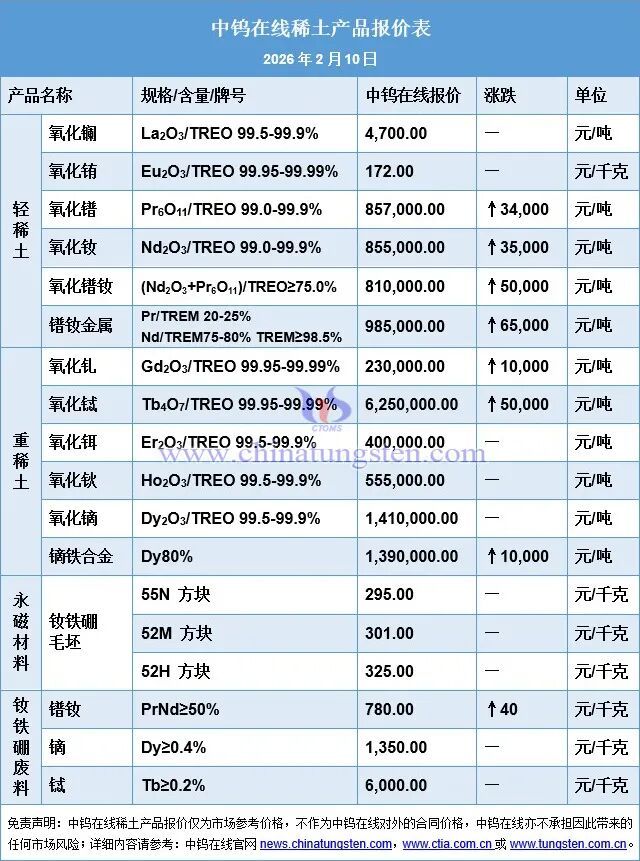
稀土接连创出价格新高,短期或持续高位波动
日经中文网· 2026-02-10 07:30
Core Insights - The prices of rare earth elements, particularly dysprosium and terbium, have reached record highs not seen since 2015, driven by increased demand and export controls from China [1][3] - Yttrium, used in high-performance medical devices, has seen its price surge to approximately 1.6 times its previous value within a month [1] - The global defense spending increase is contributing to the rising prices of rare earth materials, with strong demand in defense and electronic devices [6] Price Trends - Dysprosium prices have risen to $960 per kilogram, while terbium has reached $4,000 per kilogram, both marking historical highs [3] - Yttrium's price increased to $425 as of February 5, significantly up from $260 at the end of 2025 [3] - Gallium prices have also reached $1,600, maintaining a historical peak since early January [3] Export Controls and Strategic Resources - China has positioned rare earths as strategic resources and has implemented export controls, particularly against Japan [4][6] - The Chinese government announced enhanced export controls on dual-use items to Japan in response to political statements made by Japanese officials [6] - Following trade negotiations with the U.S., China postponed the implementation of rare earth export controls until fall 2025, leading to a stabilization of prices until the end of that year [6] Market Dynamics - Companies are reportedly rushing to secure inventory in light of the new export controls, indicating a potential supply crunch [6] - Analysts predict that rare earth prices are likely to remain volatile at high levels in the short term due to ongoing supply constraints and strong demand [6]
包头稀土产品交易所:稀土主流产品价格整体上行
2 1 Shi Ji Jing Ji Bao Dao· 2026-02-09 09:16
Core Viewpoint - The prices of mainstream rare earth products have increased overall, indicating a rising trend in the market despite limited actual transactions due to low purchasing willingness from most enterprises [1] Price Summary - The average price of praseodymium and neodymium oxide is 798,800 CNY/ton, up by 41,300 CNY/ton [1] - The average price of praseodymium and neodymium metal is 976,300 CNY/ton, up by 61,900 CNY/ton [1] - The average price of dysprosium oxide is 1,400,800 CNY/ton, up by 16,500 CNY/ton [1] - The average price of terbium oxide is 6,214,300 CNY/ton, up by 77,200 CNY/ton [1] Market Activity - At the beginning of the week, praseodymium and neodymium product prices rose again, with logistics gradually concluding and trading companies rushing to complete remaining orders, leading to active market inquiries [1] - However, most magnetic material companies have entered a holiday period, and metal companies have largely finished stocking, resulting in low overall purchasing willingness [1] - Despite the increase in prices for medium and heavy rare earths, actual transactions remain limited due to constrained market demand [1] Recommendations - Companies are advised to analyze market trends rationally and continuously monitor actual supply and demand changes in the market [1]
国内轻稀土价格上涨动能强劲,稀土ETF易方达(159715)助力低成本布局产业龙头
Mei Ri Jing Ji Xin Wen· 2026-02-09 07:53
Core Viewpoint - The rare earth industry is experiencing a significant price increase, with expectations for continued growth in 2026, driven by supply-demand dynamics and strategic value reassessment [1] Price Trends - As of February 6, the price of praseodymium-neodymium oxide reached 758,000 yuan/ton, a monthly increase of 24.9% and a year-on-year increase of 79.9% [1] - The price of heavy rare earth terbium oxide rose to 6,155 yuan/ton, with a monthly increase of 2.2% [1] Market Dynamics - There is a notable divergence between rare earth prices and stock prices, suggesting a potential return to fundamental pricing as market liquidity effects are digested [1] - Analysts predict that domestic rare earth prices will continue to rise, with the praseodymium-neodymium oxide price surpassing 700,000 yuan/ton [1] Supply and Demand Factors - The supply side is characterized by a separation of mining and smelting, with total quantity control and a slowdown in domestic production growth, lagging behind demand expansion [1] - Demand is being driven by rapid developments in industries such as robotics, low-altitude economy, and military applications [1] - High overseas smelting costs are also providing support for prices [1] Investment Perspective - The CSI Rare Earth Industry Index focuses on core segments of the rare earth industry chain, covering leading companies from mining and smelting to deep processing and downstream applications [1] - The E Fund Rare Earth ETF (159715) offers a low-cost investment tool with a management fee rate of only 0.15% per year for investors looking to enter the rare earth sector [1]


