
税务咨询

Search documents
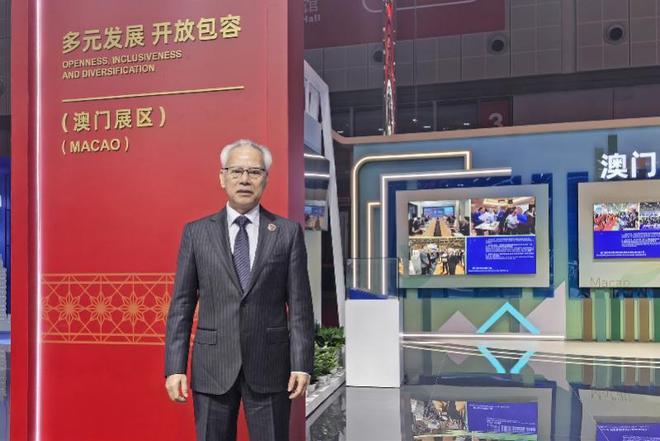
岑浩辉率团参加第八届进博会!展示澳门及葡语国家产品及服务
Nan Fang Du Shi Bao· 2025-11-05 06:32
Core Viewpoint - The 8th China International Import Expo (CIIE) opened in Shanghai on November 5, showcasing Macau's participation and its efforts to promote local businesses and services [1][9]. Group 1: Macau's Participation - The Chief Executive of the Macau Special Administrative Region, Ho Iat Seng, attended the opening ceremony and related activities, accompanied by the Secretary for Economy and Finance, Lei Wai Nong [1][3]. - A delegation of 43 small and medium-sized enterprises (SMEs) from Macau is participating in the expo, with a significant increase in health-related enterprises, totaling six [5][10]. - Approximately one-quarter of the participating companies are first-time exhibitors at the expo [5]. Group 2: Exhibition Highlights - The "Macau and Portuguese-speaking Countries Food and Beverage Pavilion" covers an area of 600 square meters, showcasing products from Macau and Portuguese-speaking countries [7]. - A 60-square-meter "Macau and Portuguese-speaking Countries Professional Services Pavilion" is also set up, offering services in education, legal, tax consulting, and product processing [7]. - The Macau Investment Promotion Agency is promoting the "Support for Macau's First Store Economic Development Plan" during the expo, aiming to attract eligible foreign brands to establish their first stores in Macau [10].

企业如何选择合适的代理记账公司_免费代理记账
Sou Hu Cai Jing· 2025-10-14 02:20
Core Insights - Financial and tax management are crucial for daily operations in businesses, especially for small and medium-sized enterprises (SMEs) that often opt for outsourcing to accounting firms due to high costs of hiring in-house accountants [1] Group 1: Professional Qualifications and Experience - Companies should assess the professional qualifications and experience of accounting firms, ensuring they possess necessary licenses and have a solid track record in handling various financial and tax processes [2] - For instance, Zhengzhou Junzhirui Financial Services Co., Ltd. has been operating for over seven years and has served more than a thousand SMEs, indicating substantial experience and client base in the field [2] Group 2: Service Content and Specialization - Different businesses have varying needs for accounting services, ranging from basic bookkeeping to complex tax consulting and planning [3] - Zhengzhou Junzhirui Financial Services Co., Ltd. has participated in tax planning for well-known provincial enterprises, showcasing its expertise and practical experience in tax matters [3] Group 3: Service Process and Communication Mechanism - Efficient and clear service processes are essential for smooth accounting operations, including the handling of documents, bookkeeping, and tax filing [7] - A responsive communication mechanism is vital, ensuring that businesses have a designated contact person and can receive timely assistance [7] Group 4: Data Security and Confidentiality - The security of financial data is paramount, and companies should inquire about the measures accounting firms take to protect client data, including secure storage and encrypted transmission [8] Group 5: Fee Structure and Contract Terms - The fee structure for accounting services is a significant consideration, with companies needing to be cautious of unusually low prices that may indicate reduced service quality or hidden fees [9] - It is important to thoroughly review service contracts to clarify rights, obligations, service duration, and termination clauses [9] Group 6: Customer Feedback and Reputation - Understanding the experiences of other businesses with accounting firms can provide insights into service quality, with positive reviews and long-term clients indicating reliability [10] Group 7: Continuous Learning and Policy Adaptation - An excellent accounting firm should demonstrate the ability to continuously learn and adapt to changes in tax regulations and accounting standards, ensuring they provide accurate guidance to clients [12]

上海静安区公司多年乱账整理经验分享
Sou Hu Cai Jing· 2025-09-19 22:30
Core Viewpoint - The article emphasizes the importance of timely and systematic management of chaotic accounts in businesses to mitigate financial risks and management pressures [1] Group 1: Issues with Chaotic Accounts - Chaotic accounts often manifest as discrepancies between actual and recorded figures, missing vouchers, disorganized accounts, and unclear fund flows [1] - These issues can hinder accurate profit and loss calculations, pose tax risks, and potentially affect the company's creditworthiness [1] Group 2: Steps for Organizing Accounts - Step 1: Collect and organize original vouchers, including bank statements, invoices, receipts, contracts, and payroll records, in chronological order and by category to facilitate future verification [2] - Step 2: Rebuild the accounting system by establishing a clear set of accounts tailored to the business's nature and characteristics, ensuring logical classification [2] - Step 3: Compare each transaction in bank statements with recorded accounts to identify discrepancies, such as unrecorded items or incorrect entries [3] - Step 4: Clear accounts receivable and payable by verifying balances with customers and suppliers, distinguishing between collectible and payable amounts [6] - Step 5: Conduct inventory and asset verification to ensure alignment between recorded and actual figures, addressing any discrepancies promptly [7] - Step 6: Check tax compliance by reviewing historical tax filings for any issues that need correction or professional guidance [9] - Step 7: Prepare a detailed adjustment report outlining the issues and resolutions, and establish standardized financial processes to prevent future occurrences [9] Group 3: Professional Assistance - Companies can benefit from the support of professional financial service institutions, such as Shanghai Qin Cang Financial Group, which specializes in account organization and tax consulting [11]

致同会计师事务所首席合伙人李惠琦:并购活跃、政策加持 中国企业出海迈入新阶段
Zhong Guo Jing Ying Bao· 2025-09-14 03:18
Group 1 - The core viewpoint of the article highlights the acceleration of Chinese enterprises' globalization across various sectors, including new energy vehicles, lithium batteries, and cultural industries, with a significant increase in foreign direct investment (FDI) [1] - In 2024, China's FDI flow reached $192.2 billion, marking an 8.4% increase from the previous year and accounting for 11.9% of the global share, maintaining a position among the top three globally for 13 consecutive years [1] - By the end of 2024, China's FDI stock is projected to reach $3.14 trillion, continuing its trend of being among the top three globally for eight years [1] Group 2 - The "going out" strategy of Chinese enterprises has evolved into a "technology + brand + ecosystem" collaborative output model, characterized by high-end, diversified, and ecological features [2] - The "new three samples" (new energy vehicles, photovoltaic, and lithium batteries) are leading high-tech exports, transitioning from product trade to full industrial chain output [2] - Cross-border e-commerce continues to drive consumer exports, with Chinese brands dominating sectors such as clothing, electronics, and home goods [2] Group 3 - Professional services such as auditing, consulting, and legal services are increasingly accompanying enterprises abroad, creating an ecosystem synergy effect [3] - Companies are adopting a systematic decision-making framework for selecting overseas destinations, focusing on supply chain layout and customer demographics [4] - The "China +1" strategy is being employed to avoid trade barriers, with investments in regions like Southeast Asia and Mexico to mitigate high tariffs [4] Group 4 - Chinese enterprises are experiencing a significant increase in overseas mergers and acquisitions (M&A), with a notable rise in large transactions despite a slight decrease in the number of deals [5][6] - Emerging markets are becoming more active in cross-border M&A, with countries involved in the Belt and Road Initiative seeing increased investment [5] - The valuation expectations between buyers and sellers are narrowing, with quality targets being pushed to the market [5] Group 5 - The Chinese government is implementing a multi-layered policy system to support enterprises going abroad, including financial credit support and cross-border investment facilitation [7] - Various policy financial products have been introduced to address the financing challenges faced by small and medium-sized foreign trade enterprises [7] - Initiatives such as simplifying the ODI (Overseas Direct Investment) filing process and encouraging enterprises to participate in international exhibitions are part of the support measures [7]