美团生活费

Search documents
哈银消金:4672万元股权遇冷火速折价二拍,新帅上任50天或重启自营?
Xin Lang Cai Jing· 2026-01-23 09:45
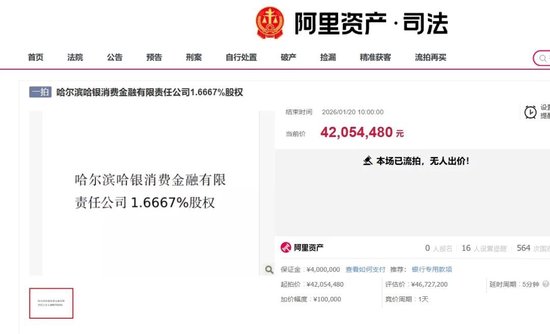
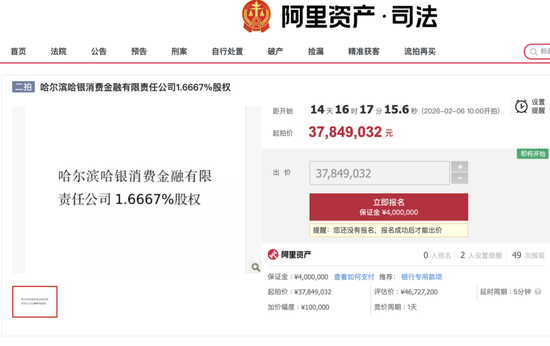
Core Viewpoint - The auction of Harbin Hain Consumer Finance Co., Ltd. (Hain Consumer Finance) shares has faced challenges, with the first auction failing to attract bids, leading to a second auction scheduled for February 6, 2026, at a lower starting price [1][10]. Group 1: Auction Details - The first auction for 1.6667% of Hain Consumer Finance's shares, held on January 20, 2026, ended without any bids, despite a starting price of 42.05448 million yuan, which was a 10% discount from the assessed value of 46.7272 million yuan [1][10]. - The second auction has a starting price of 37.849 million yuan, representing a further discount of approximately 10% from the first auction [10]. Group 2: Reasons for Lack of Interest - The low shareholding percentage (1.6667%) offers minimal strategic value, as Harbin Bank holds 53% and Du Xiaoman holds 30%, making it unattractive for investors seeking control or strategic collaboration [2][11]. - High regulatory entry and change thresholds deter potential buyers, as new regulations require compliance with strict capital and compliance standards, making suitable market participants scarce [2][11]. - The initial auction price was perceived as too high, not adequately reflecting the risks associated with declining industry profitability, leading buyers to wait for further price reductions [2][12]. - The shares are subject to legal complications due to the seller's (Seige International Trade Co., Ltd.) debt crisis, raising concerns about potential legal complexities for buyers [3][12]. Group 3: Company Performance - Hain Consumer Finance has shown steady revenue growth, with revenues of 1.031 billion yuan in 2022, 1.233 billion yuan in 2023, 1.399 billion yuan in 2024, and 1.106 billion yuan in the first half of 2025, alongside net profits of 125 million yuan, 140 million yuan, 156 million yuan, and 144 million yuan respectively [5][14]. - The company's total assets increased from 15.238 billion yuan in 2022 to 25.418 billion yuan, with an asset scale of 25.89 billion yuan as of August 2025, reflecting a 6.25% growth from the beginning of the year [5][14]. Group 4: Strategic Shift - The company has shifted its strategic focus towards loan assistance, significantly increasing its loan assistance scale since 2019, when Du Xiaoman became the second-largest shareholder [5][15]. - The core of the loan assistance model involves leveraging technology and data advantages from partner institutions for customer screening and risk assessment, while Hain Consumer Finance primarily provides funding and compliance functions [6][15]. Group 5: Challenges and Complaints - The company faces challenges related to customer complaints, with 113 regulatory complaints in 2024 and over 3,200 complaints on platforms regarding high annualized interest rates, repayment negotiations, and collection issues [7][16]. - Management instability is noted, with changes in leadership affecting continuity, as the chairman resigned in 2024 and was temporarily replaced before a new chairman was appointed in December 2025 [8][16].

哈银消金千万元股权启动二拍 起拍价缩水10%
Xin Lang Cai Jing· 2026-01-22 10:43
Group 1 - The core issue is that Harbin Hain Consumer Finance Co., Ltd. (Hain Finance) is facing a second round of equity auction for 1.6667% of its shares after the first round failed to attract bids, with the starting price reduced by nearly 10% from the initial auction [1][2][12] - The equity in question is held by Heilongjiang Saige International Trade Co., Ltd., which has had its shares frozen by the Harbin Intermediate People's Court [1][2] - The initial auction price was approximately 42.05 million yuan, while the second auction starting price is around 37.84 million yuan, reflecting a significant decrease in perceived value [1][2] Group 2 - The low attractiveness of the equity is attributed to its small shareholding percentage, which limits potential influence over company strategy, especially in a context dominated by major shareholders like Harbin Bank [2][12] - Regulatory tightening and increased competition are creating an uncertain outlook for the consumer finance industry, with new regulations set to take effect in 2024 [2][12] - The pricing of the equity does not align well with expected financial returns, as the dynamic price-to-earnings ratio appears unfavorable given the industry's profit pressures [2][12] Group 3 - Hain Finance was established in April 2017 and is the 19th licensed consumer finance institution in China, with a registered capital of 1.5 billion yuan [4][12] - The company has a diverse product offering, including self-operated loans with interest rates ranging from 10.8% to 24%, and partnerships with major platforms like Du Xiaoman and Meituan [4][12] - As of mid-2025, Hain Finance reported total assets of 25.418 billion yuan and a loan balance of 23.671 billion yuan, indicating growth in both metrics [4][14] Group 4 - In 2024, Hain Finance's total assets reached 24.369 billion yuan, a year-on-year increase of 14.01%, while the loan balance grew by 11.28% to 22.553 billion yuan [5][14] - The company has faced challenges with customer complaints, handling 113 regulatory complaints in 2024, with a 100% resolution rate [5][15] - Hain Finance's reliance on external loan channels for growth has raised concerns about the sustainability of its business model, especially in light of new regulations affecting third-party partnerships [7][17] Group 5 - The company has encountered regulatory issues, including fines for inadequate information disclosure and violations of credit management regulations [8][18] - Leadership instability has been a concern, with changes in key management positions, including the chairman and financial officer, impacting organizational continuity [9][18] - The upcoming second auction and the new leadership's strategies will be critical to watch for future developments in Hain Finance's operations [10][19]
助贷新规来了!银行圈定“白名单” 24%红线迎考验
Bei Ke Cai Jing· 2025-09-30 09:04
Core Viewpoint - The implementation of the new regulations on internet lending by commercial banks marks a shift towards compliance and risk management, moving away from the previous unregulated growth phase in the industry [6][21][22]. Group 1: Regulatory Changes - The new regulations, effective from October 1, require commercial banks to manage their internet lending partnerships through a whitelist system, ensuring transparency and accountability in their collaborations [9][10]. - Banks and consumer finance companies are increasingly disclosing their partnered lending platforms, with major players like Ant Group, JD.com, and Tencent being preferred partners [4][8][12]. - The regulations aim to control the comprehensive financing costs for borrowers, with a focus on keeping them below 24%, which poses challenges for many lending platforms [15][20]. Group 2: Market Dynamics - The market is currently in a state of observation regarding how to implement the new lending practices, with many platforms scaling back operations due to uncertainty [5][17]. - The shift towards compliance is expected to impact smaller banks more significantly, especially those that heavily rely on lending platforms for customer acquisition [22][24]. - The competition in the lending market is anticipated to evolve from a focus on scale and traffic to a focus on risk management capabilities and financial technology [23]. Group 3: Implications for Financial Institutions - Financial institutions are urged to enhance their risk management practices and ensure that their internal policies align with the new regulations [23]. - The new regulations may create a more challenging environment for smaller banks, which need to leverage their local advantages and avoid homogeneous competition [24]. - The emphasis on compliance and risk management is expected to drive banks to improve their operational capabilities and customer service standards [22][23].