
360借条

Search documents
哈银消金:4672万元股权遇冷火速折价二拍,新帅上任50天或重启自营?
Xin Lang Cai Jing· 2026-01-23 09:45
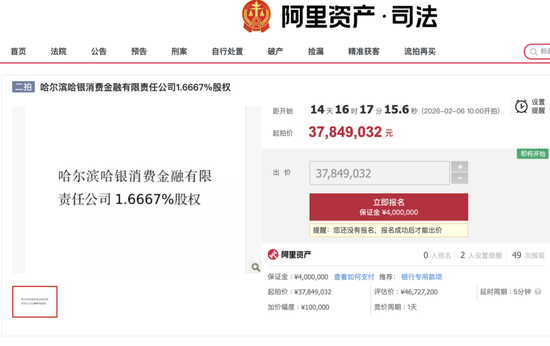
Core Viewpoint - The auction of Harbin Hain Consumer Finance Co., Ltd. (Hain Consumer Finance) shares has faced challenges, with the first auction failing to attract bids, leading to a second auction scheduled for February 6, 2026, at a lower starting price [1][10]. Group 1: Auction Details - The first auction for 1.6667% of Hain Consumer Finance's shares, held on January 20, 2026, ended without any bids, despite a starting price of 42.05448 million yuan, which was a 10% discount from the assessed value of 46.7272 million yuan [1][10]. - The second auction has a starting price of 37.849 million yuan, representing a further discount of approximately 10% from the first auction [10]. Group 2: Reasons for Lack of Interest - The low shareholding percentage (1.6667%) offers minimal strategic value, as Harbin Bank holds 53% and Du Xiaoman holds 30%, making it unattractive for investors seeking control or strategic collaboration [2][11]. - High regulatory entry and change thresholds deter potential buyers, as new regulations require compliance with strict capital and compliance standards, making suitable market participants scarce [2][11]. - The initial auction price was perceived as too high, not adequately reflecting the risks associated with declining industry profitability, leading buyers to wait for further price reductions [2][12]. - The shares are subject to legal complications due to the seller's (Seige International Trade Co., Ltd.) debt crisis, raising concerns about potential legal complexities for buyers [3][12]. Group 3: Company Performance - Hain Consumer Finance has shown steady revenue growth, with revenues of 1.031 billion yuan in 2022, 1.233 billion yuan in 2023, 1.399 billion yuan in 2024, and 1.106 billion yuan in the first half of 2025, alongside net profits of 125 million yuan, 140 million yuan, 156 million yuan, and 144 million yuan respectively [5][14]. - The company's total assets increased from 15.238 billion yuan in 2022 to 25.418 billion yuan, with an asset scale of 25.89 billion yuan as of August 2025, reflecting a 6.25% growth from the beginning of the year [5][14]. Group 4: Strategic Shift - The company has shifted its strategic focus towards loan assistance, significantly increasing its loan assistance scale since 2019, when Du Xiaoman became the second-largest shareholder [5][15]. - The core of the loan assistance model involves leveraging technology and data advantages from partner institutions for customer screening and risk assessment, while Hain Consumer Finance primarily provides funding and compliance functions [6][15]. Group 5: Challenges and Complaints - The company faces challenges related to customer complaints, with 113 regulatory complaints in 2024 and over 3,200 complaints on platforms regarding high annualized interest rates, repayment negotiations, and collection issues [7][16]. - Management instability is noted, with changes in leadership affecting continuity, as the chairman resigned in 2024 and was temporarily replaced before a new chairman was appointed in December 2025 [8][16].

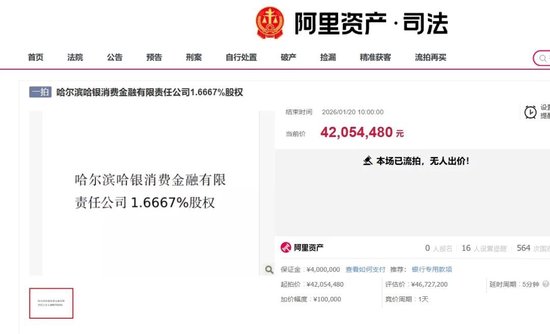
哈银消金千万元股权启动二拍 起拍价缩水10%
Xin Lang Cai Jing· 2026-01-22 10:43
Group 1 - The core issue is that Harbin Hain Consumer Finance Co., Ltd. (Hain Finance) is facing a second round of equity auction for 1.6667% of its shares after the first round failed to attract bids, with the starting price reduced by nearly 10% from the initial auction [1][2][12] - The equity in question is held by Heilongjiang Saige International Trade Co., Ltd., which has had its shares frozen by the Harbin Intermediate People's Court [1][2] - The initial auction price was approximately 42.05 million yuan, while the second auction starting price is around 37.84 million yuan, reflecting a significant decrease in perceived value [1][2] Group 2 - The low attractiveness of the equity is attributed to its small shareholding percentage, which limits potential influence over company strategy, especially in a context dominated by major shareholders like Harbin Bank [2][12] - Regulatory tightening and increased competition are creating an uncertain outlook for the consumer finance industry, with new regulations set to take effect in 2024 [2][12] - The pricing of the equity does not align well with expected financial returns, as the dynamic price-to-earnings ratio appears unfavorable given the industry's profit pressures [2][12] Group 3 - Hain Finance was established in April 2017 and is the 19th licensed consumer finance institution in China, with a registered capital of 1.5 billion yuan [4][12] - The company has a diverse product offering, including self-operated loans with interest rates ranging from 10.8% to 24%, and partnerships with major platforms like Du Xiaoman and Meituan [4][12] - As of mid-2025, Hain Finance reported total assets of 25.418 billion yuan and a loan balance of 23.671 billion yuan, indicating growth in both metrics [4][14] Group 4 - In 2024, Hain Finance's total assets reached 24.369 billion yuan, a year-on-year increase of 14.01%, while the loan balance grew by 11.28% to 22.553 billion yuan [5][14] - The company has faced challenges with customer complaints, handling 113 regulatory complaints in 2024, with a 100% resolution rate [5][15] - Hain Finance's reliance on external loan channels for growth has raised concerns about the sustainability of its business model, especially in light of new regulations affecting third-party partnerships [7][17] Group 5 - The company has encountered regulatory issues, including fines for inadequate information disclosure and violations of credit management regulations [8][18] - Leadership instability has been a concern, with changes in key management positions, including the chairman and financial officer, impacting organizational continuity [9][18] - The upcoming second auction and the new leadership's strategies will be critical to watch for future developments in Hain Finance's operations [10][19]
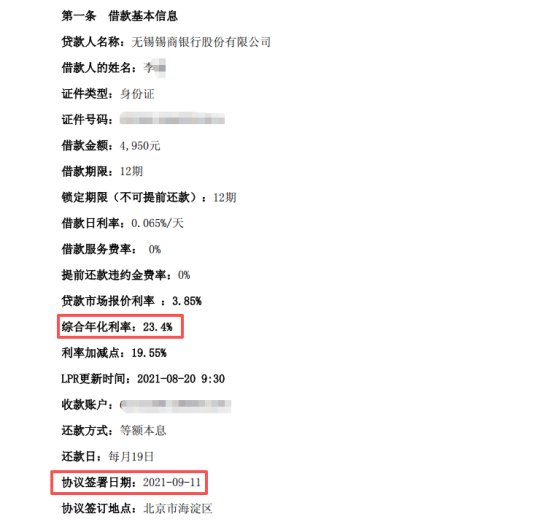
离大谱!360借条的签名,出现在度小满合同上?用户:那我问你?平台:那你问我
Xin Lang Cai Jing· 2026-01-21 10:25
Core Viewpoint - The article discusses a case involving a user, Mr. Li, who applied for a loan through the Du Xiaoman platform and discovered that his electronic signature was improperly used from the "360 Borrow" platform, raising legal concerns about the validity of the loan contract [1][9]. Group 1: Loan Application and Terms - Mr. Li applied for a loan of 5,000 yuan with an annualized interest rate of 23.4% through the Du Xiaoman platform, experiencing issues with violent debt collection after defaulting on payments [1][9]. - Between September 2021 and May 2022, Mr. Li took out four loans, each with a repayment term of 12 installments, leading to complications when he defaulted on the first loan [1][9]. Group 2: Signature and Legal Concerns - Upon reviewing the loan agreement, Mr. Li found that the electronic signature used was sourced from the 360 Borrow platform, which raises questions about the legitimacy of the contract [4][10]. - Legal experts assert that the electronic signature must be controlled solely by the signer at the time of signing, which was not the case here, indicating that the loan contract may not be legally binding [16]. Group 3: Identity Verification Process - During the loan application process, Du Xiaoman did not prompt Mr. Li for identity verification methods such as facial recognition or SMS verification, which is unusual and raises further concerns [6][13]. - Du Xiaoman's representatives stated that they utilized an existing electronic signature from the certification authority, which was valid at the time of the loan application [15]. Group 4: Potential Legal Implications - The use of Mr. Li's electronic signature from another platform without consent could be classified as "misappropriation of another's electronic signature," potentially leading to civil liability for Du Xiaoman [8][16]. - Despite the lack of a valid written contract, a factual borrowing relationship may still exist between the parties, which complicates the legal landscape [8][16].
中国网贷公司进军印度,怎么全军覆没了?
商业洞察· 2025-12-30 09:23
Core Viewpoint - Chinese online lending companies have faced significant failures in India, contrary to their profitable operations in China, leading to a complete loss of investment in the Indian market [2][3][10]. Group 1: Profitability in China - Online lending is a highly profitable industry in China, with companies like Qifu Technology reporting net profits of 2.7 billion in 2021, 4.4 billion in 2022, and projected 6.264 billion in 2024 [2]. - Other platforms such as Baidu's Du Xiaoman are also profitable, with a projected net profit of 859 million in 2024 [2]. Group 2: Challenges in India - Chinese online lending companies initially viewed India as a lucrative market, expecting to profit from lending and collecting interest [6]. - However, they encountered insurmountable challenges, leading to a total loss of investment [6][10]. Group 3: Collection Difficulties - Effective debt collection is crucial for profitability in online lending. In China, aggressive collection methods, despite being controversial, yield results [6]. - In India, these methods fail due to language barriers, lack of a credit system, and cultural differences, making it difficult to enforce repayment [7][9]. Group 4: High Default Rates - The bad debt rate for Chinese online lending companies in India has soared to 80%, meaning only 20 out of every 100 units lent are recovered [9]. - This high default rate, combined with operational costs, results in significant financial losses for these companies [9][10]. Group 5: Regulatory Environment - New regulations from the Reserve Bank of India require online lending companies to limit interest rates and increase transparency, further complicating profitability for Chinese firms [11]. - The lack of a high-credit society in India makes it nearly impossible for these companies to operate profitably, leading to widespread closures [11].


被“自己人”点名的周鸿祎
阿尔法工场研究院· 2025-12-18 00:06
Core Viewpoint - The article discusses allegations of financial fraud against 360's gaming business, initiated by former executive Yu Hong, who claims that the scale of the fraud is "at least tens of billions" and involves "all financial fraud" through methods like "self-recharge" to fabricate revenue [3][8][10]. Group 1: Allegations and Responses - Yu Hong, a former senior executive at 360, publicly accused Zhou Hongyi of financial fraud in the gaming sector, claiming he has data to support his allegations and will disclose it online [3][8]. - In response, 360 issued a statement denying the allegations, asserting that the company's financial data has been audited and that Yu Hong's claims are "malicious defamation" [4][10]. - The stock price of 360 dropped significantly following the allegations, with a 5.07% decline on December 16, resulting in a market value loss of approximately 4 billion yuan [10]. Group 2: Background of Yu Hong - Yu Hong was a senior vice president at 360 after the acquisition of his company, Quyou Group, in 2014, and he was involved in the gaming business before leaving in 2015 [11][12]. - After leaving 360, Yu Hong became active in the blockchain sector and was known for his influential role in a prominent blockchain community [12][13]. - Tensions between Yu Hong and Zhou Hongyi reportedly began in 2018, indicating a history of conflict that may have influenced the recent allegations [13]. Group 3: Historical Context of 360's Gaming Business - 360's gaming business has faced scrutiny in the past, including accusations of inflating revenue during its time on the U.S. stock market [15][17]. - The gaming segment has diminished in importance within 360's overall business strategy, now categorized under "Internet value-added services" [22][24]. - Financial performance data shows that the gaming business contributed only about 0.2% to the company's overall revenue from 2018 to 2024, indicating a significant decline [24][26]. Group 4: Current Business Structure and Future Outlook - 360's revenue structure has shifted, with the main business segments now being Internet services, digital security, and smart hardware, with gaming playing a minor role [26][28]. - The company is focusing on AI and robotics as new growth areas, but these investments are still in the development phase and exert pressure on profitability [28][30]. - The outcome of the allegations could significantly impact 360's ability to navigate its new business strategies and maintain stability moving forward [30].

噱头还是利器?奇富科技的AI风控到底为谁服务?
Sou Hu Cai Jing· 2025-11-24 01:42
Core Insights - The article highlights the dual nature of growth and risk faced by Qifu Technology, emphasizing its reliance on traditional credit matching and traffic distribution rather than technological barriers or ecosystem capabilities [3][5] - Qifu Technology has faced multiple regulatory penalties due to issues such as illegal debt collection and data misuse, raising concerns about its strategic direction and operational integrity [2][4][10] Company Overview - Qifu Technology has completed a brand upgrade from 360 Borrowing to Qifu Borrowing and has partnered with 159 financial institutions, boasting over 240 million registered users [2] - The company’s core business revolves around internet consumer finance, particularly through products like 360 Borrowing, but it has encountered significant complaints related to aggressive debt collection practices [4][6] Competitive Landscape - Qifu Technology's growth contrasts sharply with competitors like Ant Group, Tencent, and JD Technology, which have established robust ecosystems based on technology, social engagement, and supply chain finance [3][8] - The competitive environment has shifted, with players focusing on building sustainable business models and compliance in a tightening regulatory landscape, making Qifu's previous strategies less viable [9][10] Regulatory Challenges - The departure of founder Zhou Hongyi from the board raises concerns about Qifu Technology's future amid increasing regulatory scrutiny, particularly regarding debt collection methods and user privacy [6][7] - The company has been labeled as a "penalty-heavy" entity due to its regulatory issues, which could impact its valuation and fundraising capabilities [7][12] Strategic Recommendations - To achieve sustainable growth, Qifu Technology must focus on rebuilding trust with users and regulators by enhancing compliance mechanisms and transparency in operations [10][11] - The company should leverage technology not just for cost reduction but also to innovate financial products and improve risk assessment models [10][11] Future Outlook - The future of Qifu Technology hinges on its ability to balance rapid expansion with compliance, as prioritizing growth could lead to further regulatory penalties [12] - The company possesses valuable assets such as technological capabilities and a large user base, but it must cultivate a culture of respect for financial regulations and user trust to succeed in the long term [12]

经济观察:加快形成打击互联网金融“黑灰产”合力
Xin Hua Wang· 2025-08-12 05:49
Core Viewpoint - The Chinese Internet Finance Association has issued an initiative to strengthen collaboration in the internet finance sector to combat "black and gray industry" activities, urging institutions to unite against these illegal practices [1][2]. Group 1: Industry Response - Multiple institutions, including Meituan Xiaolai, Lexin, and Qifu Technology, have actively responded to the initiative, indicating a collective effort to address the issue [1]. - Internet finance companies have been engaged in combating "black and gray industry" activities, with Meituan Xiaolai reporting assistance to law enforcement in 77 cases related to various financial crimes since 2022 [2]. Group 2: Nature of "Black and Gray Industry" - The "black and gray industry" encompasses illegal activities such as fraudulent loan intermediaries, fake financial apps, and organized debt evasion, which severely disrupt the normal order of the financial industry [1][2]. - For instance, as of June 15, 2023, there were 1,927 counterfeit apps impersonating Ping An Puhui and 1,846 for 360 Borrowing, which lure victims with exaggerated claims [1]. Group 3: Regulatory Actions - Regulatory bodies have been actively working to address the "black and gray industry," with measures including a notice from the former China Banking and Insurance Regulatory Commission to crack down on illegal agency practices [2]. - A new financial black industry crackdown platform named AIF (Ai Ma) has been launched, involving several financial institutions to enhance collaboration in combating these illegal activities [2]. Group 4: Recommendations for Improvement - Experts suggest establishing a multi-departmental coordination mechanism involving finance, public security, and market regulation to enhance the effectiveness of combating "black and gray industry" activities [3]. - There is a call for improved legal frameworks and increased penalties for illegal activities to deter such practices, alongside strengthening consumer protection systems within financial institutions [3].



警惕“眼熟”陷阱!这些涉诈APP被曝光
券商中国· 2025-07-22 04:18
Core Viewpoint - The article highlights the increasing prevalence of fraudulent apps disguised as legitimate financial services, emphasizing the need for public awareness and vigilance against such scams [1][2][3]. Group 1: Recent Fraudulent Apps Exposed - The Information Communication Industry Anti-Fraud Center has identified and exposed 17 different types of fraudulent apps, including misleading names like "Tencent Payment," "Douyin Poverty Alleviation Wallet," and "360 Borrowing" [3][4]. - These apps often impersonate well-known internet platforms to carry out scams, posing significant risks to users [3][8]. Group 2: Specific Fraud Cases - A notable case involves the "Tencent Payment" app, which fraudulently claims to be a high-end payment product, enticing users to provide personal information and bind their bank accounts [4][5]. - The app employs a "referral" strategy, using virtual currencies and stock options to deceive victims, ultimately leading to the theft of sensitive information [6][8]. Group 3: General Trends in Fraud - The article notes that as digitalization accelerates, new investment fraud techniques are emerging, making it difficult for the public to recognize and avoid scams [10]. - Many fraudsters create counterfeit apps that lure users into providing sensitive information, resulting in financial losses [11]. Group 4: Public Awareness and Prevention - The Information Communication Industry Anti-Fraud Center urges the public to enhance their awareness and share anti-fraud guidelines to protect their financial security [9]. - The article provides three key strategies for identifying counterfeit websites, including checking domain suffixes, port numbers, and SSL certificates [17][18][20].


周鸿祎说“360 借条不是我的公司”,网友:也是醉了
程序员的那些事· 2025-04-28 06:35
周鸿祎昨天在直播中,突然有人过来问: "周总,欠你 360 借条的钱可以不还吗? " 周回应"那不是我的公司"… 周鸿祎曾担任奇富科技的董事及董事会主席,但是 2024 年 8 月辞任相关职务,不再直接参与管理。 这个回复成功让周总喜提热搜了。 360 借条的发展历程 360 借条的实际运营主体是奇富科技,奇富的前身是 360 数科。 2016 年 7 月,360 金融集团成立,由 360 金服(北京奇步天下科技有限公司运营的集团)孵化。 2018 年 9 月,360 金融集团独立运营。 2020 年 8 月,"360 金融"品牌正式升级为"360 数科"。 2022 年,360 数科从 360 集团分拆独立并在港交所上市(法律层面已脱离 360 集团直接控制) 2023 年 2 月,360 数科更名为奇富科技。(进一步淡化 360 的标签) 2024 年,360 借条更名为奇富借条,但名字还在用(刚在应用市场搜360 借条的结果如下) 360 借条和周鸿祎的关系 从法律层面来说,确实和周没关系了 。 但是啊,根据奇富科技 2024 年财报资料,截至 2024 年末,周鸿祎仍通过 Aerovane Compa ...