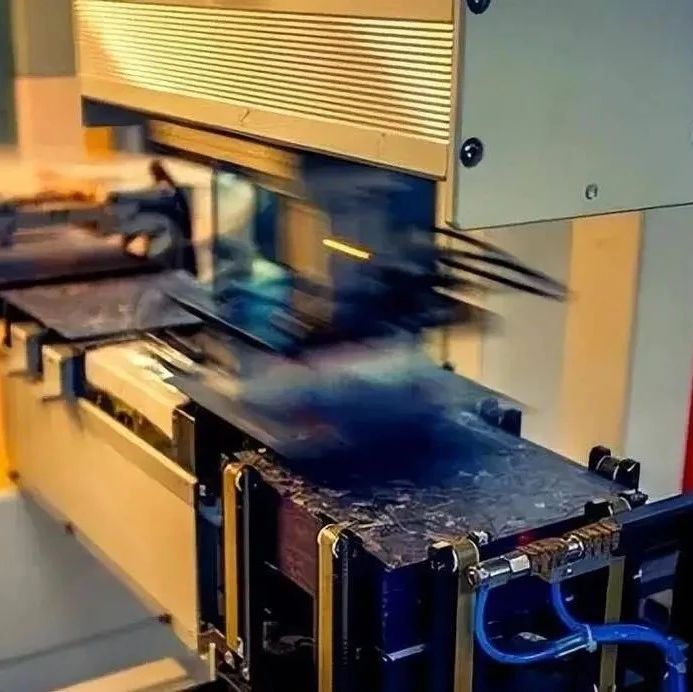
羲之电子束光刻机

Search documents
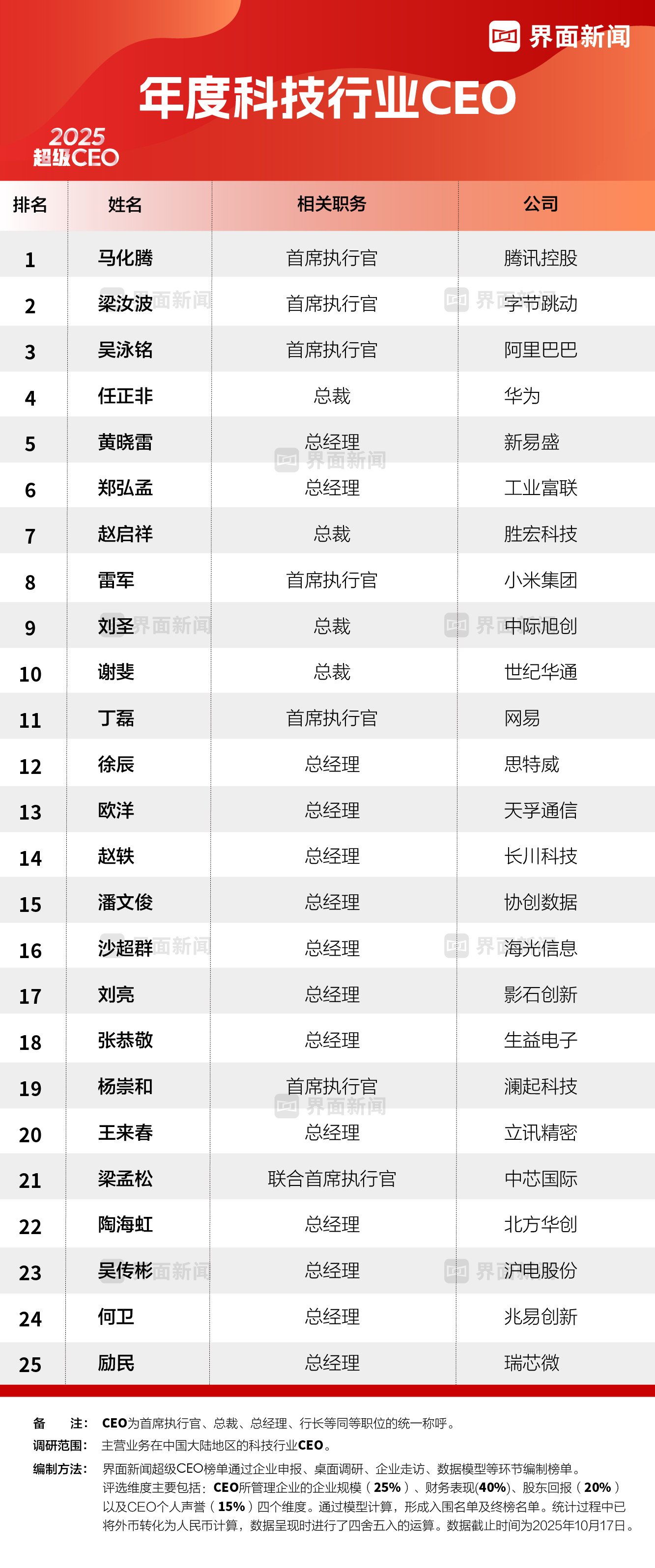
界面新闻2025年度科技行业CEO榜单发布:腾讯马化腾登顶
Xin Lang Cai Jing· 2025-12-16 08:07
Core Insights - The article highlights the release of the "Annual Super CEO" list by Zhito Finance, recognizing outstanding leaders in various industries who have achieved financial growth and shareholder returns while maintaining personal reputation [1][9] - The technology sector is emphasized, with a focus on CEOs leading companies in China's mainland technology industry, showcasing their exceptional performance in a challenging economic environment [1][9] Industry Overview - The technology industry, as defined by Zhito Finance, includes information and communication technology (ICT) and its derivative application sectors, with significant developments in artificial intelligence, cloud computing, the metaverse, and semiconductors [2] - China's R&D investment is projected to exceed 3.63 trillion yuan, with an R&D intensity of 2.69%, indicating a strong focus on innovation and technological advancement [7] CEO Performance - The 25 CEOs on the list achieved a median revenue growth of 45.06% and a median net profit growth of 71.96%, with median return on equity and total asset return at 15.99% and 10.10% respectively [9] - The average market capitalization of these companies reached 632.997 billion yuan, reflecting their significant market presence [9] Notable CEOs - Tencent's CEO, Ma Huateng, ranked first, with the company achieving a revenue of 660.257 billion yuan in 2024, a year-on-year increase of 8.41%, and a net profit of 194.073 billion yuan, up 68.44% [18] - Huawei's CEO, Ren Zhengfei, ranked fourth, with the company reporting a revenue of 862.1 billion yuan, a 22.42% increase, and R&D investment of 179.1 billion yuan, accounting for 20.8% of total revenue [19] - Zhao Qixiang, CEO of Shenghong Technology, ranked seventh, with a revenue of 10.731 billion yuan, a 35.31% increase, and a net profit of 1.154 billion yuan, up 71.96% [20] Gender and Education Representation - Among the 25 CEOs, only four are women, indicating a male-dominated leadership landscape [9] - Nearly 50% of the CEOs have advanced degrees, with eight holding master's degrees and four holding doctorates [13] Sector Distribution - The semiconductor sector leads with seven companies represented, followed by five internet-related companies [15]





首台国产商业化电子束光刻机启动测试,为我国量子芯片研发添自主“利器”
仪器信息网· 2025-08-18 03:58
Core Viewpoint - The successful launch of China's first commercial electron beam lithography machine "Xizhi" marks a significant breakthrough in quantum chip research, achieving a precision of 0.6 nanometers and a line width of 8 nanometers, thus breaking international restrictions on technology procurement [1][4][5]. Technological Breakthrough and Application Value - The "Xizhi" machine, developed by Zhejiang University’s Quantum Research Institute, operates at 100kV and is currently undergoing testing by teams from the University of Science and Technology of China and Zhejiang University [4]. - The development team likens "Xizhi" to a "nano brush" capable of intricately etching circuit designs on silicon substrates, enhancing the efficiency of chip design modifications without the need for traditional photomasks [5]. - The introduction of "Xizhi" addresses the long-standing issue of international export controls that have hindered domestic research and development in advanced semiconductor technologies, thus opening new market opportunities for companies like Huawei HiSilicon [5][6]. Collaborative Innovation Mechanism - The success of the "Xizhi" machine is part of a broader initiative combining technological and industrial innovation, facilitated by a collaborative framework involving Zhejiang University and local government [6]. - Although electron beam lithography currently has lower production efficiency compared to EUV lithography, its unique advantages in quantum chip development are irreplaceable, positioning "Xizhi" as a critical asset for advancing China's high-end semiconductor capabilities [6].

国产首台电子束光刻机!0.6nm!
国芯网· 2025-08-14 12:32
Core Viewpoint - The article highlights the successful development and testing of China's first domestically produced commercial electron beam lithography machine, named "Xizhi," which aims to enhance the country's semiconductor industry and reduce reliance on foreign technology [2][4]. Group 1: Product Development - The "Xizhi" is a next-generation 100kV electron beam lithography machine, designed for quantum chips and new semiconductor research, achieving a precision of 0.6 nanometers and a line width of only 8 nanometers, comparable to international mainstream equipment [4]. - Unlike traditional lithography machines, the electron beam lithography machine offers unique advantages in prototype design, rapid iteration, and small batch production, significantly improving the efficiency of early-stage chip development [4]. Group 2: Market Impact - The introduction of "Xizhi" breaks the long-standing export control barriers that prevented domestic research institutions and enterprises from acquiring advanced electron beam lithography equipment, facilitating collaboration with various domestic companies and research institutions [4].