老年犬粮

Search documents
国盛证券:2025年宠物行业规模增长4.1% 看好头部国产品牌中长期品牌成长空间
Zhi Tong Cai Jing· 2026-01-22 03:33
Group 1 - The pet industry is expected to grow at a rate of 4.1% by 2025, with the food market remaining the primary consumption sector. The trend of younger pet ownership may drive the industry towards high-quality development [1][2] - The number of dogs and cats, as well as per capita spending, continues to rise, with dog and cat populations increasing by 1.8% year-on-year. Average annual spending per dog has risen by 1.5%, while for cats it has increased by 3.2% [2] - Domestic brands are strengthening their foundational research and development, creating differentiated products, and focusing on long-term brand building. Leading domestic brands are enhancing product quality and brand expression, indicating a positive long-term growth outlook [1][2] Group 2 - The market concentration of leading pet food brands is increasing, with domestic brands capturing over 70% of the market share during the 2025 Double Eleven shopping festival. The top 10 brands on Tmall during the 2025 618 shopping festival have a concentration ratio of 44%, up from 37% in 2024 [3] - Online sales remain dominant, with platforms like Tmall accounting for 29% of the market. Emerging channels such as Douyin and Xiaohongshu are expected to see significant growth, while offline channels like pet stores and veterinary clinics account for 33% of the market [3] Group 3 - There is a growing consensus on scientific feeding practices, with 55.3% of pet owners willing to learn about them. Over 40% of pet owners have adopted a combination of staple and wet food. Significant growth has been observed in fresh and wet food products, with cat wet food sales increasing by 80% [4] - The trend towards specialized pet food is gaining traction, with increased demand for age-appropriate and breed-specific products. The aging dog population is driving demand for high-end staple foods and health-related products, with sales of senior dog food increasing by 67% year-on-year [5]

京东《2025宠物行业消费趋势报告》:异宠圈层持续扩张,00后用“个性宠物”表达“个性生活”
Sou Hu Wang· 2025-04-23 06:53
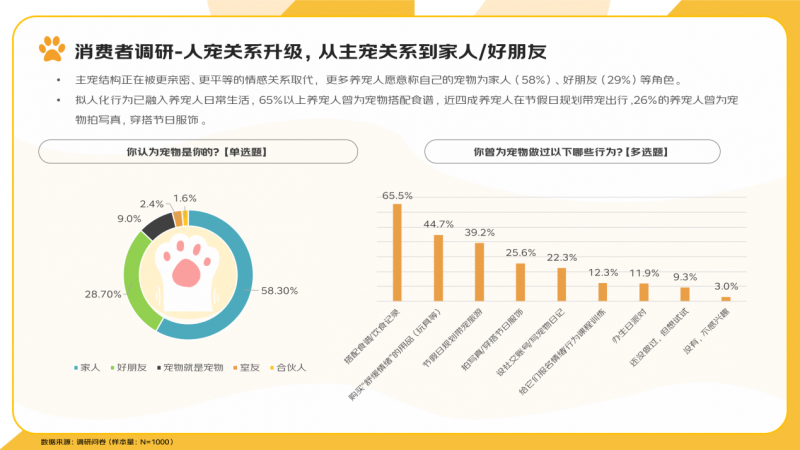
Core Insights - The pet industry is evolving towards a more intelligent, anthropomorphic, and segmented consumption model, with pets increasingly viewed as family members and emotional companions [1][2][5] Group 1: Human-Pet Relationship Evolution - Nearly 60% of pet owners incorporate pets into long-term life plans, with 58.5% creating dedicated spaces for them [7] - 66% of pet owners consider pets as close family members, and 65.5% create dietary plans for them [2][11] - Emotional resonance is significant, with 80% of users actively responding to their pets' emotions, and 61.5% willing to pay for their pets' emotional health [5][4] Group 2: Pet Food Trends - There is a noticeable trend towards specialized pet food, with senior dog food searches increasing by 62% and sales up by 87% [13] - Wet food sales for both cats and dogs have surged, with sales growth exceeding 260% year-on-year [11] - Over 80% of pet owners have adopted a mixed feeding approach of dry and wet food, with 41% making it a daily habit [11] Group 3: Smart and Personalized Pet Products - The demand for smart pet products is rising, with searches for pet air purifiers increasing by 202% [15] - Users express a desire for better integration and functionality in smart pet products, with 40% hesitant to try due to lack of understanding [15] - Anthropomorphic products are gaining popularity, with sales of pet strollers increasing tenfold and pet clothing sales up by 58% [17] Group 4: Expansion of Exotic Pets - The market for exotic pets is expanding, particularly among younger generations, with 00s showing a preference for unique pets as a form of self-expression [19][21] - 73.9% of users choose multi-pet households to experience diverse interactions and enhance social media content [10] Group 5: Overall Market Trends - The pet industry is shifting from basic care to a more nuanced, emotional, and personalized approach, reflecting a broader change in consumer mindset [23] - The integration of pets into daily life decisions is becoming more pronounced, influencing everything from living arrangements to travel plans [7]