联邦医疗保险(Medicare)

Search documents
美股异动 | 医疗保险股盘前集体大跌 哈门那(HUM.US)股价重挫逾16%
智通财经网· 2026-01-27 13:57
Core Viewpoint - The proposed maintenance of Medicare payment rates for private plans in the upcoming year has led to significant declines in major healthcare stocks, disappointing investors and raising concerns about profit margins for insurance companies [1] Group 1: Medicare Payment Rates - The U.S. government has proposed to keep the payment rates for Medicare private plans at current levels for next year, which has caused a collective drop in healthcare stocks [1] - The Centers for Medicare & Medicaid Services (CMS) announced that the payment rate for Medicare Advantage plans is expected to increase by only 0.09% by 2027, significantly lower than the previously anticipated increase of up to 6% [1] Group 2: Impact on Major Insurance Companies - Major insurance companies such as UnitedHealth, CVS Health, and Humana are crucially affected by these payment rates, as increases help cover medical costs, enhance benefits for elderly clients, and boost profits [1] - UnitedHealth's stock fell by 15%, CVS Health by nearly 10%, and Humana by over 16% following the announcement [1] Group 3: UnitedHealth's Financial Performance - UnitedHealth reported a slight earnings beat for Q4, with adjusted earnings per share of $2.11, slightly above the analyst consensus of $2.10 [1] - Q4 revenue was $113.2 billion, showing a year-over-year growth of approximately 12%, but fell short of Wall Street expectations by $520 million [1] - The company has projected a revenue decline for 2026, marking the first annual decrease in over thirty years [1]


前白宫经济顾问预警:美国借贷成瘾难戒,财政灾难已不可逆转
Xin Lang Cai Jing· 2025-12-08 09:37
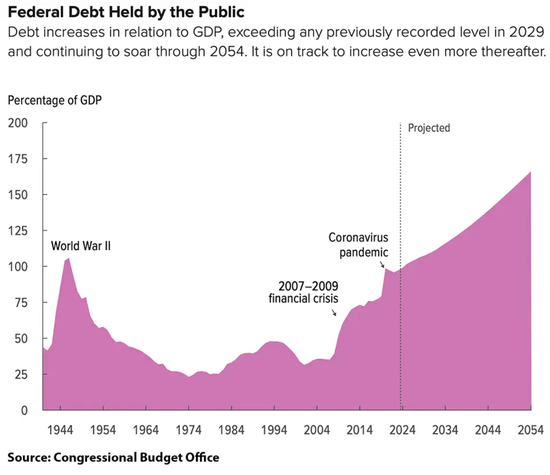
Core Viewpoint - The U.S. public debt has surged to 99% of GDP, breaking post-World War II records, indicating an impending financial disaster. Projections suggest this ratio will rise to 107% by 2029, with debt service costs reaching $11 billion weekly, accounting for 15% of federal spending for the fiscal year [1][15]. Group 1: Debt Crisis Analysis - Harvard economist Jeffrey Frankel warns that the addiction to borrowing in Washington has reached a critical point, driven by reckless spending from both political parties. The total U.S. federal debt has surpassed $38 trillion, with the bond market's patience wearing thin, signaling a potential crisis [3][17]. - Frankel dismisses five alternatives to escape the debt crisis, concluding that only severe fiscal tightening remains as a viable option. Economic growth is deemed unrealistic due to a shrinking workforce, even with potential productivity gains from artificial intelligence [4][18]. Group 2: Political Stalemate - The political deadlock is exacerbated by the Democratic Party's reluctance to reform Social Security and Medicare, while the Republican Party focuses on tax cuts for the wealthy. This impasse ensures that no meaningful reforms will be enacted before a crisis occurs [8][23]. - Oxford Economics predicts that welfare programs will face bankruptcy by 2034, which could trigger a backlash from the bond market if Congress resorts to using general revenue as a stopgap measure [8][23]. Group 3: Global Implications - The fiscal tightening in the U.S. will have global repercussions, increasing borrowing costs worldwide and adversely affecting emerging markets already struggling with debt. Europe may face imported inflation, while Asia's export engines could stall due to retaliatory tariffs [10][25]. - Discussions around financial repression are resurfacing, reminiscent of post-war Japan or 1970s Italy, but such measures could provoke strong reactions in a polarized U.S. environment [10][25]. Group 4: Welfare Programs as a Time Bomb - Social Security and Medicare, which cost trillions, are central to the crisis. The impending welfare cliff in 2034 could force the government to tap into general funds, which the bond market would likely punish as a fiscal compromise [11][26]. - Political sensitivity surrounding reforms like raising the retirement age makes it difficult to implement necessary changes, leading to a continuous expansion of the fiscal deficit and rising debt levels [11][26]. Group 5: Tariffs and Tax Cuts - Trump's "liberation day" tariff policy, intended to promote re-industrialization, has inadvertently worsened the debt situation by increasing import costs and inflation, leading to higher interest expenses. The revenue from tariffs is negligible compared to the vast expenditures [13][28]. - Republican tax cuts are projected to add trillions to the debt, while both parties' hypocrisy ensures that the countdown to a fiscal bomb continues [13][28].