
能源云平台

Search documents
换新跃升!“乌金”搭乘“科技快车”在矿井“智慧高速路”高效流淌
Yang Shi Wang· 2026-02-11 03:00
Core Viewpoint - The article highlights the advancements in intelligent mining technology in Guizhou's coal industry, emphasizing the transition from traditional mining methods to smart operations that enhance efficiency and safety while addressing the challenges posed by the region's complex geological conditions [1][20]. Group 1: Intelligent Mining Technology - Guizhou's coal mines are implementing intelligent production lines to ensure energy supply, especially during the Spring Festival, despite the high mining difficulty and safety risks due to the karst topography [1][5]. - The introduction of a 5G network and smart systems at the Qianxi Qinglong coal mine has significantly improved operational efficiency, allowing real-time monitoring of equipment and reducing downtime caused by equipment failures [7][9]. - The intelligent mining system has led to a 20% to 30% increase in annual output per mining face, setting historical records for production in complex geological conditions [11]. Group 2: Full Chain Intelligent Transformation - The intelligent transformation in Guizhou's coal industry is not limited to mining; it extends to the entire production chain, including advanced coal washing systems that achieve zero wastewater discharge and maximize the value of coal products [12][14]. - The new intelligent washing system allows for precise sorting of coal products and generates approximately 90 million yuan in annual revenue, showcasing the economic benefits of technological upgrades [14]. - The "Energy Cloud" platform enables real-time monitoring of production dynamics across 61 intelligent coal mines, facilitating data sharing and dynamic management of operations [16]. Group 3: Future Development and Industry Upgrades - By 2025, Guizhou aims to achieve an annual coal production capacity of 216 million tons, with a significant increase in the proportion of large and medium-sized mines [16]. - The provincial energy bureau plans to focus on refined mining and deep processing of coal, transitioning from raw coal sales to value-added products, thereby enhancing the industry's overall productivity and safety [18]. - The article emphasizes the importance of precise identification of bottlenecks and resource optimization in driving the transformation of traditional industries towards new productive forces [20].

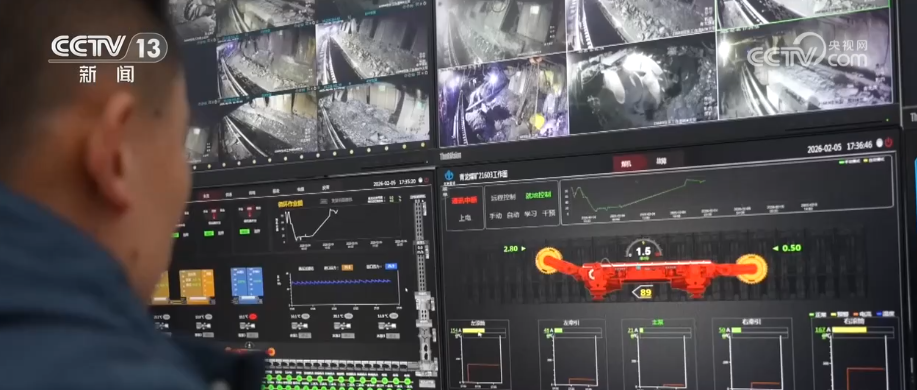
智能操控手、废料变“宝藏” 贵州煤炭全链条“焕新出道”
Yang Shi Xin Wen· 2026-02-11 01:47
Core Viewpoint - The coal mining industry in Guizhou is undergoing significant transformation through the implementation of intelligent systems, enhancing efficiency and safety in operations while addressing the challenges posed by the region's complex geological conditions [2][3][5]. Group 1: Intelligent Transformation in Coal Mining - Guizhou's coal mines are leveraging intelligent production lines to ensure energy supply, especially during peak demand periods like the Spring Festival [1]. - Workers are transitioning from traditional roles to operating advanced intelligent systems, improving both job satisfaction and operational efficiency [2]. - The introduction of a 5G network and smart equipment has enabled real-time monitoring and control of mining operations, significantly reducing downtime and enhancing safety [3][4]. Group 2: Efficiency Gains and Economic Impact - The implementation of intelligent systems has led to a 20% to 30% increase in annual output per mining face, setting historical production records under challenging geological conditions [4]. - The new intelligent washing and sorting systems in coal processing facilities have achieved zero wastewater discharge and increased revenue by approximately 90 million yuan annually [5]. - The integration of monitoring systems allows for real-time tracking of personnel and equipment, enhancing operational oversight and data sharing across the industry [5]. Group 3: Future Development Plans - By 2025, Guizhou aims to reach an annual coal production capacity of 216 million tons, with large and medium-sized mines making up 87.1% of this capacity [6]. - The focus will shift towards refined mining practices and deeper processing of coal, aiming to increase product value and improve the working conditions for miners [6].
抓好市值管理,推动央企上市公司高质量发展
Zhong Guo Hua Gong Bao· 2025-07-09 02:44
Core Viewpoint - The introduction of the new market value management regulations has led to significant developments in investor relations management, with 644 listed companies implementing value management systems or valuation enhancement plans since November 2022 [1] Group 1: Current State of Central State-Owned Enterprises (SOEs) - As of 2024, 492 central SOEs account for 9.14% of A-share listed companies but contribute 36.32% of total market value, 43.74% of revenue, and 59.03% of net profit, highlighting their critical role in the national economy [1] - There is a notable disparity within central SOEs, with companies valued over 50 billion yuan contributing nearly 80% of market value and over 90% of net profit, while smaller companies (under 10 billion yuan) represent 36.79% of the total but only 2.82% of market value [2] Group 2: Challenges and Recommendations for Small and Medium-Sized SOEs - Small and medium-sized central SOEs face dual pressures on profitability and valuation, with challenges including outdated capital tools and insufficient innovation [2] - Recommendations for regulatory bodies include differentiated assessments focusing on R&D conversion rates for tech companies and flexible regulations for companies in economically challenged regions [2][3] Group 3: Strategies for Transformation - For tech companies, strategies include binding core technologies to teams, establishing innovation incubation mechanisms, and creating suitable incentive systems [3] - Traditional industries are encouraged to upgrade production capacity, integrate supply chains, and pursue asset securitization [3] - Public service companies should focus on value reconstruction, achieving ESG premiums, and transitioning to smart services [3] Group 4: Implementation of Capital Tools - Companies can create a collaborative matrix of capital tools such as buybacks, ESG disclosures, and supply chain integration to enhance market value management [4] - Successful case studies include improvements in R&D efficiency and valuation recovery through innovative practices [4] Group 5: Long-term Goals - Short-term goals include restoring the valuation of 30 underperforming companies to a price-to-book ratio of 1.0 and reducing the overall discount rate of central SOEs by 15% by 2026 [5] - Mid-term objectives aim for a 15% increase in buyback amounts and a 25% rise in institutional holdings in small and medium-sized SOEs by 2027 [5] - Long-term aspirations include achieving a 6% R&D intensity and surpassing 500 billion yuan in overall R&D investment by 2030, with a total market value of central SOEs exceeding 100 trillion yuan [5]