英伟达H200系列芯片

Search documents
5.5万台!英伟达服务器出货量有望翻倍,寒武纪涨超3%,科创芯片50ETF(588750)放量冲击三连涨!26年投资主线展望,机构:AI仍是强主线
Sou Hu Cai Jing· 2025-12-23 03:57
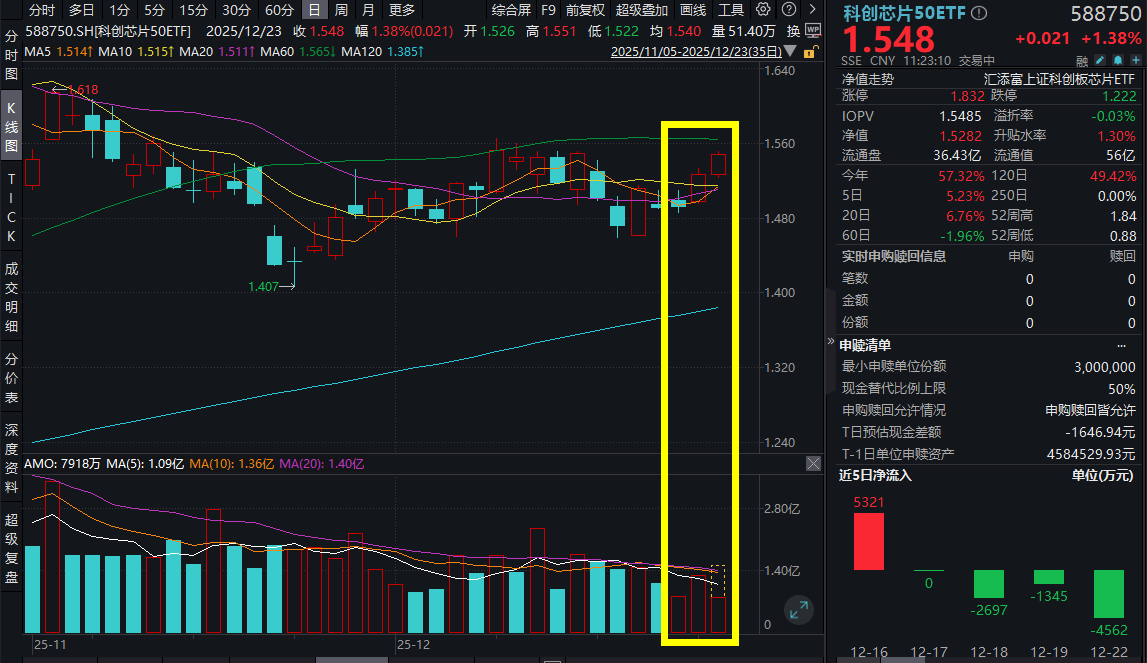
Core Viewpoint - The A-share market experienced fluctuations with the hard technology sector showing resilience, particularly the Kexin Chip 50 ETF (588750), which rose by 1.38% and achieved a trading volume exceeding 79 million yuan [1][3]. Group 1: Kexin Chip 50 ETF Performance - The Kexin Chip 50 ETF (588750) saw most of its constituent stocks rise, with Haiguang Information and Cambricon both increasing over 3%, while companies like Tuojing Technology and Yuanjie Technology rose over 1% [3]. - The top ten constituent stocks of the Kexin Chip 50 ETF include Haiguang Information and Cambricon, both of which are in the electronics sector and showed significant gains [4]. Group 2: Global Semiconductor Trends - Nvidia's stock rose nearly 2%, with plans to export H200 series chips to China in mid-February, with an expected shipment of 5,000 to 10,000 modules, corresponding to approximately 40,000 to 80,000 H200 chips [5]. - The global AI server cabinet shipments from Nvidia are projected to reach 55,000 units in the next year, marking a 129% year-on-year increase, driven by major companies like Microsoft and Meta [5]. Group 3: AI and Semiconductor Market Outlook - The AI wave is driving strong demand for chips and related hardware, with expectations for the global AI computing chip market to exceed $370 billion by 2026 and $460 billion by 2027 [7]. - The semiconductor supply chain's self-sufficiency in China is seen as a core theme with long-term investment value, supported by domestic policy and strong internal demand [6]. Group 4: Domestic AI Chip Development - China's domestic AI chip market is characterized by a diverse range of manufacturers, with significant advancements in technology and production capabilities [13]. - By 2028, China's local chip self-sufficiency rate is expected to rise to 93%, up from 58% in 2025, indicating a substantial increase in domestic production capacity [13]. Group 5: Kexin Chip Index Characteristics - The Kexin Chip 50 ETF focuses on the core segments of the semiconductor industry, with a high concentration of 96% in upstream and midstream sectors, indicating strong growth potential [17][20]. - The index's quarterly rebalancing allows it to respond quickly to trends in the semiconductor industry, enhancing its performance compared to other indices [18]. Group 6: Investment Opportunities - The Kexin Chip 50 ETF is highlighted as a high-elasticity investment option, with a maximum increase of 173% since September, outperforming peers in risk-adjusted returns [21][22]. - Investors are encouraged to consider index-based investment strategies in the Kexin Chip sector to capitalize on the ongoing demand for semiconductor technology [16].




马斯克xAI豪掷120亿扩张算力,Grok能否逆袭AI江湖?
Sou Hu Cai Jing· 2025-07-24 04:07
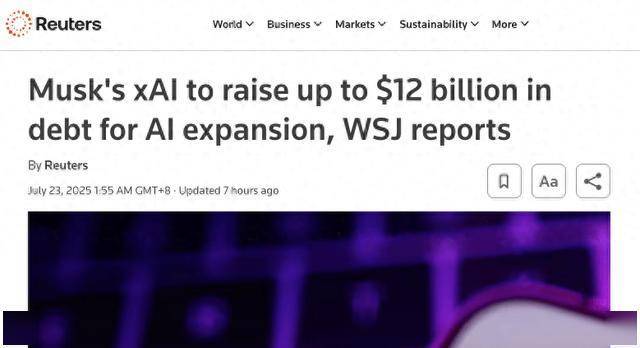
Group 1 - The core focus of the news is that Elon Musk's AI startup xAI is seeking to raise $12 billion in funding to expand its operations, primarily to purchase NVIDIA's latest AI chips and build a large data center for its AI chatbot Grok [1][3] - Over 80% of the funds will be allocated to NVIDIA's H200 series or its successor Blackwell architecture AI chips to meet the explosive demand for computational power required for Grok's model training [1][3] - The remaining funds will be used to construct a super-sized data center that will integrate thousands of NVIDIA GPUs, creating a high-performance computing cluster optimized for Grok [3] Group 2 - xAI plans to adopt an innovative "leasing model" to support its computing needs, aiming to reduce initial investment pressure and lower costs through scaled operations in the long term [3] - Since its launch, Grok has attracted attention for its "real-time access to X platform data" and unique "rebellious conversational style," although it still lags behind OpenAI's GPT-4o and Google's Gemini Ultra in terms of technical strength and performance [3] - This funding round is seen as Musk's strong bet on Grok's future development, indicating that the global AI competition has shifted from mere technological innovation to intense competition in capital and computing power [3]