菜粿

Search documents
“九子粽”包出村民共富新希望
Xin Lang Cai Jing· 2026-02-12 17:28
Core Insights - The article highlights the success of the "Nine Sons Zong" traditional snack in the context of rural revitalization and community prosperity, particularly as demand surges during the upcoming Spring Festival [1][2]. Group 1: Production and Sales - The "Nine Sons Zong" production facility, known as "Longmi Gongfu Workshop," has seen a significant increase in orders, producing over 3,000 zongs daily, with a stable daily sales revenue exceeding 30,000 yuan [1]. - The workshop has innovated by launching a New Year gift box that combines "Nine Sons Zong" with other local delicacies, enhancing both packaging and flavor variety, resulting in a daily production capacity surpassing 10,000 units [1]. Group 2: Business Development and Partnerships - The establishment of the "Longmi Gongfu Workshop" was made possible through the renovation of an idle factory using funds from the mountain-sea cooperation initiative, aiming to turn traditional snacks into a profitable industry for villagers [2]. - A pivotal partnership was formed with a local brand, "Lao Mi Snacks," which helped open sales channels for the workshop's products, facilitating a transition from single-store operations to large-scale production [2]. Group 3: Economic Impact and Future Plans - The workshop operates under a "rent + 10% profit sharing" model, closely linking it with the village collective and providing employment for over 40 villagers, contributing to local economic growth [2]. - Plans for 2026 include an investment in a new 1,500 square meter shared industry building to attract labor-intensive industries, further expanding the village's economic base and employment opportunities [3].

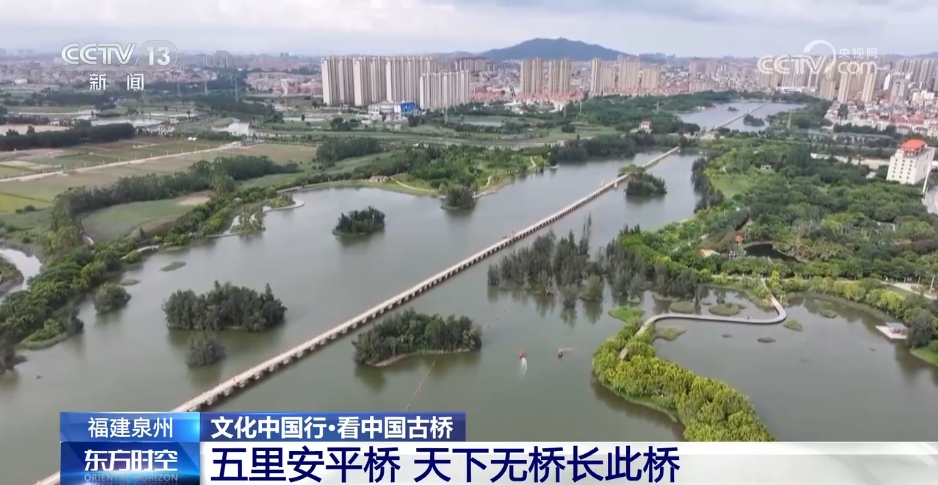
“天下无桥长此桥” 这座2255米长的非遗古桥惊艳了800载时光
Yang Shi Wang· 2025-07-27 23:57
Core Viewpoint - Anping Bridge, located in Quanzhou, Fujian, is the longest existing cross-sea beam stone bridge in China and a significant heritage site of the "Quanzhou: World Maritime Trade Center of Song and Yuan China" [1][7]. Group 1: Historical Significance - Anping Bridge was built in the 8th year of the Shaoxing era during the Southern Song Dynasty and has a length of 2,255 meters, earning the title of "the longest bridge in the world" [2][6]. - The bridge has witnessed the prosperity of Quanzhou Port over 800 years and serves as a vital transportation hub connecting land and sea [5][6]. Group 2: Architectural Features - The bridge is constructed with 361 stone piers of varying shapes, supporting giant stone slabs that range from 5 to 11 meters in length, with the heaviest weighing up to 25 tons [2][3][12]. - Unique construction techniques such as "sleeping wood foundation" and "tide-based beam placement" were employed to ensure stability and efficiency in building the bridge [11][12][13]. Group 3: Community Involvement - The construction of Anping Bridge was a collective effort, funded by local officials, merchants, and common people, showcasing community collaboration [14][15]. - Over the years, the bridge has undergone numerous repairs, funded by donations from various community members, reflecting a shared commitment to preserving this historical structure [15]. Group 4: Cultural Impact - Anping Bridge not only represents ancient engineering wisdom but also serves as a cultural symbol for the local community, connecting them to their heritage and traditions [16][27]. - The bridge's surroundings are rich in local culinary traditions, such as "cai guo" and "tied pig's trotter," which are integral to the cultural identity of the region [18][20][26].
文化中国行丨“天下无桥长此桥” 这座2255米长的非遗古桥惊艳了800载时光
Yang Shi Wang· 2025-07-23 16:08
Core Viewpoint - Anping Bridge, located in Quanzhou, Fujian, is the longest existing cross-sea beam stone bridge in China and a significant cultural heritage site, recognized as part of the "Quanzhou: World Maritime Trade Center of Song and Yuan China" [1][5]. Group 1: Historical Significance - Anping Bridge was built in the 8th year of the Shaoxing era during the Southern Song Dynasty and has a length of 2,255 meters, making it a remarkable engineering feat of its time [3][5]. - The bridge has witnessed the prosperity of Quanzhou Port over 800 years and was listed as a UNESCO World Heritage site in 2021 [5]. Group 2: Engineering Techniques - The bridge features 361 stone piers of various shapes, with stone slabs ranging from 5 to 11 meters in length, weighing up to 25 tons each [3][11]. - Innovative construction techniques such as "sleeping wood foundation" and "tide-lifting beam" were employed to ensure stability and facilitate the placement of heavy stone slabs [9][13]. Group 3: Community Involvement - The construction and maintenance of Anping Bridge involved contributions from local officials, merchants, and common people, showcasing a collective effort over the centuries [13][15]. - Historical records of repairs and donations are inscribed on repair monuments, reflecting the community's ongoing commitment to preserving the bridge [15]. Group 4: Cultural Impact - Anping Bridge serves as a cultural symbol for the local community, connecting the towns of Anhai and Shuikou, and is integral to the region's identity and heritage [16][22]. - The bridge not only represents engineering prowess but also embodies the spirit of cooperation and shared cultural values among the people of Quanzhou [15][22].