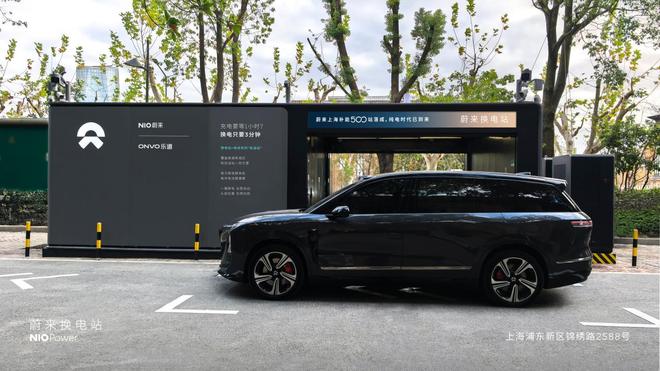
蔚来充电站

Search documents
蔚来在上海建成500座充换电站,日均提供电量超过60万度
Guan Cha Zhe Wang· 2025-12-15 10:48
Core Insights - NIO has established a robust energy and service network in Shanghai, with 198 battery swap stations and 302 charging stations, providing over 600,000 kWh of energy daily [1][3]. Group 1: Battery Swap Station Details - The newly operational battery swap station at Shanghai Pudong Xinghe Bay Hotel features 23 battery slots, supports multiple battery specifications and brands, and can service up to 480 swaps per day, with an average swap time of 2 minutes and 24 seconds [3]. - The station's computing power reaches 1016 TOPS, equipped with high-performance intelligent perception hardware, allowing users to utilize smart assisted parking for easy access [3]. Group 2: Network Coverage and Performance - The coverage rate of NIO's battery swap stations within 3 kilometers of users' residences has significantly increased from approximately 40% in 2020 to 95% [3]. - In the area within Shanghai's outer ring, there is an average of one battery swap station every 8.5 square kilometers [3]. Group 3: Market Position and Growth - Shanghai has become a leading city for new energy vehicle consumption in China, with a projected market penetration rate of over 64% for new energy vehicles by October 2025, and pure electric vehicle penetration exceeding 50% for three consecutive months [5]. - Nationally, as of October 2025, the total number of electric vehicle charging infrastructure has reached 18.645 million, a year-on-year increase of 54%, with public charging facilities growing by 39.5% [5]. - From January to November 2025, the cumulative retail sales of new energy vehicles in China reached 11.472 million units, marking a year-on-year growth of 19.6% [5].


9月全国乘用车市场零售223.9万辆;小米、蔚来发布“十一”假期出行报告 | 汽车早参
Mei Ri Jing Ji Xin Wen· 2025-10-12 22:35
Group 1: Passenger Car Market Performance - In September, the national retail sales of passenger cars reached 2.239 million units, representing a year-on-year increase of 6% and a month-on-month increase of 11% [1] - Cumulative retail sales for the year reached 17.004 million units, showing a year-on-year growth of 9% [1] - The retail sales of new energy vehicles (NEVs) in September were 1.307 million units, with a year-on-year increase of 16% and a month-on-month increase of 17%, leading to a penetration rate of 58.5% for NEVs [1] Group 2: Smart Mobility and Charging Infrastructure - Xiaomi reported that from October 1 to 8, its car owners accumulated over 261 million kilometers, with the longest single vehicle journey being 8,680.9 kilometers [2] - NIO's report indicated that its battery swap stations provided services 1,097,985 times during the same period, with a year-on-year daily increase of 37% [2] - The peak day for battery swaps on October 1 reached a record high of 145,955 swaps [2] Group 3: Autonomous Driving Developments - BYD won the bid for Singapore's first L4 autonomous bus pilot project, which will feature electric buses and is set to begin testing in mid-2026 [3] - This project is a significant advancement for BYD in the fields of autonomous driving and smart transportation, enhancing its international competitiveness [3] Group 4: Electric Vehicle Sales Performance - Lantu Motors announced that its new model, Lantu Zhi Yin, sold 3,670 units in September, making it the best-selling pure electric model among Chinese brands [4] - The total deliveries for Lantu in September reached 15,224 units, with a cumulative year-on-year growth of 85% from January to September [4]


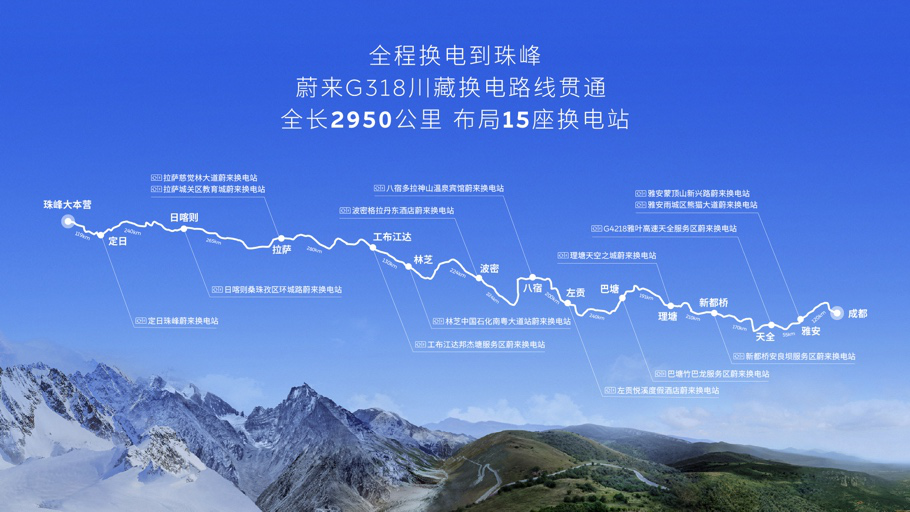
助力新能源基础设施建设 蔚来川藏换电网络全线贯通
Zhong Guo Jing Ji Wang· 2025-08-18 13:31
Group 1 - NIO's battery swap station in Dingri, Tibet, has officially commenced operations, marking the completion of the G318 battery swap route from Chengdu, Sichuan, to Mount Everest [1] - The G318 route spans 2950 kilometers with 15 battery swap stations deployed, averaging one station every 200 kilometers [1] - NIO has established a total of 142 battery swap stations and 247 charging stations in the Tibet region, connecting to 93,164 third-party charging piles [1][3] Group 2 - Tibet is focusing on becoming a national clean energy base, leveraging its abundant solar and hydropower resources to support the development of battery swap and charging stations [3] - The region's clean energy has become a primary power source, facilitating the promotion of new energy vehicles, with the number of electric vehicles surpassing 10,000 for the first time in June 2024 [3] - NIO's battery swap station in Lhasa is the world's first high-altitude station powered entirely by clean energy, significantly reducing carbon emissions from the energy source [3] Group 3 - NIO has developed 80 scenic routes, including G318, Qinghai-Tibet, and Yunnan-Tibet routes, to enhance user experience while promoting sustainable travel [4] - The company has established 8,167 charging and battery swap stations nationwide, leading the industry in infrastructure development [4] - NIO has invested over 18 billion yuan in the research, construction, and operation of charging and battery swap infrastructure, actively supporting national strategies for new energy vehicle infrastructure [4]