螳螂拳

Search documents
意大利华裔薪火相传的中国武术情
Xin Lang Cai Jing· 2026-01-19 06:51
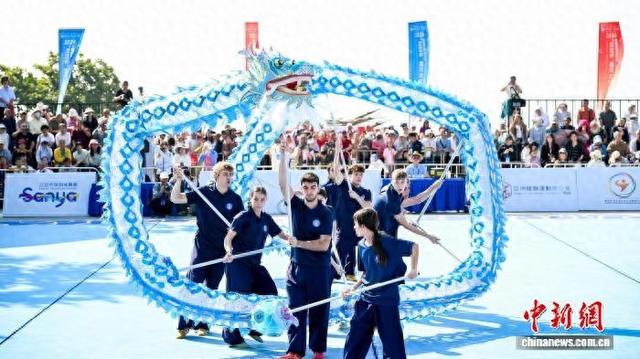
Group 1 - The article highlights the cultural significance of martial arts beyond being a sport, emphasizing the importance of understanding "martial virtue" while learning martial arts routines [1] - The 2026 "Sanya Cup" International Dragon and Lion Elite Competition is taking place from January 16 to 20 in Sanya, featuring 24 teams and approximately 300 athletes from countries including China, Malaysia, Italy, Indonesia, Vietnam, and South Korea [1][3] - The Italian dragon dance team, participating for the first time, experiences a different atmosphere compared to their usual performances, highlighting the importance of teamwork in dragon dance as opposed to individual focus in martial arts [3] Group 2 - Liu Yuwei, the mentor of Italian participant Zhu Chuyi, has been instrumental in promoting martial arts in Italy, having established a martial arts school that has trained 480 students over 20 years, with 90% being Italians [4] - Liu Yuwei's approach includes street performances to introduce local people to Chinese martial arts and its cultural significance, showcasing styles like Shaolin, Tai Chi, and Praying Mantis [4] - The article notes a growing interest among foreigners in understanding Chinese culture, with Liu Yuwei using martial arts as a bridge for cultural exchange [7]

(寻味中华|非遗)智勇相生传四海 螳螂武韵贯古今
Xin Lang Cai Jing· 2025-12-28 01:56
Core Viewpoint - The article highlights the cultural significance and global influence of the Praying Mantis Boxing, emphasizing its philosophical underpinnings of wisdom and courage, as well as its evolution from a local martial art to an international cultural ambassador for Chinese heritage [1][4]. Group 1: Historical Background - Praying Mantis Boxing originated in the late Ming and early Qing dynasties, created by Wang Lang, who integrated the fighting wisdom of insects into martial arts [3]. - The art has developed over three centuries into various styles, such as Seven Star, Plum Blossom, and Six Harmonies, and was recognized as a national intangible cultural heritage in China in 2008 [3][5]. Group 2: Training and Philosophy - The essence of Praying Mantis Boxing lies in transforming courage into techniques and embedding wisdom in adaptability, allowing practitioners to seize victory in critical moments [3][4]. - The training emphasizes tactics like "come, call, follow, and send" for strategy, and "lift, take, seal, and close" for control, alongside close-range techniques [3]. Group 3: Global Influence and Development - The art has gained international recognition, with practitioners like Yu Bo promoting it globally through teaching and evaluation in countries such as Japan, South Korea, Croatia, Italy, and Iran [3][5]. - The Praying Mantis Boxing Development Promotion Association has been established in Laiyang, facilitating exchanges and events for enthusiasts worldwide [5][8]. Group 4: Female Participation and Community - Female practitioners, such as Liu Xin, have significantly contributed to the art, emphasizing the importance of flexibility and strategy over brute strength [7]. - The global community of Praying Mantis Boxing has expanded, with practitioners from diverse backgrounds, including over 500 students in Brazil, drawn to its philosophical approach to combat [8].

“学了蛤蟆功,打跑资本家”
Hu Xiu· 2025-05-01 02:13
Core Viewpoint - The article discusses the emergence of a new cultural narrative in China, where the concept of "learning the Frog Skill to defeat capitalists" reflects a growing sentiment against capitalism and social injustice, particularly among the youth on social media platforms like Douyin [1][3][22]. Group 1: Cultural Narrative - The narrative of "defeating capitalists" is a modern myth that resonates with the current societal mood, characterized by a desire for revenge against perceived social injustices [1][17]. - The use of martial arts, specifically the Frog Skill and Mantis Fist, symbolizes the struggle of the underprivileged against the powerful, emphasizing a grassroots approach to resistance [15][19]. - The storytelling structure in these narratives often includes themes of youth disillusionment, martial arts training, and a rejection of traditional employment, reflecting a desire for empowerment [5][19]. Group 2: Social Media Influence - Social media platforms have become a breeding ground for these narratives, creating a new "flow track" that aligns with contemporary emotions and frustrations [3][22]. - The portrayal of characters in low-quality videos, often emphasizing their struggles and past glories, serves to enhance the absurdity and relatability of the narrative [7][15]. - The content produced is not just a form of rebellion but also a performance aimed at gaining attention and engagement on social media, highlighting the performative nature of modern resistance [22][24]. Group 3: Historical Context - The Frog Skill and Mantis Fist are rooted in folk martial arts, with the former often associated with less reputable practitioners, which adds to the narrative's underdog appeal [13][9]. - The concept of "Revenge of the Humiliated" is a common theme in folklore worldwide, illustrating a universal desire for justice and recognition among the oppressed [17][19]. - Historical references, such as the tale of the miner's revenge, illustrate the enduring nature of these narratives across cultures and time periods [17][19].