
西部利得专精特新量化选股A

Search documents
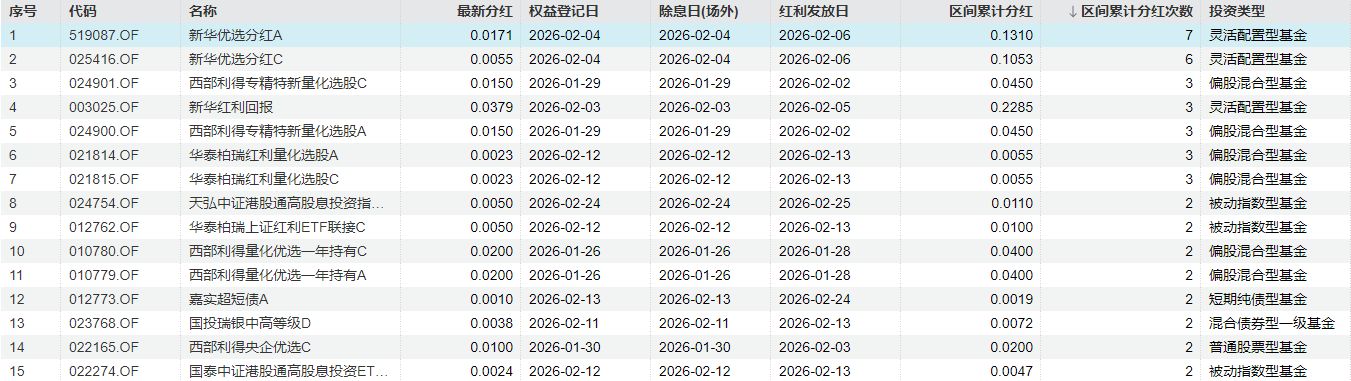
有公募基金产品年内已分红7次
Mei Ri Jing Ji Xin Wen· 2026-02-26 12:45
Group 1 - Public funds such as Invesco Great Wall, Morgan, and Cathay Fund announced that some of their funds will implement dividends soon, reflecting a growing enthusiasm for dividend distribution among public funds in 2026 [1][2] - As of February 25, 2026, public fund products have recorded up to 7 dividend distributions this year, with quantitative funds being particularly active in this regard [1][2] - The increase in dividend distributions is seen as a strategy by fund managers to enhance the long-term attractiveness of their products amid challenges in fundraising and in response to policy requirements [1][2] Group 2 - The majority of funds with the highest number of dividend distributions are active equity funds, with quantitative funds appearing more frequently in the dividend distribution landscape compared to previous years [2][3] - The focus on dividend funds is driven by the need for stable cash flows from dividend assets, which can provide dual returns through consistent cash dividends and potential capital gains [3][4] - Since the beginning of 2026, dividend-themed funds have shown strong performance, with some products achieving returns exceeding 10%, and the average return for all dividend-themed funds reaching 4.47%, surpassing the Shanghai Composite Index's growth [3][4] Group 3 - The shift in the industry is moving from scale expansion to prioritizing investor interests, with dividends becoming a key factor in enhancing the holding experience for investors [5] - The growth in the scale of passive products and the maturity of dividend mechanisms, along with the demand from long-term capital for stable cash flows, are driving the increase in dividend amounts [5]
公募基金分红潮延续:年内部分基金已分红7次!量化产品异军突起
Mei Ri Jing Ji Xin Wen· 2026-02-25 07:21
Core Viewpoint - The enthusiasm for dividend distribution among public funds is increasing significantly in 2026, with various types of equity funds, including quantitative funds, actively participating in dividend payouts [1][2]. Group 1: Dividend Distribution Trends - Multiple public funds, including those from Invesco Great Wall, Morgan, and Cathay, announced dividend distributions for their funds [1][2]. - As of February 25, 2026, some funds have already distributed dividends up to 7 times this year, with quantitative funds being particularly active in this regard [2][4]. - The trend of increasing dividend distributions is seen as a strategy by fund managers to enhance the long-term attractiveness of their products amid challenges in fundraising and regulatory compliance [1][4]. Group 2: Performance of Dividend Funds - Wind statistics indicate that the top funds in terms of dividend distribution frequency are primarily active equity funds, with a notable presence of quantitative funds [4]. - The average return rate for dividend-themed funds since the beginning of 2026 has reached 4.47%, surpassing the growth of the Shanghai Composite Index [7]. - Specific funds, such as Huashang Hong Kong Stock Connect Value Return, have achieved a return rate of 15.93% year-to-date, while several others have exceeded 10% [7]. Group 3: Market Dynamics and Investor Behavior - The demand for dividend-paying assets is driven by the need for stable cash flow, especially among risk-averse institutional investors [7][8]. - The growth in dividend distributions is supported by the expansion of passive products and the increasing scale of broad-based ETFs, which enhance the dividend mechanism [8]. - Fund managers are focusing on creating products that prioritize investor benefits, with dividends becoming a key factor in improving the holding experience [8].

不急于打满仓位 逾八成次新基金有序建仓
Zheng Quan Shi Bao· 2025-12-03 22:09
Group 1 - The core viewpoint of the articles indicates that over 80% of newly established active equity funds have shown signs of building positions, with cautious strategies due to market volatility and year-end style shifts [1][2][4] - As of December 3, 61 new active equity funds were established in the fourth quarter, with 57 being mixed equity funds, and 51 of these funds have experienced net value fluctuations [2][3] - The most notable building activity is observed in funds established in October, with some achieving over 10% returns, while others have faced slight losses due to November's market volatility [2][3] Group 2 - Fund managers are adopting a cautious approach to building positions, with many funds maintaining low levels of investment due to increased market volatility and rapid sector rotation [4][5] - The average decline in 34 core A-share indices has exceeded 3%, with some indices dropping over 11%, prompting fund managers to take a longer-term view on investments [4] - New floating fee rate funds have emerged, with an average fundraising scale of approximately 1.23 billion, and most of these funds have shown minimal net value fluctuations [5] Group 3 - The industry consensus is that AI applications will be a key focus area, with expectations for significant breakthroughs by 2026, particularly in sectors like smart driving and robotics [6][7] - Market analysts suggest that the upcoming central political bureau and economic work meetings may influence market recovery, with a focus on both new and traditional economic sectors [7] - The global AI computing market is expected to continue its strong growth, supported by increasing capital expenditures from leading cloud service providers [7]