账户变动短信通知服务

Search documents
发个信息很贵吗?超五千元交易才提示 为何银行相继提高动账通知门槛
Xin Jing Bao· 2026-02-10 01:12
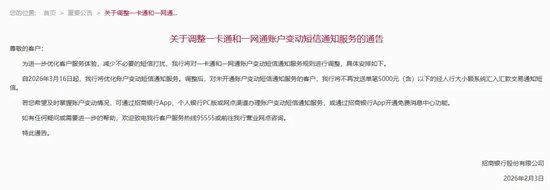
Core Viewpoint - The trend of banks increasing the threshold for free transaction notification SMS is driven by the need to manage operational costs and improve service efficiency, with many banks shifting to digital channels for notifications [1][5][6]. Group 1: Changes in SMS Notification Policies - Since 2025, multiple banks have raised the threshold for free transaction SMS notifications to between 100-500 yuan, with China Merchants Bank setting the threshold at 5000 yuan starting March 16, 2026 [2][3]. - Gansu Bank will stop sending SMS notifications for transactions below 200 yuan starting November 1, 2025, while Guangdong Huaxing Bank will cease notifications for transactions below 500 yuan from September 16, 2025 [3]. - Other banks, including Bank of China and Minsheng Bank, have also adjusted their SMS notification thresholds to 100 yuan or eliminated certain free services [3][5]. Group 2: Cost Management and Digital Transition - The rising costs of SMS services have become a burden for banks, prompting them to filter out small transaction notifications as part of refined cost management strategies [4][5]. - Banks are encouraging customers to use mobile apps and digital channels for notifications, which are more cost-effective and efficient compared to traditional SMS [1][6]. - The transition to digital channels is seen as a way to enhance customer engagement and reduce operational costs, with many banks promoting their app-based notification services [6][7]. Group 3: Customer Perspectives and Concerns - Some customers express that SMS notifications should remain a basic service, as they are more convenient and reliable compared to app notifications [6][7]. - There are concerns about the digital divide, particularly for older customers who may struggle with using mobile apps, suggesting that banks should maintain low-threshold SMS services for these groups [6][7].

招行官宣单笔5000以下入账不再短信通知,银行“免费短信时代”已渐行渐远
Xin Lang Cai Jing· 2026-02-06 01:04
Core Viewpoint - China Merchants Bank has announced an adjustment to its SMS notification service for account transactions, which will no longer send notifications for transactions below 5,000 yuan starting March 16, 2026, reflecting a broader trend in the banking industry to reduce costs and improve efficiency amid narrowing net interest margins [1][3][12]. Summary by Relevant Sections Service Adjustment - Starting March 16, 2026, China Merchants Bank will stop sending SMS notifications for transactions of 5,000 yuan or less for customers who have not activated the service [1][3]. - The bank aims to enhance customer service experience by reducing unnecessary SMS notifications, encouraging customers to use its app or online services for transaction updates [3][10]. Industry Trends - Since 2025, over ten banks, including Bank of China and Gansu Bank, have raised the threshold for free SMS notifications, with some banks setting the minimum amount to 1,000 yuan [1][7]. - The trend indicates a shift in the banking sector towards higher thresholds for free SMS notifications, with many banks now charging between 1 to 4 yuan per month for this service [6][8]. Customer Base and Growth - As of the end of Q3 2025, China Merchants Bank reported 220 million retail customers, a 4.76% increase from the previous year, with 5.78 million high-tier customers, marking a 10.42% growth [3][12]. Historical Context - The bank has progressively tightened its SMS notification policies since 2024, gradually reducing the number of free notifications for smaller transactions [4][5]. - Previous adjustments included stopping notifications for transactions below 1,000 yuan and cumulative daily amounts below 3,000 yuan [4][5]. Financial Context - The banking industry is facing pressure from narrowing net interest margins, with the average net interest margin reported at 1.42% as of Q3 2025 [12]. - Banks are increasingly looking to enhance revenue through service fees and adjustments to existing services as a response to these financial pressures [12][14].