
资本代建

Search documents
中指研究院:2025年头部代建企业新签约规模化建筑面积占比下降 中部企业加速发力
智通财经网· 2026-02-19 23:51
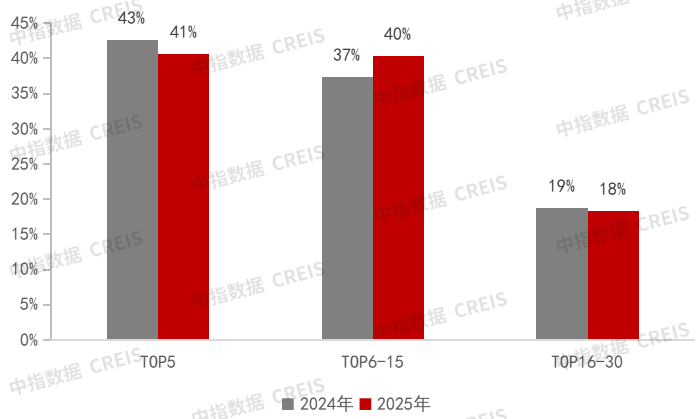
Core Insights - The market share of top construction companies in new signed project areas has decreased, while mid-tier companies are accelerating their expansion efforts [1] - State-owned enterprises are rapidly entering the construction sector, leveraging their resource advantages [2] - The structure of construction models remains stable, with commercial construction accounting for over 70% [3] Group 1: Market Trends - The proportion of new signed project areas by the top 5 construction companies is 41%, a decrease of 2 percentage points compared to the same period in 2024 [1] - The share of companies ranked 6-15 has increased to 40%, up 3 percentage points from 2024 [1] - In 2025, the new signed project areas in first-tier cities, second-tier cities, and third-fourth tier cities are 8.1%, 46.3%, and 45.6% respectively, indicating a shift towards third-fourth tier cities [7] Group 2: State-Owned Enterprises - Among the top 50 companies by sales, 30 have scaled up their construction business, with state-owned enterprises making up nearly 40% [2] - In 2025, state-owned enterprises are showing significant growth in new signed project areas, with companies like China Railway Real Estate seeing a 51% year-on-year increase [2] - The focus of state-owned enterprises includes urban renewal and the disposal of non-performing assets [2] Group 3: Construction Model Structure - The breakdown of new signed project areas in 2025 shows government construction at 21.6%, commercial construction at 74.0%, and capital construction at 4.4% [3] - The share of capital construction has increased by 1.1 percentage points, primarily driven by the disposal of non-performing assets [3] - Commercial construction remains the preferred model due to higher management fees and lower risks compared to capital construction [3] Group 4: Project Types and Management Fees - The share of residential projects in new signed areas has increased to 66.7%, up 11.4 percentage points from 2024 [12] - Management fees for construction projects are declining, with 84% of projects having fees between 1%-3%, an increase of 4 percentage points from 2024 [16] - The proportion of construction and sales projects is 49%, indicating a trend where most projects require both construction and sales capabilities [18]

代建行业竞争白热化,房企如何破局
Xin Lang Cai Jing· 2025-11-06 02:09
Core Insights - The real estate industry is undergoing a transformation, with construction agency services becoming a significant direction for companies, leading to accelerated expansion among leading construction firms [1][2] - The competition in the construction agency sector is intensifying, prompting companies to adhere to long-term strategies rather than pursuing blind scale expansion [1][4] Industry Overview - The overall scale of construction agency services has significantly increased, with six leading companies adding over 10 million square meters of new construction agency scale in the first three quarters of 2025 [2] - The top 20 construction agency firms saw a year-on-year increase of 31% in new signed construction area, totaling 15,771 million square meters [2] - Green City Management leads the sector with over 2,700 million square meters of new construction area, approximately double that of the second-ranked firm [2] Types of Construction Agency Services - Construction agency services are categorized into government, commercial, and capital agency types, each serving different market needs [3] - Government agency services focus on public projects such as affordable housing and schools, while commercial agency services are the most prevalent, providing management services to clients lacking development capabilities [3] - Capital agency services are the most complex, often involving financial institutions to manage distressed assets [3] Competitive Landscape - The competition among construction agency firms is becoming more specialized, with companies focusing on niche markets to establish differentiated advantages [4] - Recent government policies have increased the precision and detail of construction agency regulations, raising the professional requirements for firms [4][5] - Companies are encouraged to broaden their focus to include urban renewal projects and affordable housing, as these areas present significant opportunities [5] Strategic Recommendations - Firms are advised to deepen their engagement in specialized fields and enhance service quality to achieve sustainable growth [5][6] - Emphasis on long-term strategies, project fulfillment rates, and client satisfaction is crucial for success in a competitive environment [5][7] - Companies should innovate their business models and explore high-value, high-barrier niche markets to avoid price competition [5][6] Emerging Trends - The shift towards managing distressed assets reflects a broader change in the real estate industry's underlying logic, moving from new development to revitalizing existing assets [6][7] - The "guarantee delivery" policy has created substantial demand for professional intervention in construction and delivery projects, providing clear business opportunities for capable construction agencies [6][7]