
赤坎华侨古镇

Search documents
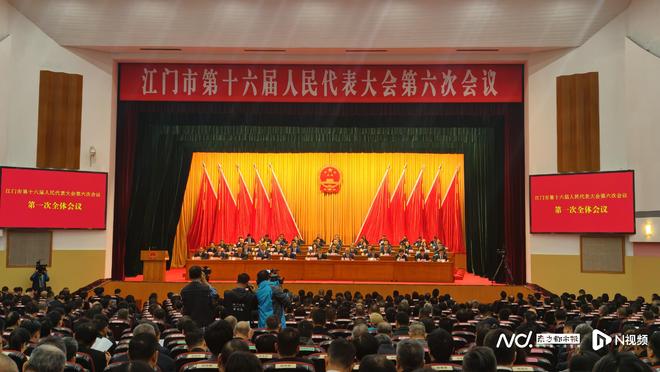
江门:2026年GDP预期增长目标为5%左右
Nan Fang Du Shi Bao· 2026-02-05 08:47
Core Viewpoint - The government work report of Jiangmen City outlines economic growth targets and achievements, emphasizing a focus on industrial development and infrastructure improvements to enhance regional competitiveness and integration into the Greater Bay Area [1][6]. Economic Growth Targets - Jiangmen aims for a GDP of 4,294 billion yuan by 2025, with a growth rate of 2.8%, and a target of approximately 5% growth in 2026 [1][6]. - The report sets a goal for an average annual GDP growth of 6% during the "15th Five-Year Plan" period [6]. Historical Economic Performance - Over the "14th Five-Year Plan," Jiangmen's GDP grew at an average rate of 4.7%, ranking 4th in the province [3][5]. - The industrial added value for large-scale enterprises increased by 6.7% annually, placing Jiangmen 3rd in the province [5]. Sectoral Performance - The construction industry achieved a total output value of 570 billion yuan, growing by 2.3%, which is 11.4 percentage points higher than the provincial average [3]. - The agricultural, forestry, animal husbandry, and fishery sectors reported a total output value of 691 billion yuan, with a growth rate of 5.8%, ranking 6th in the province [3]. Trade and Investment - Jiangmen's total import and export volume approached 200 billion yuan, with a growth of 3.2%, ranking 37th nationally [3]. - The city plans to attract over 200 billion yuan in project investments, including 32 manufacturing projects with investments exceeding 10 billion yuan, which represent growth rates of 23.1% and 19.2%, respectively [3]. Tourism Growth - The number of tourists and tourism revenue in Jiangmen experienced double-digit growth, with the Qiaoxiang Ancient Town receiving over 3.6 million visitors and doubling its revenue [3][5]. Infrastructure Development - Jiangmen is accelerating the construction of key transportation projects, including the Shenjiang Railway and Zhuji High-speed Railway, to enhance connectivity within the Greater Bay Area [8].

广东省19个地区试点整县推进农文旅融合发展
Zhong Guo Fa Zhan Wang· 2025-10-22 08:33
Core Insights - The integration of agriculture, culture, and tourism in Guangdong is becoming a pillar industry for county development, driven by the "Hundred Counties, Thousand Towns, and Ten Thousand Villages High-Quality Development Project" [1][2][3] - A total of 19 regions have been selected as pilot areas for this integration, with significant projects emerging from these initiatives [2][12][20] Summary by Categories Project Development - The first batch of 11 pilot areas has seen notable achievements, including the construction of the 218-kilometer "Most Beautiful Tourist Road" in Huizhou and the opening of 101 cultural tourism projects in the Kaiping-Taishan area [2][12][20] - The second batch of 8 pilot areas is also making progress, with plans for 35 key projects in Foshan, totaling over 5.8 billion yuan in investment [3][20][21] Economic Impact - The integration is revitalizing idle resources and promoting the development of rural industries, leading to increased economic activity and job creation [3][13][21] - In 2022, the city of Jiangmen received over 20 million tourists, with tourism revenue growing at double-digit rates for two consecutive years [5][22] Strategic Recommendations - Experts suggest focusing on rural resources, agricultural development, cultural uniqueness, and market orientation to enhance the quality of integration [4][13] - The need for effective branding and promotion of tourism projects is emphasized, with initiatives in places like Heyuan showcasing local attractions [7][16] Infrastructure and Connectivity - Huizhou's development of a 218-kilometer tourist road is connecting various tourism resources, enhancing accessibility [15][23] - Digital infrastructure is being strengthened to support agricultural tourism, with initiatives like smart farming and data-driven agricultural models [9][18][25] Market Engagement - The involvement of various market players is crucial for sustainable development, with companies like Guangdong Tourism Holdings leveraging their full industry chain advantages [8][24] - Investments in innovative projects are being made, with companies committing over 3 billion yuan to enhance local tourism offerings [8][24][25]
广东已遴选19个地区试点整县推进农文旅融合发展
Nan Fang Ri Bao Wang Luo Ban· 2025-10-18 01:50
Core Insights - The "Hundred Counties, Thousand Towns, and Ten Thousand Villages High-Quality Development Project" is revitalizing the value of rural areas in Guangdong, leading to increased consumer engagement and the integration of cultural tourism with agriculture, forestry, commerce, and sports, establishing it as a pillar industry for county development [1][2] Group 1: Pilot Projects and Development - Guangdong has selected 19 regions in two batches as pilot areas for the integration of agriculture and cultural tourism, promoting diverse business models and revitalizing rural consumption markets [2][3] - Notable projects include the Huizhou 218-kilometer scenic tourism road and the establishment of 101 cultural tourism projects in Jiangmen, with the Chikan Overseas Chinese Town emerging as a new tourism highlight in the Pearl River Delta [2][3] Group 2: Regional Highlights and Strategies - The second batch of pilot areas showcases significant projects, such as the planning of 35 key agricultural and cultural tourism projects in Foshan with a total investment exceeding 5.8 billion [3] - Jiangmen is leveraging its cultural heritage and coastal resources to enhance tourism, achieving over 20 million visitors last year, with a notable increase in tourism revenue [6][7] Group 3: Social Participation and Market Forces - The integration of agriculture and cultural tourism relies on the active participation of various market entities, with companies focusing on planning, investment, and operation to enhance service levels and extend the integration into sports and wellness sectors [8][9] - Guangdong's digital infrastructure supports rural tourism development, with initiatives like the digital agricultural trading model and smart deep-sea farming platforms enhancing the agricultural tourism experience [8][9]