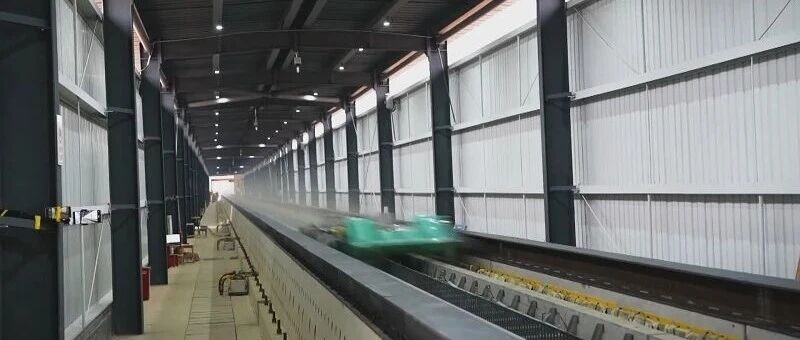
超导电动磁悬浮试验车

Search documents
首艘、首条、首批!上周,大国工程好消息频传
Yang Shi Xin Wen· 2025-12-28 22:34
Group 1: Technological Breakthroughs - China has achieved a world record in superconducting electric magnetic levitation, accelerating a test vehicle weighing tons to 700 km/h in just two seconds, marking the fastest speed for this type of platform globally [1] - The world's first methanol dual-fuel intelligent super-large oil tanker, "Kai Tuo," has been successfully delivered, featuring a length of approximately 333 meters and a capacity to carry about 2.1 million barrels of crude oil [2] - The first near-zero carbon steel production line in China has been fully connected, capable of reducing carbon emissions by over 3.14 million tons annually, equivalent to reforesting 2,000 square kilometers [3] Group 2: Energy and Infrastructure Developments - China's largest offshore oil field, Bohai Oilfield, is projected to produce over 40 million tons of oil and gas equivalent by 2025, providing a solid guarantee for national energy security [6] - The "Linglong No. 1," the world's first land-based commercial modular small reactor, successfully completed its non-nuclear commissioning test, laying a solid foundation for future nuclear operations [8] - The first unit of China's largest pumped storage power station has been connected to the grid, marking a significant breakthrough in hydropower equipment and engineering [13] Group 3: Transportation Expansion - Multiple high-speed rail lines have been opened, including the Guangzhou-Zhanjiang high-speed rail, which can reach Zhanjiang in as little as 1 hour and 32 minutes [20] - The Shantou-Shantou South high-speed rail has officially commenced operations, with a total length of 162 kilometers and a design speed of 350 km/h [21] - The Baotou-Yinchuan high-speed rail has achieved full operation, bringing high-speed rail access to Inner Mongolia [23] - The Xi'an to Yan'an high-speed railway has been opened, contributing to a total high-speed rail network exceeding 50,000 kilometers [24] - The Wuhan to Yichang section of the Huhangyu Railway has been opened, enhancing rapid passenger transport in the Jianghan Plain and western Hubei [25] - The Hangzhou to Quzhou high-speed rail has been opened, adding a new artery to the Yangtze River Delta intercity rapid transit network [26] - The Ankang to Lanhua Expressway has been completed, becoming an important inter-provincial passage between Shaanxi and Chongqing [27] - The world's longest highway tunnel, the Tianshan Victory Tunnel, has been opened, significantly reducing travel time between Urumqi and Korla [28] - The Cangzhou-Zhao Expressway has been officially opened, ending reliance on ferry transport for over 10,000 residents [29] - The Guiyang to Beihai Expressway has been opened, providing a new north-south route to the Beibu Gulf [30] - The first "6-lane to 12-lane" expressway expansion project in China has been completed, enhancing the capacity of the Jing-Tai Expressway [31]


我国创造全球最快超导电动磁悬浮试验速度
Qi Lu Wan Bao· 2025-12-26 09:30
Core Viewpoint - The research team from the National University of Defense Technology has achieved a world record in superconducting magnetic levitation technology by accelerating a ton-level test vehicle to 700 kilometers per hour within two seconds, marking the fastest speed for this type of platform globally [1] Group 1 - The magnetic levitation team has been working on this project for 10 years [1] - The record-breaking speed was achieved on a 400-meter magnetic levitation test line [1] - The test vehicle was able to safely stop after reaching the maximum speed of 700 kilometers per hour [1]
吨级重试验车2秒飙至时速700公里
Xin Lang Cai Jing· 2025-12-25 16:20
Core Insights - The research team from National University of Defense Technology has achieved a world record by accelerating a ton-level test vehicle to 700 kilometers per hour within two seconds, marking the fastest superconducting magnetic levitation test speed globally [1] Group 1: Technological Breakthroughs - The team has overcome key technological challenges in areas such as ultra-high-speed electromagnetic propulsion, electric levitation guidance, transient high-power energy storage inversion, and high-field superconducting magnets [1] - This achievement signifies China's entry into the international leading position in the field of ultra-high-speed magnetic levitation [1] Group 2: Future Applications - The advancements provide new options for the development of vacuum tube magnetic levitation transportation and offer new methods for aerospace launch assistance and testing [1] - Future efforts will focus on ultra-high-speed pipeline magnetic levitation transportation, aerospace equipment testing, and electromagnetic launch assistance, promoting deep integration of production, education, and research [1]
我国创造超导电动磁悬浮推进世界纪录
第一财经· 2025-12-25 05:04
Core Viewpoint - The research team from the National University of Defense Technology has achieved a groundbreaking speed of 700 kilometers per hour for a ton-class maglev test vehicle, setting a global record for superconducting electric maglev testing [1][3]. Group 1 - The maglev team has spent 10 years overcoming core technological challenges, including ultra-high-speed electromagnetic propulsion, electric suspension guidance, transient high-power energy storage inversion, and high-field superconducting magnets [3]. - The successful test was conducted on a 400-meter maglev test track, demonstrating the ability to accelerate and safely stop a ton-class load at the record speed [3]. - This achievement positions China at the forefront of ultra-high-speed maglev technology, providing new options for the development of vacuum tube maglev transportation and offering innovative methods for aerospace launch and testing [3]. Group 2 - The subsequent technological iterations and industrial applications are expected to bring new momentum to China's aerospace and rail transportation sectors [3].
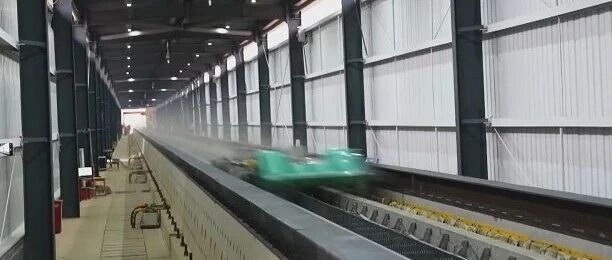
700公里/小时!中国速度领跑全球
中国基金报· 2025-12-25 04:50
Core Viewpoint - The research team from National University of Defense Technology has achieved a world record in magnetic levitation technology by accelerating a ton-level test vehicle to 700 kilometers per hour within two seconds, marking a significant advancement in the field of superconducting electric magnetic levitation [2] Group 1 - The test was conducted on a 400-meter magnetic levitation experimental line, successfully reaching the highest test speed of 700 kilometers per hour with a ton-level load and safely stopping [2] - This breakthrough addresses key technical challenges in ultra-high-speed electromagnetic propulsion, electric levitation guidance, transient high-power energy storage inversion, and high-field superconducting magnets [2] - The achievement positions China at the forefront of ultra-high-speed magnetic levitation technology, providing new options for the future development of vacuum tube magnetic levitation transportation [2] Group 2 - The advancements in this technology also offer new methods and means for aerospace launch assistance and testing [2] - The subsequent technological iterations and industrial applications are expected to bring new momentum to the development of China's aerospace and rail transportation sectors [2]

国防科大磁悬浮实验:2秒内,将吨级重试验车加速至700公里/小时
财联社· 2025-12-25 04:25
Core Viewpoint - The research team from the National University of Defense Technology has achieved a groundbreaking speed of 700 km/h for a ton-level test vehicle in magnetic levitation experiments, setting a new global record for superconducting electric magnetic levitation speed [1] Group 1: Technological Breakthroughs - The team has overcome key technical challenges in ultra-high-speed electromagnetic propulsion, electric levitation guidance, transient high-power energy storage inversion, and high-field superconducting magnets [1] - This achievement marks China's entry into the international leading position in the field of ultra-high-speed magnetic levitation [1] Group 2: Future Implications - The advancements provide new options for the development of vacuum tube magnetic levitation transportation in China [1] - The technology can also offer new methods and means for aerospace launch assistance and testing [1] - Future iterations and industrial applications of this technology are expected to bring new momentum to China's aerospace and rail transit sectors [1]