跨境贸易

Search documents
2026年格隆汇“全球视野”十大核心资产之汇丰控股
Ge Long Hui· 2026-01-05 11:09
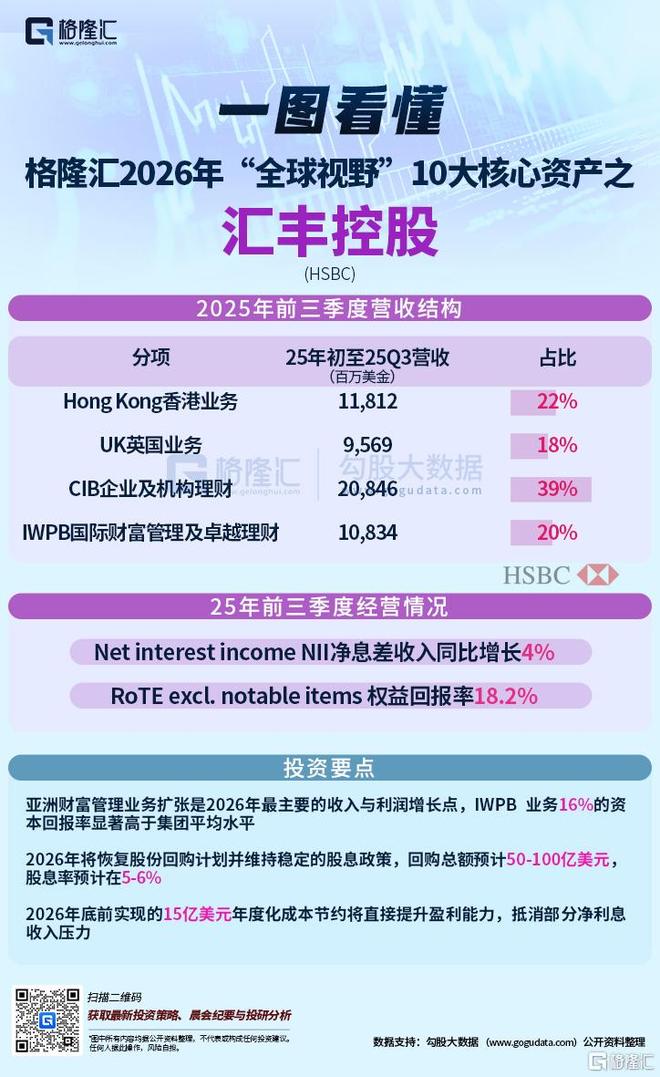
Core Viewpoint - HSBC Holdings has been selected as a key asset in the "Global Vision" top ten core assets for 2026, representing the financial sector, due to its strategic transformation and focus on the Asia-Pacific market [1] Group 1: Strategic Transformation - HSBC has undergone a significant transformation over three years, divesting low-profit retail assets in Europe and the U.S. and refocusing on the Asia-Pacific market, emphasizing retail banking, cross-border trade, and wealth management [1] - The results of this transformation are evident in the first three quarters of 2025, with net interest income increasing by 4% year-on-year and a return on tangible equity (RoTE) of 18.2% [1] Group 2: Industry Opportunities - The global banking industry is entering a recovery phase in 2024, with the Asia-Pacific region becoming a core growth engine, contributing over 60% of the global cross-border trade growth of 8% [5] - The interest rate cut cycle is expected to benefit HSBC by reducing cross-border financing costs and stimulating demand for cross-border mergers and acquisitions, trade financing, and IPO activities in the Asia-Pacific region [5] Group 3: Business Segments Performance - HSBC's business structure has been reorganized into four main segments: Hong Kong, UK, Corporate and Institutional Banking (CIB), and International Wealth Management and Premier Banking (IWPB), enhancing operational efficiency [7] - The Hong Kong segment serves as a profit anchor, with a revenue increase of 5% to $11.8 billion in the first three quarters of 2025, driven by a 21% growth in non-resident clients since January 2023 [7] - The CIB segment is projected to benefit from a recovery in global capital markets, with revenue growth of 10%-12% driven by cross-border trade financing and investment banking activities [11] - The IWPB segment is expected to achieve revenue growth of 18%-20% due to the increasing wealth of high-net-worth individuals in the Asia-Pacific region [14] Group 4: Competitive Advantages - HSBC's core competitive advantage lies in its deep-rooted local network and cross-border service capabilities in the Asia-Pacific region, which have been built over 160 years [16] - The bank's strategic restructuring has enhanced its resilience to market cycles, with a focus on high-return businesses, resulting in 59% of revenue coming from CIB and IWPB [16] Group 5: Financial Improvement and Valuation - HSBC's financial health is improving, with a 4% year-on-year increase in net interest income and a stable RoTE above 18% [19] - The bank's current valuation is below historical averages, with potential for a 15%-20% recovery as the market recognizes its focus on high cash returns and Asia-Pacific growth [19]


2025全国新一线城市排名出炉:成都第2,重庆第6,东莞入围
Sou Hu Cai Jing· 2025-05-29 15:08
Core Insights - The 2025 China Urban Comprehensive Strength Ranking released by GYbrand evaluates cities based on economic vitality, innovation index, talent attraction, infrastructure, and consumption potential [1] New First-Tier Cities - Hangzhou ranks 5th, followed by Chengdu at 6th, with Nanjing, Wuhan, and Suzhou taking 7th to 9th places, and Chongqing at 10th [3] - Chengdu maintains its 6th position due to balanced development, excelling in consumption potential and talent attraction [3] - Dongguan enters the new first-tier city list for the first time at 20th, transitioning from a manufacturing hub to a smart manufacturing base [7] Economic Development in Chengdu and Chongqing - Chengdu's transportation hub status is strengthened by the Chengdu-Chongqing Economic Circle, with annual passenger throughput exceeding 100 million at its airports [5] - Chongqing, as the only municipality in central and western China, has a strong industrial base and a comprehensive transportation system, with significant contributions from its automotive and electronic information industries [5] Dongguan's Transformation - Dongguan's electronic information industry has surpassed 1 trillion in output value, supported by major projects from Huawei and OPPO [7] - The city benefits from talent policies attracting over 100,000 graduates annually, although it faces challenges in educational resources and urban infrastructure [7] Competitive Landscape in the Yangtze River Delta - Hangzhou and Nanjing lead the Yangtze River Delta new first-tier cities, with Hangzhou's e-commerce ecosystem driving growth in live commerce and cross-border trade [8] - Nanjing leverages its educational resources and historical background to support its chip industry and financial sector [8] Emerging Trends in Central and Western Cities - Cities like Wuhan, Xi'an, and Hefei are rising due to precise industrial positioning, focusing on sectors like semiconductors and quantum information [10] - Northern cities such as Qingdao and Shenyang face growth challenges, while cities in the Guangdong-Hong Kong-Macau Greater Bay Area are rapidly rising due to policy support and industrial collaboration [10] New Urban Development Logic - The ranking reveals a shift from single-pole advancement to multi-center collaboration, emphasizing the importance of industrial depth over mere scale expansion [12] - Future competition among new first-tier cities will focus on innovation capacity, ecological livability, and global resource allocation [12]