
轻型装甲车

Search documents
关注+管制!商务部重拳出击,日本右翼彻底慌了
Xin Lang Cai Jing· 2026-02-24 13:11
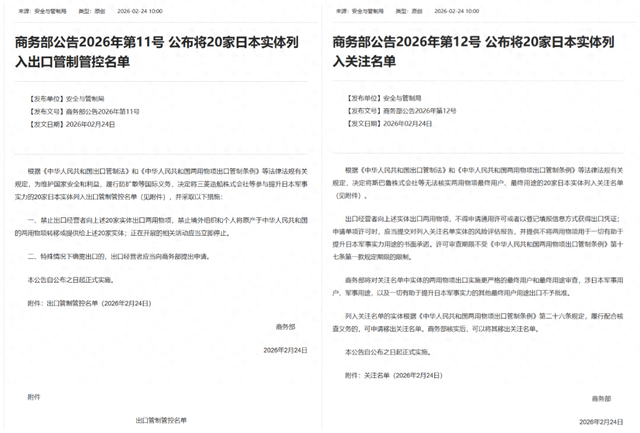
Group 1 - The Chinese government has placed 40 Japanese entities under export control, with 20 on a "control list" for enhancing Japan's military capabilities and threatening China's national security, and another 20 on a "watch list" due to serious military dual-use risks [1][2][3] - The announcement has caused significant concern within the Japanese government and media, indicating a strong response from China against Japan's military ambitions [3][4] - The entities on the control list are primarily key players in Japan's military-industrial complex, including major companies like Mitsubishi Heavy Industries, which is involved in the production of advanced naval vessels and military aircraft [5][7][9] Group 2 - Companies like Subaru, traditionally known for consumer vehicles, are revealed to be involved in military production, including vehicles for the Japanese Self-Defense Forces, highlighting the dual-use nature of their operations [12][14] - The entities on the watch list are described as "hidden" players in the military sector, with companies like ENEOS supplying critical fuels for military operations while disguising their activities as civilian [12][16] - The timing of these export controls is linked to Japan's increasing militarization under the current government, which has significantly raised defense budgets and ambitions for offensive military capabilities [18][19][21] Group 3 - The U.S. is seen as a catalyst for Japan's military resurgence, having relaxed restrictions on military technology transfers to Japan, which raises concerns about a potential return to militarism [22][23] - China's export controls are positioned as a necessary measure to protect national security, reflecting its growing confidence in its industrial capabilities and supply chain leverage [25][26] - The potential for further sanctions against Japan's military-industrial complex is indicated, should Japan continue its provocative actions against China [27][28]

基辅响起爆炸声 乌军:俄米格-31战机升空 乌全境面临导弹袭击威胁!
Mei Ri Jing Ji Xin Wen· 2025-12-27 01:40
Group 1 - Ukraine's military is facing missile attack threats from Russian MiG-31 aircraft, prompting air raid alerts in Kyiv [4][3] - Russian Deputy Foreign Minister Ryabkov stated that setting specific dates to resolve the Russia-Ukraine conflict is inappropriate and that there should be no deadlines given at this time [4] - Ryabkov also indicated that the risk of nuclear conflict has not been eliminated and emphasized the need for genuine negotiations with the United States [5] Group 2 - Former U.S. President Trump expressed confidence in an upcoming meeting with Ukrainian President Zelensky, stating that Zelensky has nothing without his approval [6] - Trump positioned himself as a potential "final arbiter" of the Ukraine peace agreement, suggesting that Ukraine's fate largely depends on convincing him of their concessions [8] - Zelensky plans to discuss security guarantees and sensitive issues with Trump, aiming to reach an agreement on a framework to end the conflict, including a proposed timeline [8] Group 3 - Russian President Putin announced a meeting to review the national armament plan for 2027-2036, highlighting significant increases in military production compared to 2022 [9] - Specific production increases include tanks at 2.2 times, light armored vehicles at 3.7 times, military aircraft at 4.6 times, military vehicles at 5.7 times, and various munitions at over 22 times [9] - Putin emphasized the importance of reducing production costs, enhancing testing facilities, and integrating artificial intelligence in defense production to maintain and strengthen military capabilities [9]
俄总统普京召开国家军备计划会议
Yang Shi Xin Wen· 2025-12-26 14:22
Core Insights - The Russian government is significantly increasing its military production capabilities as part of the national armament plan for 2027-2036, with President Putin highlighting substantial growth in various military equipment outputs compared to 2022 [1] Group 1: Military Production Growth - Tank production has increased to 2.2 times the previous output [1] - Light armored vehicle production, including infantry fighting vehicles and armored transport vehicles, has risen to 3.7 times [1] - Military aircraft production has grown to 4.6 times [1] - Military vehicle production has expanded to 5.7 times [1] - Production of rocket artillery and missile systems has surged to 9.6 times [1] - Communications and electronic warfare equipment production has increased to 12.5 times [1] - Individual soldier protective equipment production has approached 18 times [1] - The output of various types of ammunition and strike weapons has exceeded 22 times [1] Group 2: Future Plans and Innovations - President Putin emphasized the need for further work on reducing product costs during the execution of the new national armament plan [1] - There is a focus on enhancing testing and testing ground facilities [1] - The promotion of artificial intelligence technology and the development of advanced materials are key priorities [1] - The defense industry is expected to drive innovation across the entire industrial sector [1]