通用机器人Apollo

Search documents
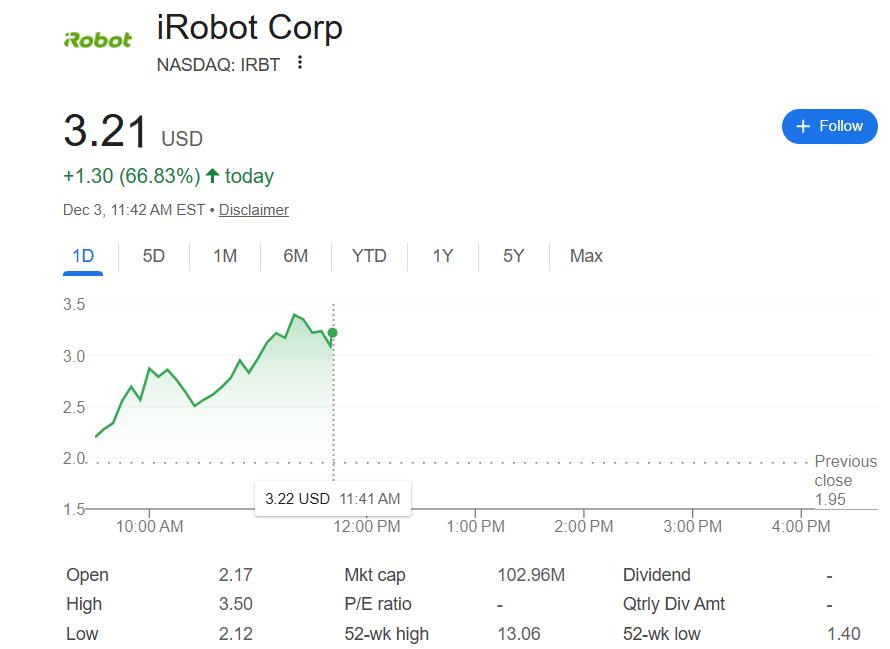
iRobot盘中飙涨近80%!特朗普政府All in!据称考虑明年发机器人行政令
美股IPO· 2025-12-04 00:55
Core Viewpoint - The U.S. government is intensifying its support for the robotics industry, viewing it as crucial for bringing key manufacturing back to the U.S. and competing globally, particularly following the focus on artificial intelligence (AI) [1][5][6]. Group 1: Government Initiatives - The U.S. Secretary of Commerce has been meeting with CEOs in the robotics sector, indicating strong governmental support for the industry's accelerated development [2][5]. - The U.S. Department of Transportation is preparing to announce the formation of a robotics working group, potentially by the end of the year [6]. - There is growing interest in Congress regarding the robotics industry, with proposals for a national robotics committee, reflecting a strategic focus on robotics as a competitive frontier [6]. Group 2: Market Response - Following the announcement of government support, stocks in the robotics sector surged, with iRobot's stock rising over 79% intraday and closing nearly 74% higher [2][3]. - Other notable stock movements included Tesla up approximately 4.1%, Richtech Robotics up 18.5%, and Serve Robotics up 18.2% [2]. Group 3: Investment Landscape - Significant investment is anticipated in the robotics sector, with projections indicating that funding could reach $2.3 billion by 2025, doubling from the previous year [7]. - Goldman Sachs estimates that the global humanoid robotics market could reach $38 billion by 2035, highlighting the potential for growth in this sector [7]. Group 4: Industry Perspectives - Industry leaders are advocating for government tax incentives and federal funding to support the integration of advanced automation technologies and strengthen supply chains [7]. - The CEO of Apptronik emphasized the need for a national robotics strategy to maintain competitiveness in this emerging industry [7]. Group 5: Technological Integration - The concept of "physical AI," which encompasses robotics and autonomous driving technologies, is gaining traction among tech giants, indicating a shift in focus from traditional AI to its application in robotics [9]. - SoftBank's CFO highlighted the importance of investing in "physical AI" as a transformative force, despite recent divestments from Nvidia [9][10]. Group 6: Economic Implications - Tesla's CEO, Elon Musk, stated that AI-driven robots could be the only solution to the U.S. debt crisis, suggesting that increased productivity from these technologies could lead to deflation [11][12]. - Musk predicts that within a few years, the growth in goods and services driven by AI and robotics will surpass the increase in money supply, potentially reshaping the economic landscape [12][13].



特朗普政府All in!据称考虑明年发机器人行政令,iRobot盘中飙涨近80%
Hua Er Jie Jian Wen· 2025-12-03 17:28
Core Viewpoint - The Trump administration is actively promoting the robotics industry, indicating a strategic shift towards robotics as a key area for competition with other major economies, following the focus on artificial intelligence (AI) [1][4]. Group 1: Government Support and Initiatives - U.S. Secretary of Commerce, Gina Raimondo, has been meeting with robotics CEOs to express full support for the industry's development, with plans for an executive order on robotics next year [1][3]. - The U.S. Department of Transportation is preparing to announce the establishment of a robotics task force, highlighting growing congressional interest in the robotics sector [4]. - The commitment to robotics is seen as essential for bringing critical manufacturing back to the U.S., following a previous AI acceleration plan [3][4]. Group 2: Investment and Market Potential - Significant investment is anticipated in the robotics sector, with projections indicating that funding could reach $2.3 billion by 2025, doubling from the previous year [5]. - Goldman Sachs estimates that the global humanoid robotics market could reach $38 billion by 2035, showcasing the potential for growth in this industry [5]. Group 3: Industry Perspectives and Challenges - The robotics industry is advocating for government tax incentives and federal funding to help integrate advanced automation technologies and strengthen supply chains [6]. - Apptronik, a humanoid robotics startup, emphasizes the need for a national robotics strategy to maintain competitiveness in this emerging sector [6]. Group 4: Technological Integration and Future Outlook - Major tech companies are investing in "physical AI," which encompasses robotics and autonomous driving technologies, indicating a broader trend in the industry [7]. - SoftBank's CEO, Masayoshi Son, has expressed the belief that physical AI will significantly impact global GDP, suggesting a transformative potential for the economy [8]. Group 5: Economic Implications - Tesla CEO Elon Musk argues that AI-driven robots are the only viable solution to address the U.S. debt crisis, emphasizing their potential to enhance productivity and output [9]. - Musk predicts that advancements in AI and robotics could lead to deflation, as production increases outpace monetary supply growth [9][10].