逸扉酒店

Search documents
“收钱祸害客人!”罗永浩炮轰凯悦逸扉酒店,CEO孙武的“消费者导向”被员工打脸?
新浪财经· 2025-12-13 07:39
Core Viewpoint - The incident involving Luo Yonghao criticizing Hyatt's "Eiffel Hotel" highlights significant management and service issues within the hotel, particularly regarding customer experience and operational transparency [2][4][11]. Group 1: Incident Overview - Luo Yonghao's criticism was sparked by a blogger's complaint about staying at the Hyatt's Eiffel Hotel in Shanghai, where they paid over 1300 yuan per night but faced issues like noise and air conditioning problems that disrupted their sleep [2][7]. - The hotel staff acknowledged that senior management is involved in addressing the situation, but specific updates were not provided [2][9]. - Consumer feedback in the hotel's comment section revealed ongoing issues with noise, hygiene, and service quality, indicating a pattern of dissatisfaction among guests [2][10]. Group 2: Management and Service Issues - The CEO of Hyatt's China division previously emphasized a "consumer-oriented" approach, which now appears contradicted by the current service failures reported by guests [3][11]. - The hotel has been criticized for knowingly selling rooms with unresolved issues, which some guests view as deceptive practices [7][9]. - Feedback from various consumers included complaints about misleading room descriptions, poor management, and inadequate responses to reported problems, suggesting systemic issues within the hotel's operations [10][13]. Group 3: Brand and Operational Challenges - The Eiffel Hotel, a joint venture between Hyatt and Shoulu Rujia, was positioned as a mid-to-high-end business hotel, but consumer experiences indicate it has not met these standards [13]. - Previous management issues, such as a failure to synchronize booking data with Hyatt's membership system, have led to operational inefficiencies and reputational damage for the brand [13][14]. - The hotel's unique management culture, which encourages a relaxed and informal service style, has resulted in significant service gaps and customer dissatisfaction [15].


凯悦酒店在中国为何总是“慢一拍”?
3 6 Ke· 2025-11-19 11:16
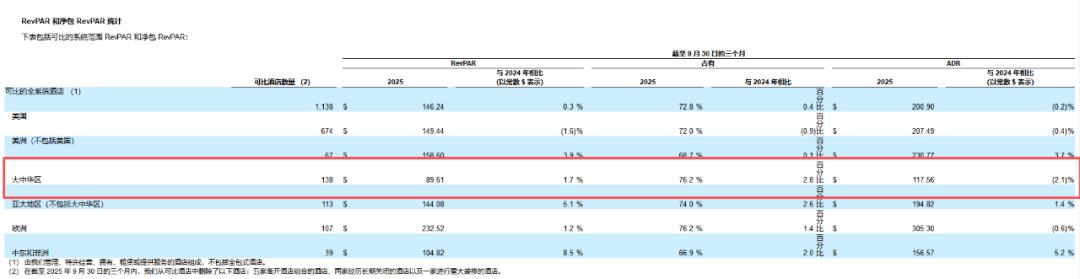
Core Insights - Hyatt Hotels Group has been experiencing a prolonged period of growth in occupancy (OCC) and revenue per available room (RevPAR) in China, but average daily rate (ADR) has been declining, raising questions about its pricing strategy and product structure adjustments [2][9][12] - The company faces challenges from the rise of local hotel groups and changing market dynamics in China, leading to concerns about its competitive positioning and growth strategy [3][4][28] - Hyatt's performance in China is characterized by a significant drop in ADR compared to its global performance, indicating a reliance on "price for volume" strategy [5][9][12] Performance Metrics - In Q3 2023, Hyatt's global RevPAR was $146.24, with a 0.3% year-over-year increase, while ADR was $200.90, down 0.2% [6] - In China, RevPAR was $89.61, up 1.7% year-over-year, with an OCC of 76.2%, up 2.8 percentage points, but ADR fell to $117.56, down 2.1% [8] - For the first half of 2023, Hyatt's China RevPAR was $84.82, with a 2.1% increase, while ADR decreased by 3.1% [10] Market Positioning - Hyatt's hotel count in China exceeded 180 by 2024, with 32 new openings, but this growth rate lags behind competitors like Marriott and Hilton [13][15] - The company has struggled to establish a strong presence in the mid-to-high-end market segment, which has been increasingly dominated by local brands [21][28] - The introduction of the "Yifei" brand aimed to capture the mid-range market, but it has not met initial growth targets [25][30] Strategic Partnerships - Hyatt has engaged in multiple partnerships with local hotel groups to expand its presence in China, including collaborations with ShouLai Hotel Group and others for brand development [36][37] - The company has adopted a strategy of leveraging local partners for its mid-range and select service brands, which may not be sufficient for achieving significant market penetration [39][43] - Recent agreements to develop new brands like Hyatt Studios indicate a shift towards addressing gaps in the mid-to-high-end market [34][35]
凯悦酒店在中国到底有多少“合伙人”?
3 6 Ke· 2025-04-23 03:11
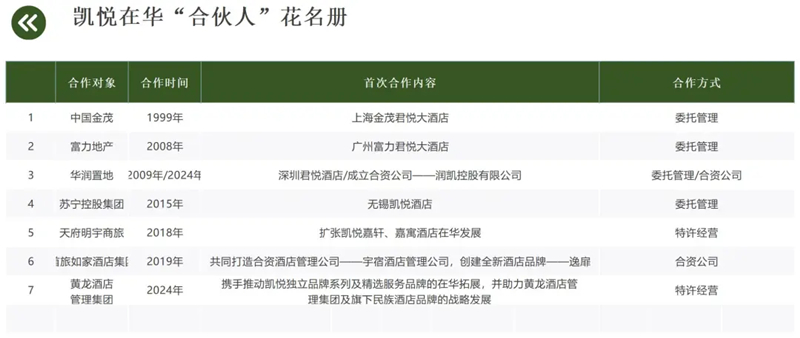
Group 1 - The core viewpoint of the article highlights the expansion of the partnership between Tianfu Mingyu and Hyatt, with the upcoming opening of the Kunming Pengruili Mingyu Hotel Group, which includes six hotel brands [1][2] - The hotel group features 1,936 modern smart rooms and a multifunctional conference center of approximately 3,000 square meters, catering to various guest needs [1] - The partnership between Mingyu and Hyatt has been ongoing for seven years, with a goal set in 2018 to develop 50 hotels in five years, although progress has been slower than expected [2] Group 2 - Hyatt has established multiple partnerships in China, including with China Jinmao since 1999, and has opened several hotels under various brands [3][4] - The collaboration with China Jinmao has led to significant projects, including the Shanghai Jinmao Hotel, which was one of the tallest hotels in the world at its opening [3] - Hyatt's partnership with R&F Properties began in 2008, resulting in several successful hotel openings, despite R&F facing financial difficulties [4][10] Group 3 - The relationship with China Resources Land has been particularly close, with a joint venture established in 2024 to develop and manage multiple hotels across various cities [4][10] - Hyatt's collaboration with Suning Holdings began in 2015, leading to the opening of several hotels, although Suning is currently facing debt restructuring issues [5][9] - The partnership with BTG Homeinns has resulted in the creation of a new hotel brand, UrCove, targeting the mid-range business travel market [5][6] Group 4 - Despite a broad network of partnerships, Hyatt's hotel count in China remains relatively low compared to competitors, with over 180 hotels compared to more than 800 for InterContinental and over 600 for Marriott [11] - Hyatt's approach to partnerships has primarily focused on management contracts rather than franchise models, which has limited its rapid expansion [13][14] - The late introduction of franchise rights in 2018 has hindered Hyatt's competitive position in the Chinese market, where other hotel groups have already established significant footprints [15][16]