
遗体告别

Search documents
三部门:建立健全殡葬服务收费目录清单和收费公示制度 清单之外不得收费
智通财经网· 2026-01-27 09:33
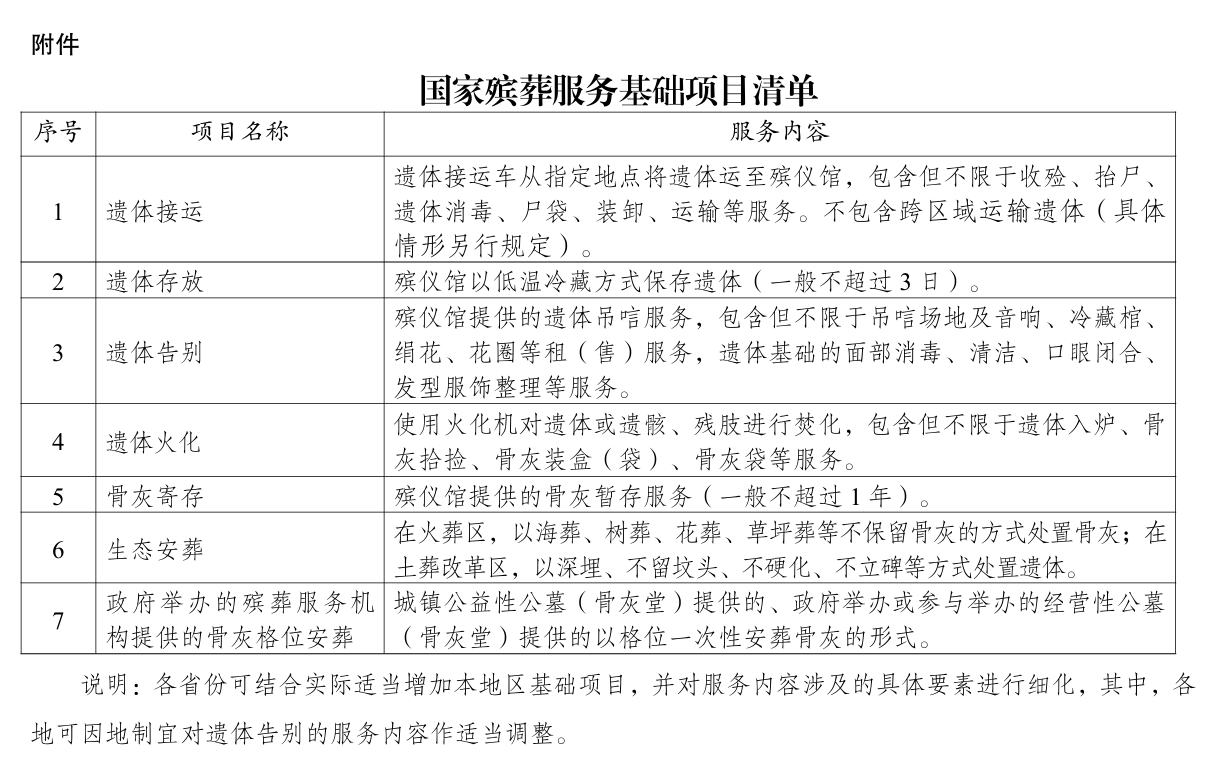
Core Viewpoint - The notification issued by the National Development and Reform Commission, Ministry of Civil Affairs, and Ministry of Finance aims to improve the funeral service fee policy, enhance regulatory collaboration, and reduce the financial burden on the public regarding funeral expenses [1] Group 1: Strengthening Funeral Service Fee Management - Funeral services are categorized into basic and non-basic projects, with basic projects including body transportation, storage, farewell services, cremation, and ash storage [2] - The provincial civil affairs departments, in collaboration with local development and finance departments, will determine the basic project list and set fee standards, while non-basic projects will be defined based on local demand [2][3] Group 2: Establishing Fee Standards - The government-guided pricing for funeral services will focus on public welfare, with standards based on actual costs minus government subsidies and donations [5] - Local governments are tasked with guiding funeral service providers in establishing internal pricing management and cost accounting systems [6] Group 3: Strengthening Price Guidance for Funeral Supplies - Local governments will guide funeral service providers in the procurement of funeral supplies to ensure availability of affordable options, adhering to the principle of "civilized and frugal" [7] Group 4: Regular Evaluation System - A monitoring system for funeral service fees will be established to assess market changes and industry dynamics, with evaluations conducted at least every three years [8] Group 5: Establishing a Fee Directory and Public Disclosure System - A comprehensive fee directory will be created, detailing service items, fee standards, and specific service content, which must be approved by local governments before implementation [9] - Local governments will also ensure that funeral service providers publicly disclose their service items and fees, enhancing transparency [10] Group 6: Regulating Funeral Service Fee Behavior - Local civil affairs departments will strengthen oversight of funeral service providers, ensuring compliance with established regulations and preventing unauthorized fee charges [11] - The focus will be on protecting the rights of the public and promoting rational choices in service selection [11] Group 7: Specific Basic Project List - The basic project list includes services such as body transportation, storage, farewell services, cremation, and ecological burial options, with detailed descriptions of each service [14]

受权发布丨殡葬管理条例
Xin Hua Wang· 2026-01-07 10:58
Core Viewpoint - The regulation aims to strengthen the public welfare nature of the funeral industry, enhance management, and promote reforms in the funeral sector to support the construction of socialist spiritual civilization [2]. Group 1: General Principles - The funeral management adheres to principles of public welfare, civilization, thrift, and ecological sustainability, while improving funeral services and promoting changes in customs [4]. - The State Council's civil affairs department is responsible for national funeral management, while local civil affairs departments oversee management within their jurisdictions [4][5]. Group 2: Funeral Services and Pricing - Funeral services are categorized into basic and non-basic projects, with pricing policies developed by relevant government departments [7]. - The state will gradually include eligible funeral service projects in the basic public service scope and adjust them dynamically [8]. Group 3: Funeral Facilities - Funeral facilities, including funeral homes, columbariums, and cemeteries, are essential to meet public demand, and new facilities must be non-profit and government-run [12]. - Local governments are required to integrate funeral facility construction into relevant planning and ensure compliance with local regulations [15]. Group 4: Burial Practices - The state promotes cremation and reforms burial practices to save land, with local governments tasked to expand cremation areas based on regional conditions [9]. - The regulation encourages eco-friendly burial methods and respects minority customs regarding burial practices [10]. Group 5: Supervision and Management - Local governments must establish a comprehensive regulatory framework covering all aspects of funeral activities and enhance inter-departmental cooperation [47]. - The regulation mandates that funeral service institutions submit annual reports and undergo regular inspections to ensure compliance [52]. Group 6: Legal Responsibilities - Violations of the regulations can result in warnings, fines, and other penalties, with specific consequences outlined for various infractions [41][42]. - The regulation emphasizes the importance of ethical conduct in the funeral industry, prohibiting practices that harm the rights of the bereaved [32].
修订后的《殡葬管理条例》自3月30日起施行,主要包括这五方面内容
Xin Lang Cai Jing· 2026-01-07 09:57
Core Viewpoint - The revised Funeral Management Regulations, effective from March 30, 2026, aim to enhance the public welfare aspect of the funeral industry, regulate funeral service fees, and improve overall management and service quality in the sector [1][2]. Group 1: Regulatory Framework - The new regulations emphasize public welfare, clarify investment mechanisms, strengthen facility supply, reduce the financial burden on the public, and enhance convenience in services [1]. - A basic project list will be established by the state to ensure essential funeral services, including body transportation, storage, farewell ceremonies, cremation, ash storage, ecological burials, and government-provided burial services [1]. Group 2: Facility Management - Local governments at the county level and above are required to build funeral homes based on population size and distribution, while considering existing land resources and ecological principles [1]. - The establishment of for-profit funeral service institutions is prohibited, and all funeral facilities and services will be subject to unified regulatory oversight [1]. Group 3: Service Standardization - The regulations specify normative requirements for body transportation, storage, and cremation, and mandate that burial services provide graves based on necessary documentation [2]. - It is prohibited to establish projects or charge fees outside the designated list, with relevant departments responsible for formulating pricing policies and monitoring compliance [2]. Group 4: Cultural Shift and Supervision - The regulations promote a culture of civility, frugality, and ecological sustainability throughout the funeral process, advocating for green burial practices and environmentally friendly funeral products [2]. - A comprehensive regulatory system covering all aspects of funeral activities will be established, with local governments responsible for oversight and regular inspections [2].