
酷睿Ultra 300系列处理器

Search documents
苏黄之争!AI芯片迎来巅峰战
Shen Zhen Shang Bao· 2026-01-08 18:08
Group 1 - Nvidia launched its new AI computing platform, Vera Rubin, which aims to revolutionize the AI industry by significantly reducing inference costs by 90% [2][6] - AMD responded with the introduction of the MI455X GPU and other products, indicating fierce competition in the AI chip market where Nvidia previously held an 80% market share [2][10] - The competition between Nvidia and AMD is not just about market share but also influences the future direction of the global AI industry [2] Group 2 - Nvidia's CEO Jensen Huang emphasized the shift towards "Physical AI," where AI systems will learn to understand the physical world, marking a new industrial revolution [4][5] - The Blackwell Ultra platform, which supports the "Physical AI" initiative, is set to enter mass production in Q2 2026, offering a 50% increase in computing power and a 30% reduction in power consumption [4] - Nvidia's Rubin platform integrates six new chips, drastically reducing AI inference costs and training GPU usage, with major companies like Microsoft and OpenAI planning to deploy it [6][11] Group 3 - AMD's MI455X GPU showcases significant improvements in energy efficiency and training/inference throughput, with performance reportedly increasing several times compared to its predecessor [8][10] - AMD announced a deep collaboration with OpenAI, enhancing its credibility in the AI infrastructure space [8][10] - The competition between Nvidia and AMD is characterized by differing product strategies, with Nvidia focusing on GPU-centric solutions and AMD adopting a more comprehensive platform approach [12] Group 4 - The AI chip market is experiencing rapid growth, with global AI active users expected to rise from millions to billions, necessitating significant advancements in computing power [11] - AMD is planning to release its next-generation MI500 chip, which is projected to enhance computational performance by up to 1000 times compared to previous models, expected to launch in 2027 [11] - The ongoing rivalry between Nvidia and AMD is evolving into a broader ecosystem competition, with both companies striving to innovate and capture market share in the AI sector [12] Group 5 - Other chip manufacturers, such as Intel and Qualcomm, are also showcasing new products at CES, indicating a competitive landscape in the AI and computing sectors [13][14] - Intel introduced the Core Ultra 300 series processors, which aim to enhance performance in AI workloads, while Qualcomm is expanding its focus beyond mobile to include automotive and robotics [13][14]


四大芯片巨头CEO罕见同台
Di Yi Cai Jing Zi Xun· 2026-01-07 08:19
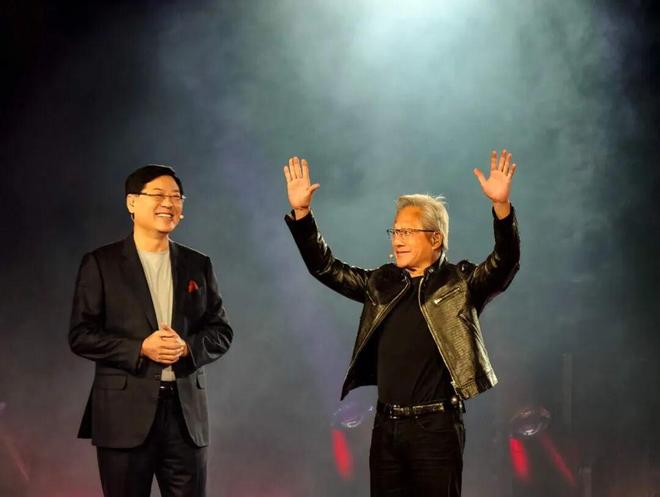
Core Insights - The article highlights the collaboration and competition among four major chip companies: NVIDIA, Intel, AMD, and Qualcomm, during the Lenovo Tech World event, emphasizing the evolving landscape of the AI industry [2] - A new partnership between Lenovo and NVIDIA aims to quadruple their business collaboration over the next three years, focusing on AI infrastructure and deployment [3][4] - The shift from traditional computing to AI-driven applications is reshaping the IT industry, with an estimated investment of $10 to $15 trillion needing upgrades to accommodate new AI architectures [4] Group 1: Collaboration and Partnerships - Lenovo and NVIDIA announced a new initiative called "Lenovo AI Cloud Super Factory," which aims to standardize AI infrastructure and streamline AI deployment for clients [5] - This collaboration is expected to help cloud service providers reduce the "time to first token" for AI deployment and scale up to 100,000 GPUs [7] - Lenovo will also be one of the first adopters of AMD's Helios AI platform, indicating a strategic partnership to address enterprise needs for local inference and data security [8] Group 2: Industry Trends and Innovations - NVIDIA's focus is on GPU-accelerated computing, while AMD emphasizes system-level architecture, showcasing the need for a comprehensive computing ecosystem rather than a single chip solution [8] - Intel's new AI PC, Aura Edition, represents a shift in the traditional PC market towards AI integration, highlighting the convergence of legacy computing systems with new AI paradigms [9] - Qualcomm is targeting AI-native endpoints, collaborating with Lenovo to develop wearable devices that function as "personal intelligent companions," indicating a trend towards low-power, always-connected devices [10] Group 3: Market Potential and Future Outlook - The wearable device market is projected to exceed one billion units, showcasing significant growth potential in this segment [11] - The article emphasizes that the true value of AI lies not in having the most powerful chip but in the ability to transform computing power into usable capabilities for businesses and consumers [11]



四大芯片巨头CEO罕见同台
第一财经· 2026-01-07 08:06
Core Viewpoint - The article highlights the collaboration and competition among major chip manufacturers, including NVIDIA, Intel, AMD, and Qualcomm, during the Lenovo Tech World event, emphasizing the shift in the AI landscape from training to inference and the need for integrated systems that can leverage diverse computing power [3][4]. Group 1: Collaboration and New Opportunities - NVIDIA's CEO Jensen Huang and Lenovo's Chairman Yang Yuanqing aim to quadruple their business collaboration over the next three years, reflecting a long-standing partnership that has evolved through various technological shifts [5][6]. - The collaboration focuses on the "Lenovo AI Cloud Super Factory," which aims to standardize AI infrastructure, transforming highly customized AI deployments into industrialized solutions [6][8]. - This partnership is expected to help cloud service providers reduce the "time to first token" for AI deployment and scale up to support trillion-parameter models [8]. Group 2: Competitive Landscape - AMD's CEO Lisa Su introduced the Helios rack-level AI platform, positioning it as a challenge to NVIDIA's GPU-centric approach, emphasizing the need for robust system-level infrastructure to support larger models and higher throughput [10][11]. - Intel's new CEO Pat Gelsinger announced the Aura Edition AI PC, showcasing a shift from traditional PCs to AI-enhanced computing experiences, indicating a blend of legacy computing with new AI paradigms [11]. - Qualcomm's CEO Cristiano Amon focused on AI-native endpoints, highlighting the evolution of wearable devices into "personal intelligent companions," which aligns with Lenovo's strengths in ecosystem and global channels [12]. Group 3: Industry Trends and Insights - The article notes that the market for wearable devices is expected to exceed one billion units, indicating significant growth potential in this segment [13]. - The collaboration among the four chip giants illustrates a new industry consensus that the true value of AI lies not in having the most powerful chip, but in the ability to transform computing power into usable capabilities for businesses and users [13].

一次集齐四大芯片巨头CEO,联想成了“最大公约数”
Di Yi Cai Jing· 2026-01-07 06:48
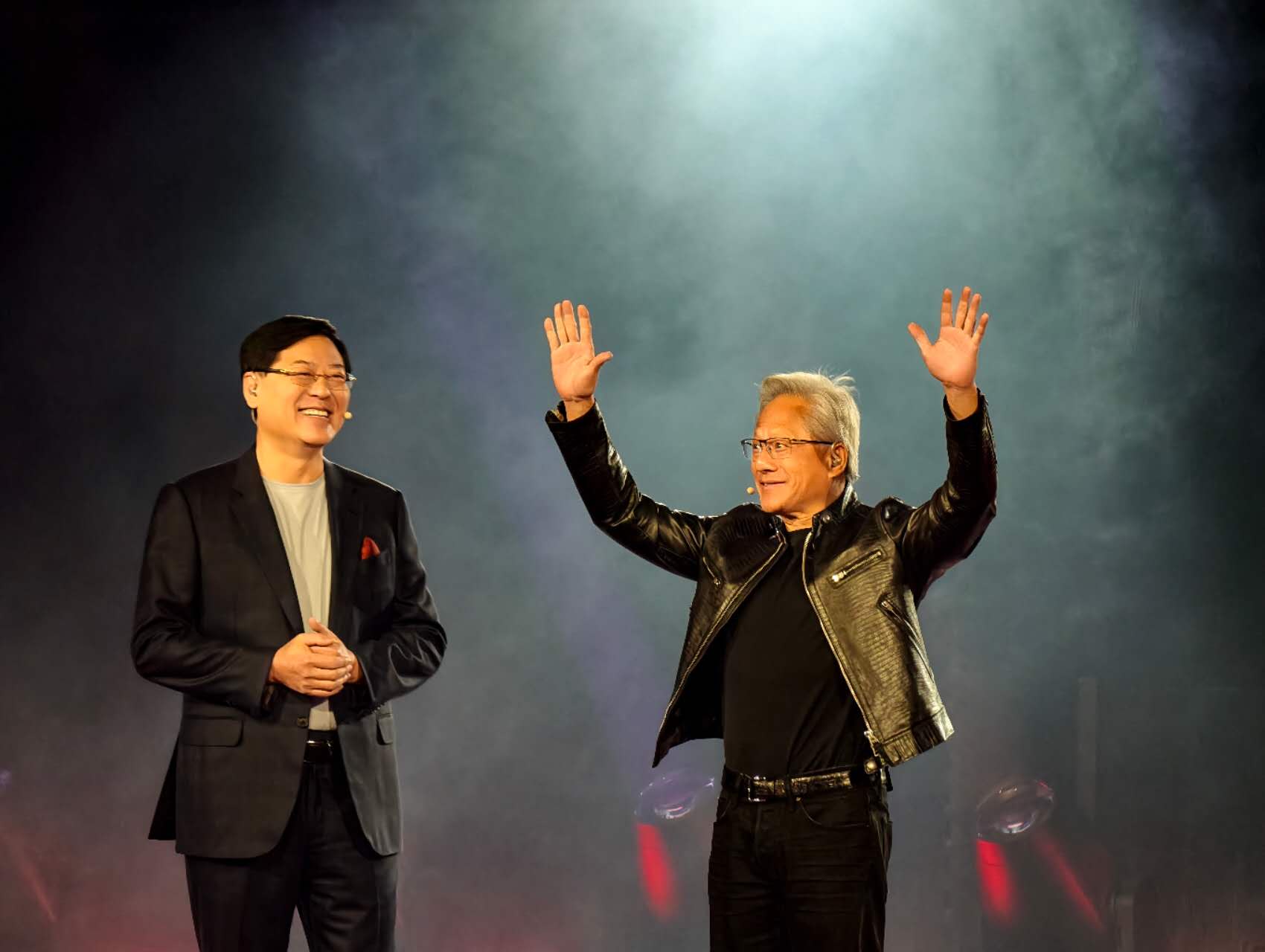
Core Insights - The gathering of the four major chip giants—NVIDIA, Intel, AMD, and Qualcomm—at the Lenovo Tech World during CES 2026 highlights the evolving dynamics of the semiconductor industry, where collaboration and competition coexist in the AI narrative [1] - The focus is shifting from individual chip manufacturers to system-level players that can integrate diverse computing power and facilitate the deployment of intelligent hardware solutions [1] Group 1: Industry Transformation - Jensen Huang, CEO of NVIDIA, emphasized the significance of AI as a foundational architecture akin to operating systems, marking a new platform shift in computing [4] - The IT industry has invested approximately $10 to $15 trillion over the past thirty years, necessitating a complete overhaul to adapt to AI applications [5] - Huang and Lenovo's CEO, Yang Yuanqing, announced a new collaboration plan to create a "Lenovo AI Cloud Super Factory," aiming to standardize AI infrastructure and transition from highly customized deployments to industrialized solutions [5][7] Group 2: Competitive Landscape - AMD's CEO, Lisa Su, introduced the Helios rack-level AI platform, positioning it as a direct challenge to NVIDIA's GPU-centric approach, highlighting the need for robust system-level infrastructure to support larger models and higher throughput [8] - Intel's new CEO, Pat Gelsinger, showcased the Aura Edition AI PC, which integrates the latest Intel processors, indicating a shift from traditional PCs to data centers and cloud computing [9][10] - Qualcomm's focus on AI-native endpoints, particularly in wearable devices, reflects a broader trend towards personal intelligent companions that require low power consumption and continuous connectivity [10] Group 3: Collaborative Ecosystem - The collaboration among the four chip giants illustrates a new industry consensus that the true value of AI lies not in possessing the most powerful chip but in transforming computing power into usable capabilities for enterprises and users [11] - Lenovo's role as a "system integrator" and "scene amplifier" is crucial in this collaborative ecosystem, as it bridges the various offerings from NVIDIA, AMD, Intel, and Qualcomm [11] - The wearable device market is projected to exceed one billion units, showcasing the potential for growth in AI-driven consumer technology [11]
英特尔CEO陈立武:AI正在重塑软硬件市场格局
Xin Lang Cai Jing· 2026-01-07 02:57
Core Viewpoint - The event highlights the collaboration between Intel and Lenovo in developing AI-driven PC experiences, emphasizing the transformative impact of AI on the hardware and software market [1][2]. Group 1: AI and Market Impact - Intel's CEO, Chen Liwu, stated that AI is reshaping the entire hardware and software market landscape, enhancing user experiences through continuous iteration [1][2]. - The focus on AI is expected to drive significant advancements in daily life experiences for users [1][2]. Group 2: Product Launches - During CES 2026, Intel and Lenovo unveiled the Aura Edition AI PC and the FIFA-branded gaming laptop, Legion Pro 7i, which are products of their joint development efforts [1][2]. - The Aura Edition product line will feature Intel's first chip built on its proprietary 18A process technology, the Core Ultra 300 series processor [1][2]. Group 3: Future Collaboration - Chen Liwu indicated that Intel and Lenovo plan to deepen their collaboration in the areas of PCs, data centers, and cloud computing in the future [1][2].