重组疫苗

Search documents
专家:带状疱疹并非老年人“专属疾病” 高危人群需尽早预防
Xin Lang Cai Jing· 2025-12-21 03:16
Core Viewpoint - Shingles is not exclusively a disease of the elderly; younger individuals with compromised immune systems are also at significant risk of infection [1] Group 1: High-Risk Populations - High-risk groups for shingles include patients with weakened immune systems due to conditions such as rheumatic diseases, blood cancers, and solid tumors [1] - Another high-risk group consists of individuals undergoing treatment with corticosteroids, immunosuppressants, or biological agents, which further weaken the immune system [1] - It is now recognized that individuals aged 18 and older with compromised immune function can develop shingles, contrary to the previous belief that it primarily affects the elderly [1] Group 2: Vaccination Recommendations - Vaccination is the most effective means of preventing shingles, but immunocompromised individuals have specific vaccine requirements [2] - Live attenuated vaccines are not recommended for patients with immune deficiencies; inactivated or recombinant vaccines are preferred due to their higher safety profile [2] - Patients recovering from shingles should evaluate vaccination options three months post-recovery [2] Group 3: Clinical Implications - Shingles can cause severe pain that may lead to sympathetic nervous system excitation, increasing the risk of coronary artery spasm and serious cardiovascular events [2] - Data indicates that shingles patients have a 78% increased risk of stroke and a 39% higher risk of developing shingles if they already have cardiovascular diseases [2] - The risk of shingles significantly increases with the number of comorbid chronic diseases, such as hypertension, hyperlipidemia, diabetes, and chronic obstructive pulmonary disease [2] Group 4: Current Vaccination Rates and Recommendations - Despite the significant benefits of vaccination, the current vaccination rate for shingles in China remains low [3] - Vaccination not only alleviates patient suffering but also reduces healthcare costs, as the treatment cost for a shingles patient often exceeds the vaccine cost [3] - The autumn and winter seasons are peak times for shingles outbreaks, and high-risk individuals, especially those with immune deficiencies and chronic diseases, are advised to consult healthcare providers for vaccination [3]
趋势研判!2025年中国生物制药行业政策、发展历程、产业链、市场规模、竞争格局及行业发展趋势分析:行业增长非常强劲,市场规模有望达到4600亿元[图]
Chan Ye Xin Xi Wang· 2025-08-08 01:36
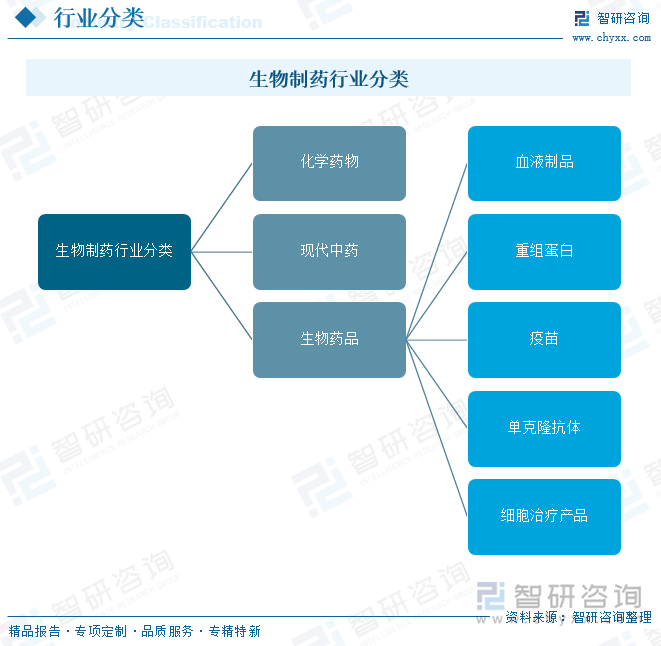
Core Viewpoint - The biopharmaceutical industry in China is rapidly developing, with significant growth expected in market size from 257.65 billion yuan in 2018 to 454.17 billion yuan in 2024, and projected to reach 460 billion yuan by 2025 [1][6][4]. Group 1: Definition and Classification - Biopharmaceuticals are products used for prevention, treatment, and diagnosis, developed using principles from microbiology, biology, medicine, biochemistry, and biotechnology [2][4]. - The biopharmaceutical industry can be categorized into biopharmaceuticals, chemical drugs, and modern traditional Chinese medicine, with biopharmaceuticals further divided into blood products, recombinant proteins, vaccines, monoclonal antibodies, and cell therapy products [2]. Group 2: Current Development Status - The development of the biopharmaceutical industry is closely linked to innovations in biotechnology, with significant advancements since the 20th century [4][6]. - China's biopharmaceutical market is still in its early stages but is experiencing strong growth, with biopharmaceuticals becoming a crucial part of the pharmaceutical sector [6][4]. Group 3: Industry Chain - The upstream of the biopharmaceutical industry consists of raw materials, pharmaceutical equipment, and biotechnology, with raw materials primarily sourced from natural biological materials [8]. - The midstream involves the research and production of biopharmaceutical products, while the downstream focuses on sales channels to medical institutions, diagnostic agencies, research units, and consumers [8]. Group 4: Development Environment and Policies - Recent policies have supported and regulated the development of the biopharmaceutical industry, focusing on improving new drug pricing mechanisms, drug price governance, centralized procurement, and medical service standardization [10][12]. Group 5: Competitive Landscape - The biopharmaceutical industry is a strategic emerging industry in China, with notable companies including WuXi AppTec, HengRui Medicine, and BeiGene, among others [13][15]. - Various segments within the biopharmaceutical industry have seen the emergence of leading companies, such as vaccine producers and diagnostic reagent manufacturers [15][20]. Group 6: Development Trends - There is a strong emphasis on developing new vaccines and improving traditional vaccines to meet global health challenges [25]. - The industrialization of antibody drugs and protein drugs is advancing, with significant roles in treating various diseases [26][27]. - Research and product development in diagnostic and detection technologies for major diseases are increasingly utilizing nanomaterials for enhanced sensitivity and specificity [28].