量子光芯片

Search documents
长光华芯:公司通过全资子公司出资成立苏州星钥光子科技有限公司
Zheng Quan Ri Bao Zhi Sheng· 2026-02-25 12:45
Core Viewpoint - The company emphasizes that silicon photonic integration will become an irreversible technological mainline in optical communication, deeply binding to the global digitalization process with the evolution of next-generation technologies such as 3.2T modules and quantum optical chips [1] Group 1 - The company has established a wholly-owned subsidiary, Suzhou Xingyao Photonic Technology Co., Ltd., to proactively lay out the next-generation technology route [1] - The company has also made advancements in coherent optical communication chips [1]

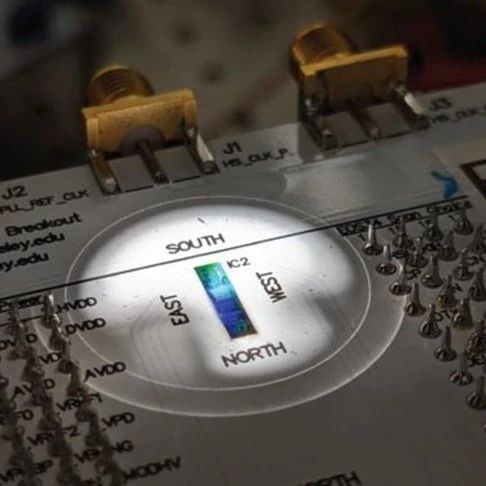
量子光芯片,全球首颗
半导体行业观察· 2025-07-15 01:04
Core Viewpoint - The article discusses the development of the world's first integrated electronic-photonic-quantum chip by researchers from Boston University, UC Berkeley, and Northwestern University, marking a significant step towards practical quantum systems [2][4]. Group 1: Chip Development - The chip utilizes standard 45-nanometer semiconductor technology to integrate quantum light sources with stable electronic devices on a single platform [3][11]. - Each chip contains twelve independent quantum light sources, each less than one square millimeter in size, driven by lasers and utilizing micro-ring resonators to generate photon pairs [7][10]. Group 2: Technical Innovations - The team embedded a real-time control system directly into the chip to address the sensitivity of resonators to temperature changes and manufacturing variations, ensuring stable quantum processes [9][10]. - The integration of photonic devices with classical electronic technology posed significant challenges, requiring a rethinking of how these technologies coexist on the chip [11][12]. Group 3: Collaborative Efforts - The project involved collaboration across various fields, demonstrating that complex quantum photonic systems can be constructed and stabilized entirely within CMOS chips [12]. - Several student researchers from the project have transitioned to the industry, continuing work in silicon photonics and quantum computing at companies like PsiQuantum, Ayar Labs, and Google X [12]. Group 4: Support and Funding - The research received support from the National Science Foundation, Packard Fellowship, and GlobalFoundries, highlighting the importance of funding in advancing quantum technology [13].